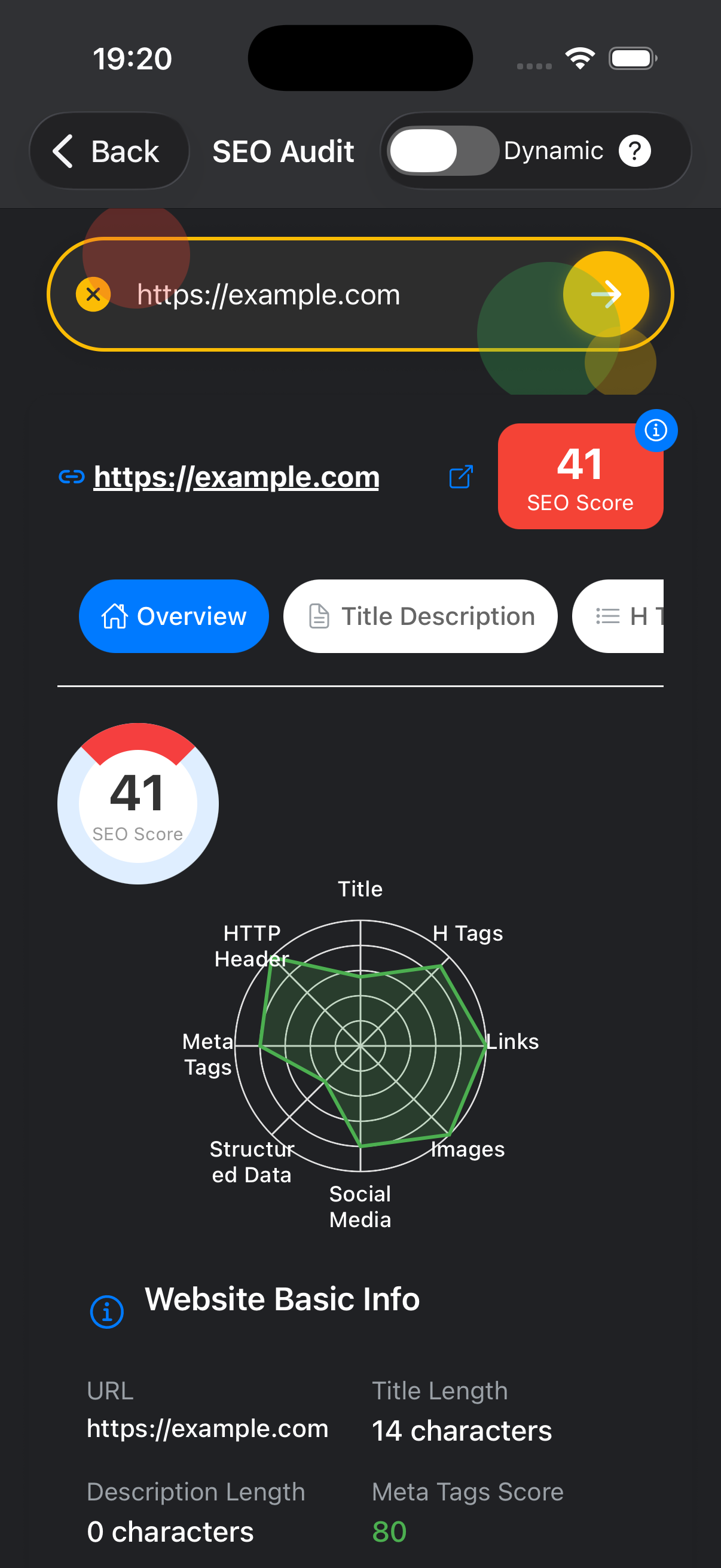
# FennecSEO Full Content Export > Generated on 2026-03-03 # Table of Contents ## Articles - [FennecSEO App & Chrome Extension Launch: The Ultimate Mobile-First SEO Toolkit](#fennec-seo-app-chrome-extension-launch) - [Googlebot WRS & JavaScript SEO: Decoding the Rendering Separation](#googlebot-wrs-javascript-seo) - [Hidden Content & SEO: The Truth About display:none in 2026](#hidden-content-seo-display-none) - [FennecSEO Chrome Extension + OpenClaw SKILL: Real-Time SEO Audits for Humans and Agents](#fennecseo-chrome-extension-openclaw-skill) - [Unlocking the Future of Search: Generative Engine Optimization (GEO) in the AI Era – Principles, Strategies, and Ties to Traditional SEO](#unlocking-the-future-of-search-generative-engine-optimization-geo-in-the-ai-era) - [OpenClaw: Building Your Personal SEO Automation Workflow](#openclaw-seo-automation) - [AI Bot Data Monitoring and Citation Analysis: Measuring GEO Success in 2026](#ai-bot-data-monitoring) - [KGR (Keyword Golden Ratio): The Ultimate Guide to Finding Low-Competition, High-Potential Keywords](#kgr-keyword-golden-ratio-guide) - [AI Overview Zero-Click Conversions: How to Adapt Your SEO Strategy for 2026](#ai-overview-zero-click) - [Understanding Core Web Vitals in 2026: The Ultimate Guide](#core-web-vitals-2026) - [The Future of AI in Content Marketing](#ai-content-marketing) - [Voice Search Optimization Strategies for 2026: The Complete Guide](#voice-search-optimization) - [Mastering Google Search Console with FennecSEO App: A Comprehensive Guide](#fennec-seo-app-gsc-integration) - [Advanced Technical SEO: The Complete Guide for 2026](#technical-seo-advanced) - [Mastering KGR Analysis: The Ultimate Guide to Keyword Golden Ratio](#kgr-analysis) - [Mastering TF-IDF Analysis for SEO: The Complete Guide](#tf-idf-tool) - [FennecSEO vs Traditional SEO Tools: Why Mobile-First is the Future](#fennec-seo-vs-traditional-tools) - [OpenClaw 'clawd' Bot: The Ultimate Guide to Local AI Agents for SEO Automation](#openclaw-clawd-bot-seo-automation) --- # Articles ## FennecSEO App & Chrome Extension Launch: The Ultimate Mobile-First SEO Toolkit URL: https://fennecseo.app/blog/fennec-seo-app-chrome-extension-launch/ Date: 2026-03-03 ID: fennec-seo-app-chrome-extension-launch We are thrilled to announce that **FennecSEO** is now available across all major platforms! 🚀 Whether you are at your desk or on the move, you can now master your website's SEO signals with our powerful suite of tools. - **📱 iOS & Android App**: Your pocket-sized SEO command center. - **💻 Chrome Extension**: Real-time analysis directly in your browser. ## Why FennecSEO? The Mobile-First Revolution 🌍 Traditional SEO tools are powerful but often tether you to a desktop. In 2026, SEO happens in real-time. FennecSEO bridges this gap by providing professional-grade auditing capabilities on your mobile device and browser. ### The Problem with Legacy Tools | Feature | Traditional Tools | FennecSEO | | :--- | :--- | :--- | | **Accessibility** | Desktop Only | Mobile + Web + Extension | | **Speed** | Slow Crawls | Real-time Analysis | | **UX/UI** | Cluttered Dashboards | Clean, Modern Interface | | **AI Integration** | Limited / Cloud-based | Local AI Agents (OpenClaw) | ## 📱 FennecSEO Mobile App: SEO Audit in Your Pocket Gone are the days when you needed to be glued to your desktop to monitor your website's health. With the FennecSEO mobile app, you can audit, analyze, and optimize anytime, anywhere.
Mobile Audit Preview
### Key Features 🔑 1. **⚡ Real-time SEO Audits**: Instant checkups for On-Page SEO, technical health, and performance. 2. **📊 Core Web Vitals Monitoring**: Keep a close eye on your [LCP, CLS, and INP](/blog/core-web-vitals-2026/) scores directly from your phone. 3. **💡 Actionable Insights**: Get clear, prioritized recommendations to fix issues and boost rankings. 4. **🌐 Multi-Site Management**: Monitor all your projects from a single dashboard.
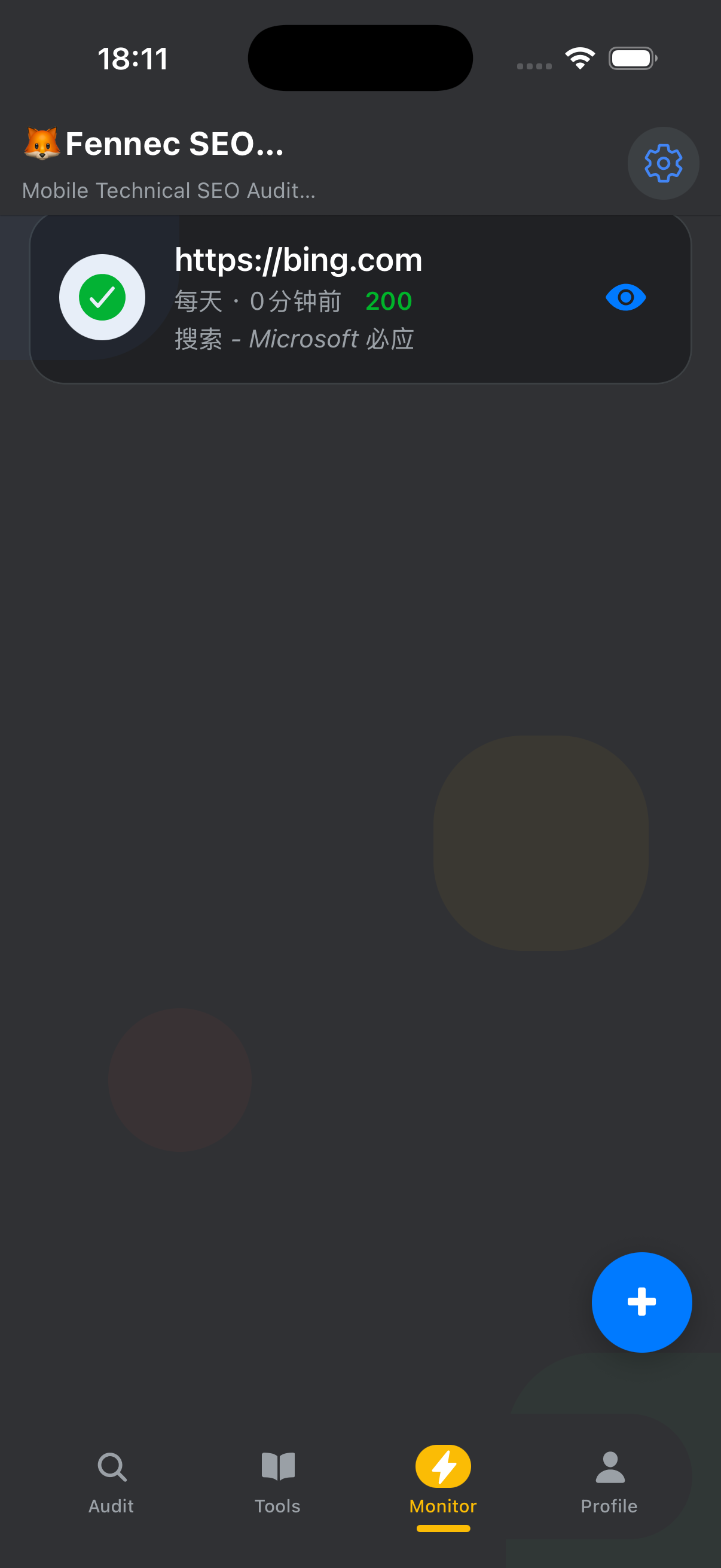
Site Monitoring
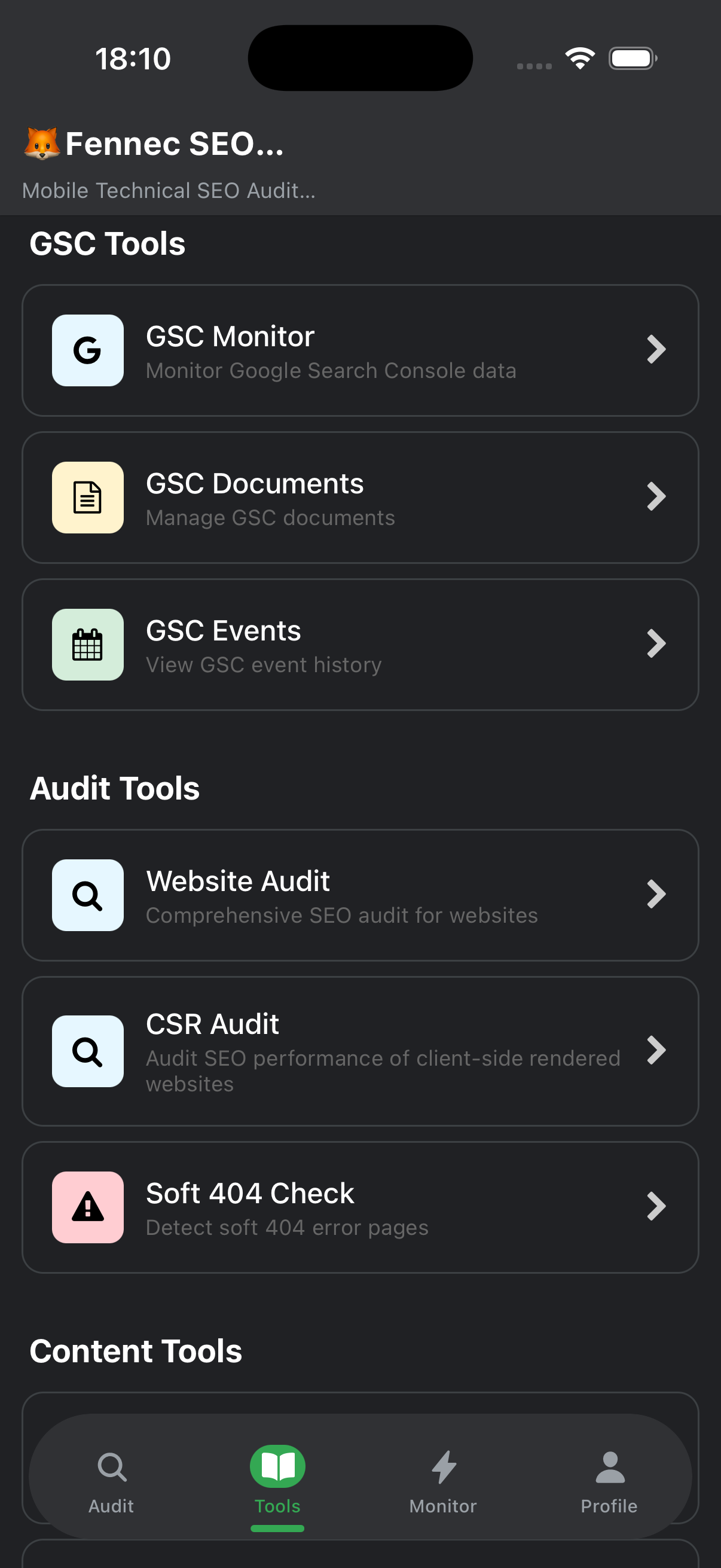
Tools
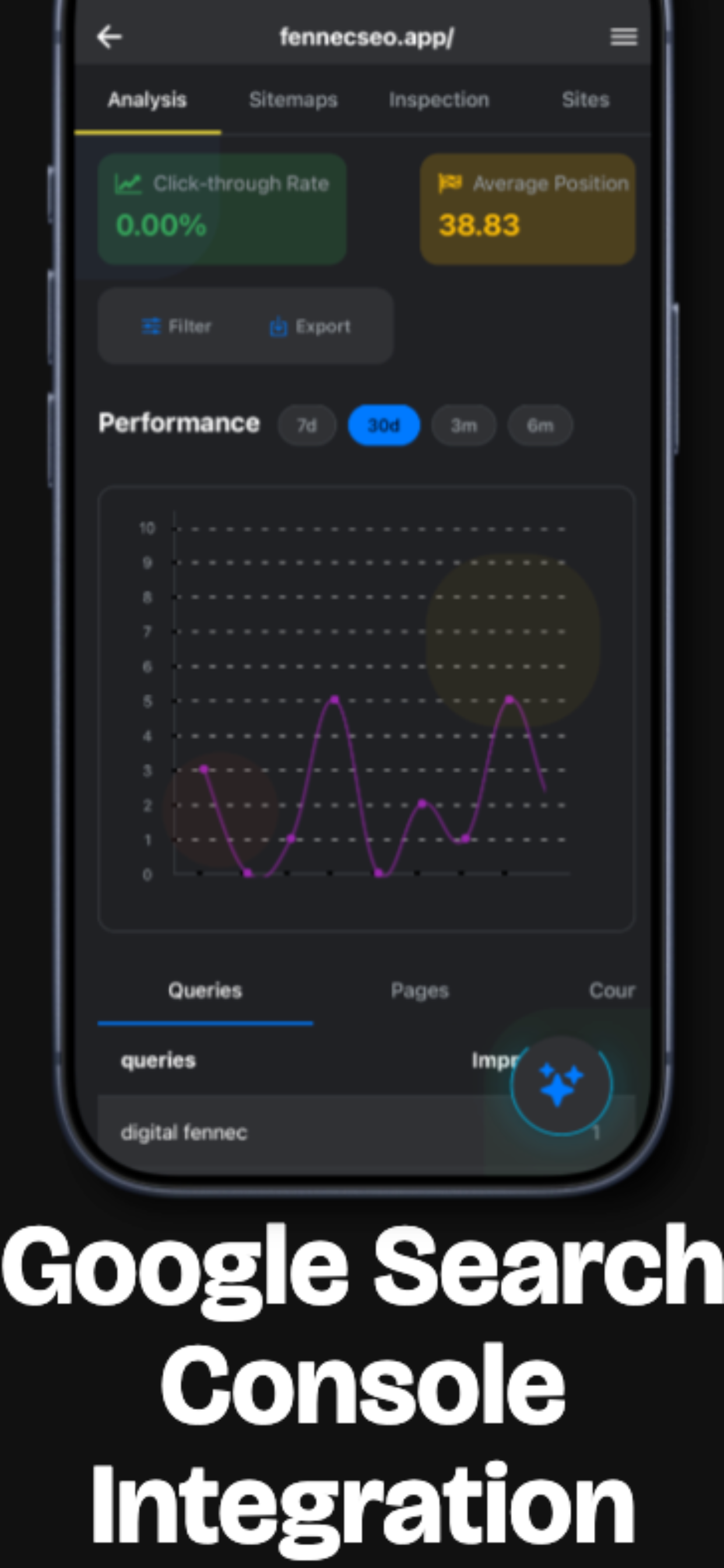
### 📈 Advanced GSC Integration FennecSEO takes Google Search Console data to the next level. We don't just show you charts; we help you understand them. * **Search Analytics**: Deep dive into clicks, impressions, CTR, and position data. * **Historical Data Analysis**: Compare performance over time to spot trends and seasonality. * **Custom Filtering (Regex)**: Use advanced regular expressions to filter queries and pages like a pro. * **URL Inspection**: Check index status directly from the app. * **Sitemap Management**: Submit and monitor sitemaps effortlessly. * **AI-Powered Query Analysis**: Ask AI questions about your search data to uncover hidden opportunities.
GSC Integration
### 🔔 Smart Monitoring & Alerts Never miss a critical issue with our proactive monitoring system. * **24/7 Site Monitoring**: We check your site's health around the clock. * **Push Notifications**: Get instant alerts via APN (iOS) or FCM (Android) when issues arise. * **Exception Tracking**: Be the first to know about downtime, 404 spikes, or ranking drops.
Site Monitoring
Alerts
### App Feature Breakdown | Module | Description | | :--- | :--- | | **Site Audit** | Full technical crawl detecting broken links, 404s, and redirect chains. | | **Tech Stack** | Identify CMS, analytics, and frameworks used by any site. | | **GSC Data** | Visualize search performance with advanced regex filtering. | | **Rank Tracker** | (Coming Soon) Monitor keyword positions daily. |
Download on the
App Store
Get it on
Google Play
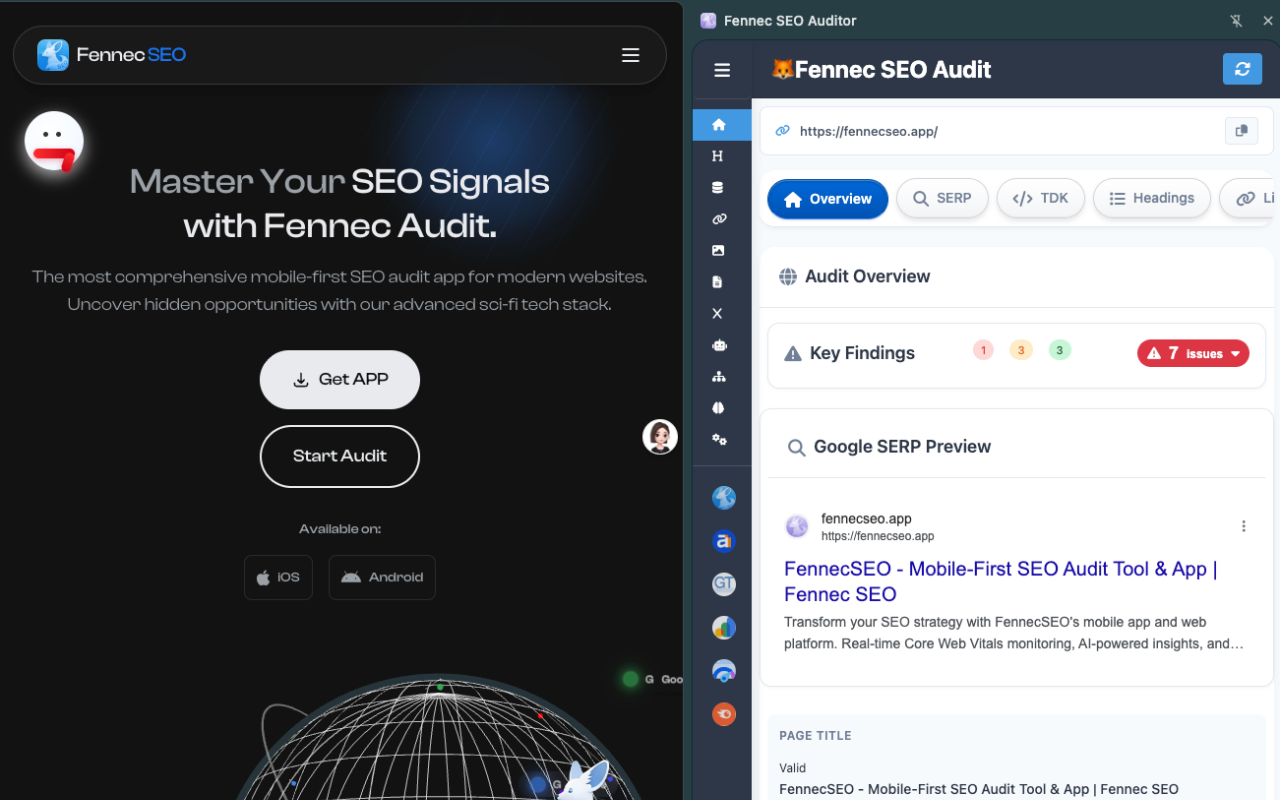
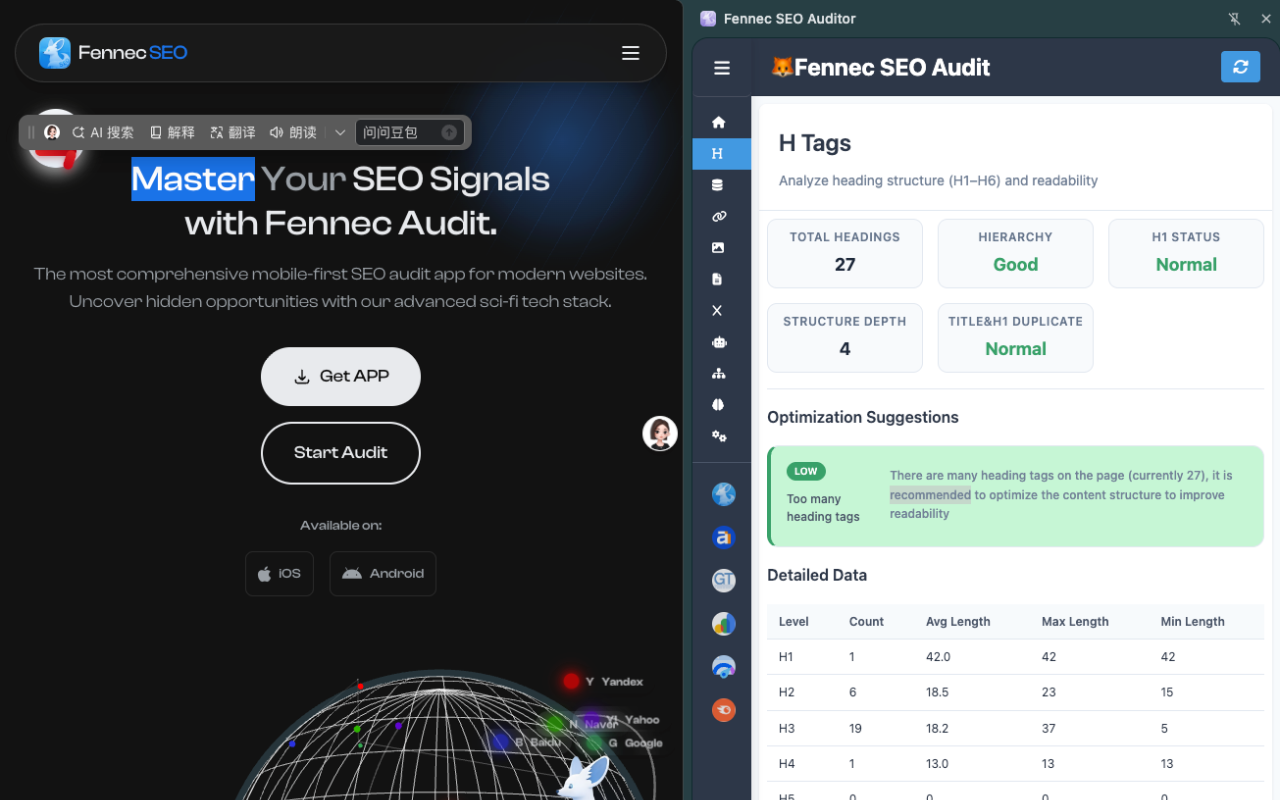
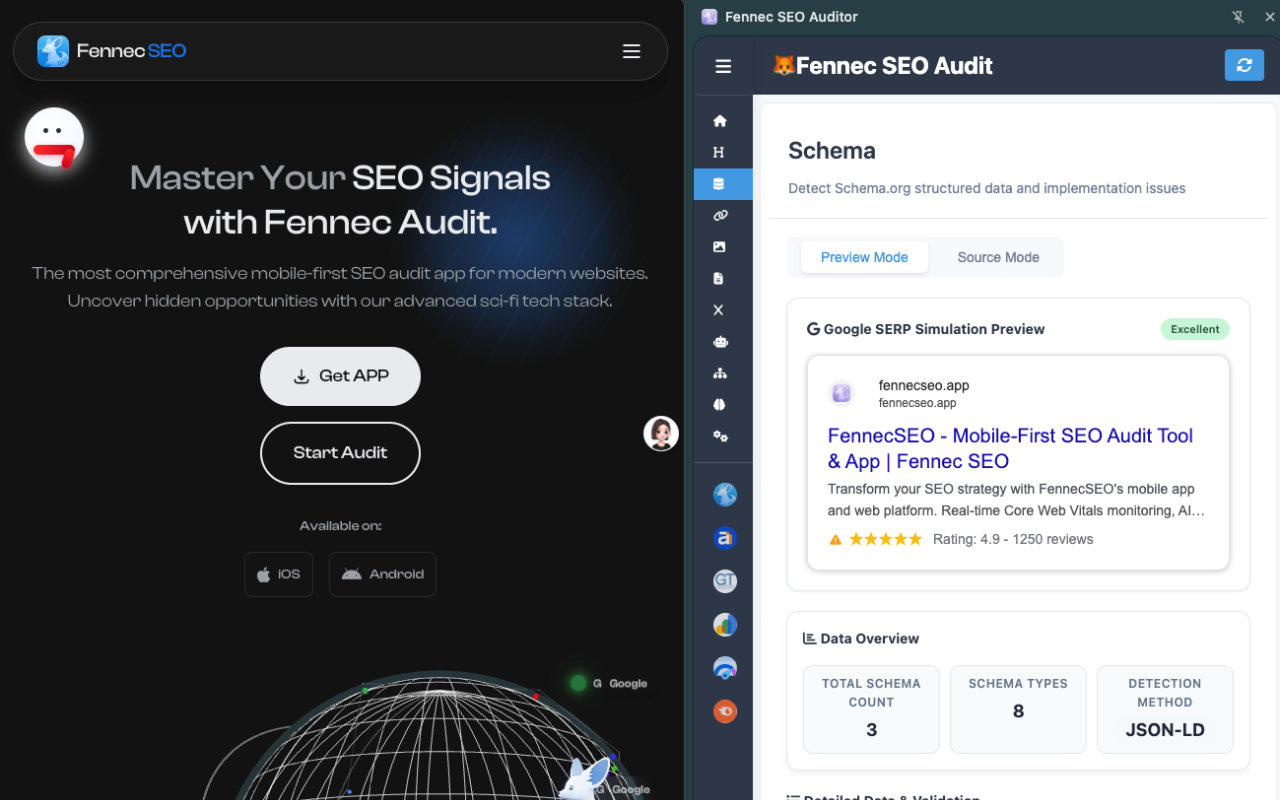
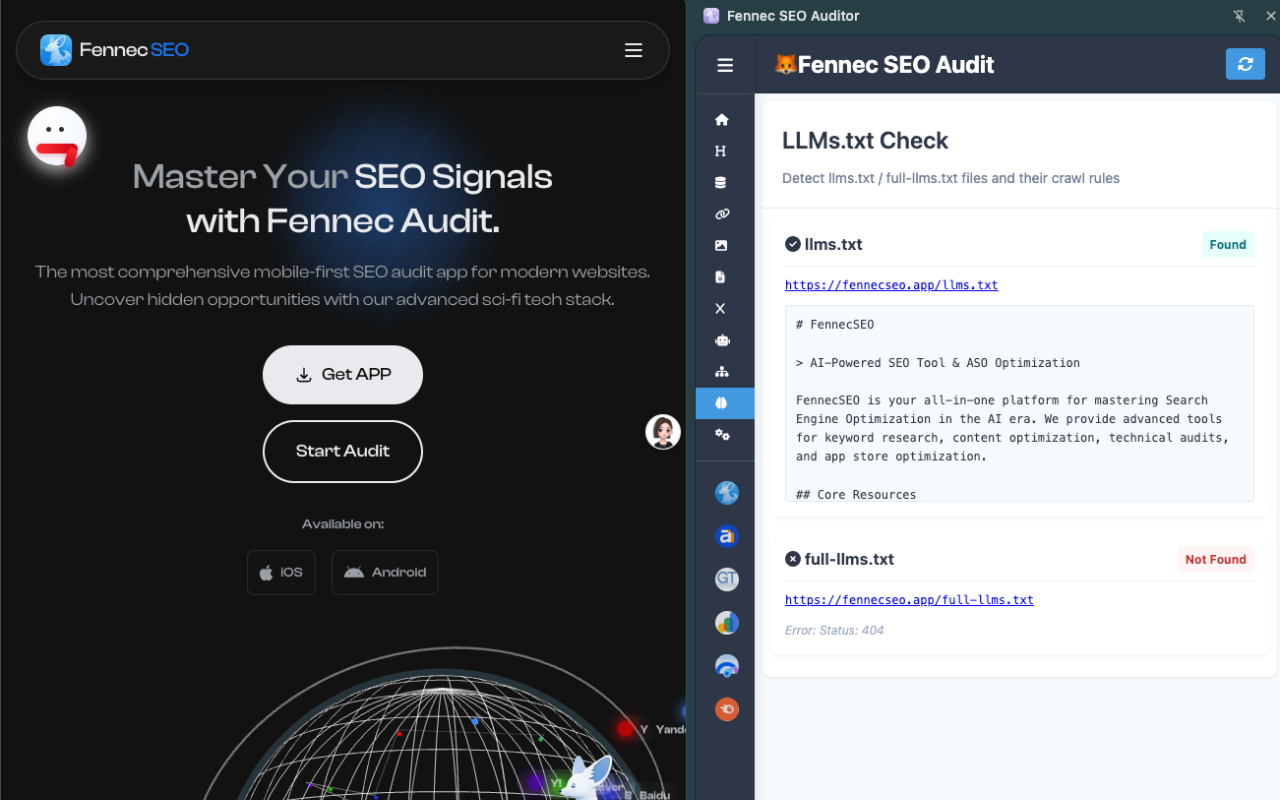
## 💻 FennecSEO Chrome Extension: Instant Browser Analysis Our Chrome Extension brings the power of FennecSEO directly into your browsing experience. Analyze any page you visit with a single click.
Extension Dashboard
Extension Audit
Extension Monitoring
Extension Tech Stack
### Why Install It? 🛠️ * **🔍 One-Click Audit**: Instantly view meta tags, headers, and link structures. * **🧬 Tech Stack Detection**: Peek under the hood to see what technologies a website is using. * **🤖 Local AI Integration**: Seamlessly connect with local AI agents (like [OpenClaw](/blog/openclaw-seo-automation/)) for automated tasks. * **🔒 Privacy First**: Analysis happens locally in your browser. ### Extension Capabilities | Category | Features | | :--- | :--- | | **On-Page** | Title, Meta Description, H1-H6 Headers, Image Alt Text | | **Technical** | Canonical, Robots.txt, Sitemap, Hreflang, Schema Markup | | **Links** | Internal/External Links, Broken Link Checker | | **Social** | Open Graph, Twitter Cards Preview |
Add to Chrome - It's Free
## What's New in Version 1.0 🆕 This launch marks a significant milestone in our mission to democratize professional SEO tools. Here is what you get in v1.0: 1. **🔄 Unified Ecosystem**: Your data syncs seamlessly between the web, mobile app, and extension. 2. **📄 Advanced Reporting**: Generate professional PDF reports to share with your team or clients. 3. **🎨 Enhanced UI/UX**: A completely redesigned interface for better usability and faster workflows. Check out our full [Changelog](/changelog/) for a detailed list of updates and improvements. ## Get Started Today 🚀 Don't let your competitors get ahead. Download FennecSEO today and start making data-driven decisions that drive real growth. Stay tuned for more updates! We have an exciting roadmap ahead, including deeper AI integrations and more automation features. **Happy Optimizing!** 🦊 *The FennecSEO Team* --- ## Googlebot WRS & JavaScript SEO: Decoding the Rendering Separation URL: https://fennecseo.app/blog/googlebot-wrs-javascript-seo/ Date: 2026-03-03 ID: googlebot-wrs-javascript-seo JavaScript frameworks like React, Vue, and Angular have revolutionized web development, but they have also introduced significant challenges for SEO. The core of this challenge lies in how search engines, specifically Google, process and render JavaScript. This is where Google's **Web Rendering Service (WRS)** comes into play. In this deep dive, we will explore the mechanics of WRS, the reality of the "two-wave" indexing process, and actionable strategies to ensure your JS-heavy sites rank high. For a broader look at how these technical factors impact your site's performance metrics, check out our guide on [Core Web Vitals in 2026](/blog/core-web-vitals-2026/). ## What is WRS (Web Rendering Service)? WRS is the component of Google's indexing system responsible for executing JavaScript. Think of it as a headless Chrome browser running in the cloud. When Googlebot crawls a URL, it first downloads the raw HTML response. If the page relies on client-side JavaScript to generate content (as most SPAs do), the raw HTML is often empty or minimal. WRS then steps in to execute the scripts, fetch API data, and construct the final DOM (Document Object Model) that contains the actual content. ## The "Two-Wave" Indexing Process: Myth or Reality? Historically, SEOs described Google's process as two distinct waves: 1. **First Wave**: Crawl and index the immediate HTML response. 2. **Second Wave**: Render the page (WRS) and index the full content, often days later. **In 2026, the gap between these waves has shrunk dramatically.** Google has invested heavily in rendering capacity. For many sites, rendering happens almost immediately after crawling. However, **separation still exists**. ### Why Separation Matters Even if the delay is short, it relies on the **Render Queue**. * **Queue Priority**: Popular, frequently updated sites get rendering priority. * **Resource Limits**: WRS has a finite "crawl budget" and "render budget." If your JS is inefficient, WRS might time out before your content loads. ## Key Challenges with WRS ### 1. The 5-Second Soft Limit While not an official hard limit, testing suggests WRS aims to render a page within roughly 5 seconds. If your API calls take 3 seconds and your main thread is blocked for another 3 seconds, Googlebot might take a snapshot of a partially loaded page. ### 2. User Interactions Googlebot **does not click buttons or scroll** to load content. * Content hidden behind `onClick` events is invisible to WRS. See our guide on [Hidden Content & SEO](/blog/hidden-content-seo-display-none/) for more details. * Infinite scroll content might not be indexed unless implemented with paginated URLs or History API. ### 3. Error Handling If your JS throws an unhandled exception, the rendering stops. Unlike a user who might refresh, Googlebot simply moves on, indexing a broken page. ## Optimization Strategies for JS SEO ### 1. Server-Side Rendering (SSR) & Static Site Generation (SSG) The best way to bypass WRS limitations is to give Googlebot fully rendered HTML from the start. * **Next.js / Nuxt**: Use SSR or SSG features to pre-render content. * **Dynamic Rendering**: Serve a pre-rendered static HTML version to bots while serving the SPA to users (though Google recommends Isomorphic rendering over this now). ### 2. Hydration & Rehydration Ensure your hydration process is efficient. If the client-side takeover destroys and recreates the DOM, it causes layout shifts (CLS) and wastes processing power. ### 3. Proper Link Implementation Googlebot discovers new URLs via `` tags. * **Bad**: `
` (Googlebot ignores this). * **Good**: `` (Googlebot follows this). ### 4. Meta Tags Management Ensure your `title`, `meta description`, and `canonical` tags are updated in the DOM *before* or *during* the initial render. Tools like `react-helmet` or `vue-meta` are essential here. ## Validating Your Work Don't guess—verify how WRS sees your page. 1. **Google Search Console**: Use the "URL Inspection" tool to see the rendered HTML screenshot. 2. **Rich Results Test**: Provides a live rendering test. 3. **Fennec SEO App**: Our "Tech Stack" and [Audit](/audit/) features can help identify if your JS framework is causing indexing bottlenecks. ## Conclusion WRS is powerful but not magic. By understanding its constraints and optimizing your rendering path, you can enjoy the benefits of modern JS frameworks without sacrificing organic visibility. --- ## Hidden Content & SEO: The Truth About display:none in 2026 URL: https://fennecseo.app/blog/hidden-content-seo-display-none/ Date: 2026-03-03 ID: hidden-content-seo-display-none "Does Google index hidden content?" This is one of the oldest debates in SEO. With the rise of mobile-first indexing and modern UI frameworks like React and Vue, the answer has evolved. In 2026, the short answer is **yes, but with caveats**. Let's break down how Google treats content hidden via CSS (`display: none`) versus content removed from the DOM (conditional rendering). For a broader context on how Google processes content, check out our guide on [Core Web Vitals in 2026](/blog/core-web-vitals-2026/). ## The Evolution of Hidden Content ### Desktop Era vs. Mobile-First Era In the past, Google devalued content that wasn't immediately visible to the user on page load. However, with the shift to **Mobile-First Indexing**, Google acknowledged that screen real estate is limited on mobile devices. Google's John Mueller has confirmed multiple times: **Content hidden in tabs, accordions, or "read more" buttons for user experience (UX) purposes is given full weight.** ## CSS Hiding: `display: none` & `visibility: hidden` When you use CSS to hide content, the HTML element still exists in the DOM. Googlebot parses the HTML, sees the content, but also sees the CSS rule hiding it. ### SEO Impact * **Indexing**: Google **indexes** this content. It can rank for keywords found within it. * **Weight**: In 2026, hidden content is generally treated equally to visible content, *provided* it's easily accessible to the user (e.g., via a click). * **Risk**: Hiding keyword-stuffed text that users can *never* see is considered **cloaking** and is a violation of Google's Spam Policies. ## Framework Rendering: Vue `v-if` vs `v-show` & React Modern frameworks offer two ways to hide content, and the SEO implications are vastly different. ### 1. Conditional Rendering (e.g., Vue `v-if`, React `{condition && ...}`) This method **removes the element from the DOM entirely**. * **Googlebot**: Does NOT see this content in the initial HTML or rendered DOM. Learn more about how [Googlebot WRS handles this](/blog/googlebot-wrs-javascript-seo/). * **SEO Impact**: **Zero**. If the content isn't in the DOM, it doesn't exist to the crawler. * **Use Case**: User-specific data (e.g., dashboard profile) that shouldn't be indexed. ### 2. CSS Toggling (e.g., Vue `v-show`, React `style={{display: 'none'}}`) This method keeps the element in the DOM but adds `display: none`. * **Googlebot**: **Sees and indexes** this content. * **SEO Impact**: **Full**. The content is crawlable. * **Use Case**: Accordions, tabs, mobile menus, and any content you want to rank for. ## Best Practices for 2026 1. **Use `v-show` / CSS for SEO Content**: If you want it indexed (FAQ sections, product details in tabs), ensure it's in the DOM. 2. **Avoid Layout Shift (CLS)**: When revealing hidden content, ensure it doesn't push other content down unexpectedly. Use animations or reserved space. See our [CLS optimization tips](/blog/core-web-vitals-2026/). 3. **Accessibility (a11y) is Key**: Google uses accessibility signals. Ensure hidden content is accessible via keyboard and screen readers (`aria-expanded`, `aria-hidden`). 4. **Don't Hide Core Content**: Your main value proposition and H1 should always be visible immediately. ## Conclusion Hidden content is a powerful design tool. For SEO, the rule is simple: **If you want it ranked, keep it in the DOM.** Use `display: none` responsibly for UX, but avoid removing critical SEO text with conditional rendering logic unless it's truly irrelevant to search engines. --- ## FennecSEO Chrome Extension + OpenClaw SKILL: Real-Time SEO Audits for Humans and Agents URL: https://fennecseo.app/blog/fennecseo-chrome-extension-openclaw-skill/ Date: 2026-02-21 ID: fennecseo-chrome-extension-openclaw-skill 🚀 We’ve officially launched the **FennecSEO Chrome Extension** and published a matching **OpenClaw SKILL** so that both humans *and* local AI agents can run the same high‑fidelity SEO audits. If you live inside the browser or you’re building autonomous SEO workflows on top of **OpenClaw**, this combo is designed for you. - 🔗 Chrome Web Store: **[FennecSEO Chrome Auditor](https://chromewebstore.google.com/detail/fennec-seo-auditor/fifppiokpmlgceojhfdjbjjapbephcdo)** - 🤖 OpenClaw SKILL: **[fennecseo-audit SKILL on ClawHub](https://clawhub.ai/2winter-dev/fennecseo-audit)** --- ## What the FennecSEO Chrome Extension Does 🦊 The extension lives in the **Chrome side panel**, so you can audit any page without leaving the current tab. It’s built for real‑time, page‑level audits rather than generic domain overviews. ### Core capabilities **One-click comprehensive audit** - Run a full on-page + technical audit for the active tab - Analyze meta data, headings, content structure, links, images and more in one place **Deep on-page structure** - Title / meta description length and status - Canonical URL, language, viewport and other critical head tags - H1–H6 structure with potential issues (missing / duplicated / over‑used) **Link & image intelligence** - Internal vs external links, nofollow usage, duplicates - Link table with URL, anchor text, rel, target, basic status - Image coverage: missing or empty `alt`, large image hints **Robots & sitemap checks** - robots.txt availability and basic content hints - sitemap endpoints and simple stats where available **Structured data & social tags** - Detect JSON‑LD / Microdata / RDFa - Quick summary of schema types implemented - Open Graph / Twitter card coverage for social sharing **Productivity features** - Side panel workflow while browsing SERPs or competitor sites - Quick links to external tools (e.g. PageSpeed, Ahrefs entry points, etc.) > Design principle: the extension only reads what it needs for SEO analysis, runs in a local, isolated Chrome context, and does not inject ads or unrelated scripts. ### Feature overview at a glance | Area | What we check | Why it matters | | ----------------- | ------------------------------------------------------------------------- | -------------------------------------------- | | Meta & head | Title, description, canonical, language, viewport, indexability signals | CTR, relevance and crawl/index control | | Headings (H1–H6) | Counts, nesting, duplication, missing headings | Content structure & topical clarity | | Links | Internal vs external, nofollow, duplicates | Crawl budget, PageRank flow, UX | | Images | Alt attributes, basic size hints | Accessibility, image search, page weight | | robots.txt | Availability, key rules, sitemap hints | Crawl control and discoverability | | Sitemap | Sitemap URLs, basic stats where available | Coverage and content discovery | | Schema / structured data | JSON‑LD / Microdata / RDFa presence, schema types summary | Rich results eligibility, AI understanding | | Social tags | Open Graph & Twitter card coverage | Social sharing and link preview quality | --- ## OpenClaw SKILL: Turning the Extension into an SEO Agent Tool 🤖 Alongside the extension, we’ve published a dedicated **OpenClaw SKILL**: - SKILL URL: **[https://clawhub.ai/2winter-dev/fennecseo-audit](https://clawhub.ai/2winter-dev/fennecseo-audit)** The goal is simple: give your **OpenClaw agents** the same audit surface that you see in the Chrome side panel. ### Typical workflow 1. Your OpenClaw agent receives a URL that needs a technical or on‑page review. 2. The agent calls the **fennecseo-audit SKILL**, which in turn uses the Chrome extension to analyze the page. 3. The extension runs the full audit locally (meta, headings, links, images, robots, sitemap, schema, social). 4. The SKILL returns structured audit data back to the agent. 5. The agent uses this data as context to plan follow‑up actions (e.g. content rewrites, ticket creation, monitoring). You can think of the SKILL as a **bridge**: - Local browser rendering power ✅ - SEO‑specific audit logic in the extension ✅ - Agent orchestration and long‑running workflows in OpenClaw ✅ ### Example: Monitor New Content + Auto Audit Workflow (YAML) Below is a more complete conceptual example of how you could wire the SKILL into an OpenClaw workflow: ```yaml task: monitor_new_content_and_audit schedule: "0 * * * *" # Run every hour sources: - type: rss name: main_blog url: "https://fennecseo.app/rss.xml" steps: - name: detect_new_urls action: diff_feed_urls params: cache_key: "latest_audited_urls" - name: run_fennecseo_audit when: "{{ detect_new_urls.new_urls | length > 0 }}" action: call_skill params: skill: "fennecseo-audit" input: urls: "{{ detect_new_urls.new_urls }}" depth: 1 options: render_js: true include: - meta - headings - links - images - robots - sitemap - schema - social - name: summarize_for_humans action: llm_summarize params: model: "local-llama3" prompt: | You are a senior technical SEO. Based on the audit results below, produce for each URL: 1) Top 3 issues 2) Concrete, actionable fixes 3) Which team needs to be involved (content, dev, ops) Audit results: {{ run_fennecseo_audit.report }} - name: notify_slack action: notify params: channel: "seo-alerts" format: "markdown" message: | 🦊 New content auto-audit completed: {{ summarize_for_humans.summary }} ``` This pattern covers a very common real‑world use case: - Detect new content (via RSS, sitemap or custom feeds) - Trigger browser‑level audits through the SKILL - Use a local LLM to turn raw metrics into human‑readable recommendations - Push a concise summary into Slack or any team channel ### How to Install and Use the SKILL in OpenClaw The SKILL is a **local skill package** that lives on disk and is picked up by OpenClaw from your skills directory. You typically install it in one of two ways: 1. **Install via CLI (recommended)** Make sure you have Node / Bun available, then run one of: ```bash npx clawhub install fennecseo-audit # or bunx clawhub install fennecseo-audit ``` This will download the SKILL package from ClawHub and place it under your local skills directory (for example `~/.openclaw/skills/fennecseo-audit`). 2. **Install manually from ZIP** - Open the **ClawHub page** for the SKILL: 👉 **[fennecseo-audit SKILL on ClawHub](https://clawhub.ai/2winter-dev/fennecseo-audit)** - Download the ZIP archive for the SKILL. - Unzip it into your OpenClaw skills folder, e.g.: `~/.openclaw/skills/fennecseo-audit` After installation: - Restart or reload OpenClaw so it discovers the new SKILL. - In your agent or workflow configuration, reference the SKILL by name (for example `fennecseo-audit`) in the `call_skill` step, as shown in the YAML example above. - Pass URLs and options (which sections to audit, whether to render JS, etc.) through the SKILL input. For more details on how skills are discovered and loaded, see the OpenClaw skills documentation: 👉 https://docs.openclaw.ai/tools/skills#skills ### Controlling Existing Chrome Windows with the OpenClaw Browser Extension By default, OpenClaw can launch its own browser context when running web tools. If you want **agents to reuse your existing Chrome windows** instead of opening a fresh one every time, you can: 1. Install the official **OpenClaw browser extension** in Chrome. 2. Follow the guide in the OpenClaw docs to let the extension **attach to your current Chrome session** and expose it as a controllable target for agents. 3. Configure your OpenClaw tools / workflows so that browser‑based steps (including those used by the `fennecseo-audit` SKILL) run via the **Chrome extension integration** rather than spawning a separate headless browser. This setup is especially useful when: - You are already logged into multiple properties/accounts in your main browser. - You want agents to see exactly what you see (cookies, sessions, feature flags). - You are debugging complex sites where reproducing the same state in a separate browser is hard. For detailed configuration options and the latest capabilities, refer to the official OpenClaw documentation for the Chrome extension: 👉 https://docs.openclaw.ai/tools/chrome-extension ### Architecture snapshot (Mermaid) ```mermaid flowchart LR U[SEO Specialist \n or Team] -->|clicks audit| E[FennecSEO Chrome Extension] A[OpenClaw Agent] -->|calls SKILL| S[fennecseo-audit SKILL] S -->|triggers audit| E E -->|returns metrics & issues| R[SEO Audit Report] R -->|used as context| A ``` This pattern lets you reuse the same audited signals everywhere: - In your **manual reviews** (Chrome side panel) - In your **automated agents** (OpenClaw workflows and cron‑style tasks) --- ## Mobile App Version: Coming Soon 📱 The browser extension is just the first step. We’re also preparing a **mobile app version** of FennecSEO that focuses on: - 🔍 **GSC integration** – subscribe to Google Search Console events for ranking drops, coverage changes and Core Web Vitals shifts. - 🤖 **AI SEO workflows** – generate fix suggestions and checklists directly on your phone, powered by local or cloud LLMs. - 📊 **On-the-go audit dashboards** – triage issues across multiple sites during commutes, client visits or conferences. The goal is to unify: - Browser‑based audits (Chrome extension) - Agent‑driven automation (OpenClaw SKILL) - Mobile‑first monitoring and response (upcoming app) If you’re already using the extension, the app will feel like a **portable command center** for the same SEO stack. --- ## Who Should Care About This Stack? This combination is particularly useful if you are: - An **SEO lead** running recurring technical audits for multiple brands. - A **content or growth team** that needs fast, page‑level diagnostics without leaving Chrome. - A **technical SEO or engineer** experimenting with autonomous agents and local LLM workflows. For deeper technical reading and broader **SEO Study Resources**, you can also explore external references like [Tech SEO resources](https://yusihk.com) — a helpful hub for hands‑on SEO ideas and experiments. --- ## How to Get Started Today 1. Install the Chrome extension - 👉 **[FennecSEO Chrome Auditor on the Chrome Web Store](https://chromewebstore.google.com/detail/fennec-seo-auditor/fifppiokpmlgceojhfdjbjjapbephcdo)** 2. Run a few audits on your key pages - Homepage, top landing pages, and important money pages 3. Add the SKILL to your OpenClaw workspace - 👉 **[fennecseo-audit SKILL](https://clawhub.ai/2winter-dev/fennecseo-audit)** 4. Wire it into your first workflow - For example: “monitor new blog posts + audit + send summary to Slack” As we ship the upcoming **mobile app + GSC + AI SEO** features, this stack will evolve into a full funnel: > Discover issues → Audit deeply → Generate fixes → Monitor impact If you have specific workflows you’d like to automate with the extension or SKILL, feel free to reach out and we’ll iterate on the toolchain together. 🦊 --- ## Unlocking the Future of Search: Generative Engine Optimization (GEO) in the AI Era – Principles, Strategies, and Ties to Traditional SEO URL: https://fennecseo.app/blog/unlocking-the-future-of-search-generative-engine-optimization-geo-in-the-ai-era/ Date: 2026-02-07 ID: unlocking-the-future-of-search-generative-engine-optimization-geo-in-the-ai-era In the rapidly evolving landscape of digital search, traditional methods are giving way to AI-driven paradigms. As users increasingly turn to conversational AI tools like ChatGPT, Google AI Overviews, Perplexity, and Claude for instant, synthesized answers, content creators must adapt. Enter Generative Engine Optimization (GEO), often dubbed AISEO, which represents the next frontier in visibility. This blog delves deep into GEO's essence, its foundational principles tied to Retrieval-Augmented Generation (RAG), core optimization strategies, and its intricate relationship with classic Search Engine Optimization (SEO). By understanding these elements, you'll be equipped to future-proof your content in an AI-dominated world. ## The Essence and Principles of GEO: Beyond Traditional Visibility At its core, GEO is the strategic process of structuring and enhancing digital content to maximize its chances of being retrieved, summarized, and cited in AI-generated responses. Unlike conventional search where results are ranked lists of links, generative engines synthesize information from multiple sources to deliver direct, human-like answers. The essence of GEO lies in making content "AI-ready" – not just discoverable, but extractable and referenceable by large language models (LLMs). The principles of GEO stem from how AI processes information. It emphasizes semantic relevance over keyword stuffing, prioritizing content that demonstrates Expertise, Experience, Authoritativeness, and Trustworthiness (E-E-A-T). This means content must be contextually rich, factually accurate, and structured for easy parsing. GEO isn't about gaming algorithms; it's about aligning with AI's goal of providing trustworthy, comprehensive responses. In practice, this involves semantic expansion – incorporating entities, long-tail queries, and related concepts to broaden AI recall – while ensuring multimodal elements like images and videos are optimized for RAG systems. Fundamentally, GEO operates on the principle that visibility in AI search is about influence rather than ranking. Your content becomes part of the AI's "reasoning" process, potentially cited without driving direct traffic, which shifts metrics from clicks to citations and brand mentions. ## The Role of RAG in GEO: The Mechanistic Backbone To grasp GEO's principles, one must understand **Retrieval-Augmented Generation (RAG)**, the technology powering most generative engines. RAG combines retrieval of relevant external data with generative capabilities of LLMs, ensuring responses are grounded in fresh, accurate information rather than solely on pre-trained knowledge. Here's how RAG works: When a user queries an AI, the system first embeds the query into a vector space, searches a knowledge base (often web-indexed via semantic similarity), retrieves top-matching documents, and augments the LLM prompt with these snippets to generate a response. This hybrid approach mitigates hallucinations and boosts relevance. In GEO, optimization targets the retrieval phase: Content must be semantically aligned, authoritative, and structured to score high in vector similarity searches. For instance, using clear headings, bullet points, and schema markup helps AI chunk and retrieve passages effectively. > **Related Reading:** Learn how AI bots like [OpenClaw](/blog/openclaw-seo-automation/) are automating data retrieval and SEO monitoring in the modern web ecosystem. ```mermaid graph TD A[User Query] --> B[Embedding Model] B --> C[Vector Database] C -->|Retrieve Context| D[Relevant Documents] D --> E[LLM Prompt Augmentation] A --> E E --> F[LLM Generation] F --> G[Final Response] ``` This diagram illustrates the RAG flow, highlighting why GEO focuses on making content retrieval-friendly. ## Core Strategies for GEO Optimization (AISEO): Practical Depth AISEO, or GEO in action, involves targeted tactics to elevate content in generative responses. Here's a breakdown of the core strategies, drawn from emerging best practices: 1. **Establish Authority and E-E-A-T**: AI favors content from verifiable experts. Include author bios, citations from reputable sources, and real-world examples. Avoid anonymous content; build topical authority through in-depth coverage. 2. **Structure for Parseability**: Use semantic HTML, descriptive headings (H2/H3), lists, tables, and FAQ sections. This makes content skimmable for both humans and AI, increasing the likelihood of direct quotes. 3. **Optimize for Conversational Queries**: Start with user prompts, not keywords. Research natural language questions (e.g., "What are the best free GEO tools?") and answer them directly. Incorporate long-tail phrases and entities for semantic depth. 4. **Citation and Source Optimization**: Make content "citation-worthy" by including statistics, quotes, and references. Use a direct, conversational tone to mimic AI outputs. 5. **Multimodal and Technical Enhancements**: Integrate visuals with alt text, videos, and structured data (e.g., FAQ schema). Ensure clean code and fast loading for better indexing in RAG systems. > **Pro Tip:** Use [Technical SEO Tools](/blog/technical-seo-advanced/) to ensure your site's structure is optimized for both traditional crawlers and AI bots. 6. **Iterate and Test**: Use A/B testing for GEO elements, monitoring citations in tools like ChatGPT or Perplexity. Avoid pitfalls like over-optimization or vague content. 7. **Long-Term Strategy**: Regularly update content, build entity relationships (e.g., via Knowledge Graphs), and balance GEO with user value. These strategies ensure your content isn't just found but favored in AI synthesis. ## GEO and SEO: Symbiosis in the AI Search Ecosystem GEO isn't SEO's replacement; it's its evolution. Both share foundations like high-quality content, relevance, and structure, but diverge in focus and mechanics. | Aspect | SEO | GEO | |--------|-----|-----| | **Primary Goal** | Rank high in SERPs to drive clicks and traffic | Be cited or synthesized in AI responses for influence and visibility | | **Target** | Traditional search engines (e.g., Google) | AI generative engines (e.g., ChatGPT, Perplexity) | | **Optimization Focus** | Keywords, backlinks, meta tags | Semantic depth, E-E-A-T, structured data for RAG retrieval | | **Metrics** | Organic traffic, rankings, dwell time | Citations, brand mentions in AI outputs, synthesis accuracy | | **User Behavior** | Clicks to pages | Direct answers without navigation | | **Similarities** | Both emphasize authoritative, user-first content and technical cleanliness | | The key similarity? GEO builds on SEO: Well-optimized SEO content often performs in GEO due to shared E-E-A-T signals. However, GEO demands more: conversational alignment and AI-parseable formats. In AI search engines, SEO provides the crawlable base, while GEO ensures inclusion in generated narratives. Brands succeeding in both create "triple-threat" content that ranks, answers, and influences. ## Conclusion: Embracing GEO for a Search-Defined Future As AI search grows – with projections of the generative AI market reaching $356 billion by 2030 – GEO (AISEO) becomes essential for digital relevance. By mastering its essence (AI-ready content), principles (semantic and authoritative optimization), core strategies (structure and testing), and SEO ties (symbiotic evolution), you position your brand at the forefront. Start by auditing your content through an AI lens: Test queries in generative tools, refine for RAG compatibility, and iterate. The future of search isn't about links; it's about being the trusted voice in AI conversations. > Ready to future-proof your SEO strategy? Explore how [Fennec SEO](/blog/fennec-seo-vs-traditional-tools/) can help you adapt to the AI search era with advanced analytics and optimization tools. --- ## OpenClaw: Building Your Personal SEO Automation Workflow URL: https://fennecseo.app/blog/openclaw-seo-automation/ Date: 2026-01-31 ID: openclaw-seo-automation ## What is OpenClaw? OpenClaw (formerly known as CLAWDBOT and moltbot) is a revolutionary personal AI assistant that runs on your own devices. It communicates with you through the messaging platforms you already use (WhatsApp, Telegram, Slack, Discord, etc.) and can directly control your computer system and various software to implement true automation. Unlike traditional SEO tools that require manual intervention, OpenClaw operates autonomously, making it an ideal solution for [SEO automation workflows](https://fennecseo.app/blog/openclaw-seo-automation/). ### Core Features - **Local-first approach**: Data stored on your own devices, protecting privacy - **Multi-channel communication**: Supports 15+ communication platforms - **Autonomous execution**: Not just answering questions, but actively performing tasks - **System control**: Can execute shell commands, operate browsers, and control applications - **Voice interaction**: Supports voice wake-up and conversation mode - **Visual operation**: Provides visual workspace through Canvas - **Extended ecosystem**: 565+ available skills and 50+ platform integrations ## Why Choose OpenClaw for SEO Automation? Traditional SEO tools are often passive, requiring manual operation to complete tasks. OpenClaw, as an autonomously running AI assistant, can: 1. **24/7 monitoring**: Continuously monitor your website rankings, traffic, and [technical health](https://fennecseo.app/technical-seo/) 2. **Intelligent analysis**: Automatically analyze competitor strategies and industry trends 3. **Active execution**: Complete repetitive [SEO tasks](https://fennecseo.app/on-page-seo/) without human intervention 4. **Personalized customization**: Tailor workflows to your specific needs 5. **Cross-platform collaboration**: Seamlessly switch between different devices and platforms OpenClaw's ability to work autonomously makes it particularly valuable for [core web vitals](https://fennecseo.app/core-web-vitals/) monitoring, [keyword research](https://fennecseo.app/keywords/), and [content optimization](https://fennecseo.app/blog/ai-content-marketing/). ## Setting Up OpenClaw for SEO Automation ### 1. Installation and Configuration OpenClaw requires Node.js 22 or higher. Follow these detailed steps for a complete setup: ```bash # Check Node.js version node --version # Install OpenClaw globally npm install -g openclaw@latest # or using pnpm pnpm add -g openclaw@latest # Run the interactive onboarding wizard openclaw onboard --install-daemon # Verify installation openclaw doctor # Start the gateway service with custom port openclaw gateway --port 18789 --verbose ``` The onboarding wizard will guide you through: - Gateway setup and daemon installation - Workspace configuration - Communication channel pairing - Model authentication - Basic skill installation ### 2. Communication Channel Setup OpenClaw supports over 15 communication platforms. Here's how to set up the most popular ones: #### WhatsApp Setup 1. Scan the QR code generated by the wizard 2. Send a test message to verify connection 3. Set up message routing rules #### Telegram Setup 1. Create a Telegram bot using @BotFather 2. Get the bot token 3. Enter the token in the OpenClaw wizard 4. Start a conversation with your bot #### Discord Setup 1. Create a Discord application 2. Add a bot to your server 3. Configure permissions 4. Enter bot token in OpenClaw ### 3. Advanced Model Configuration OpenClaw supports multiple AI models with different capabilities: ```bash # List available models openclaw models list # Configure primary model openclaw config set --key "models.primary" --value "anthropic.claude-4.5-opus" # Set up model failover openclaw config set --key "models.failover" --value '["openai.gpt-4o", "google.gemini-1.5-pro"]' # Configure context length openclaw config set --key "models.context-length" --value "200000" ``` **Recommended Model Setup:** - **Primary**: Anthropic Claude Pro/Max (100/200K context) - **Secondary**: OpenAI GPT-4o - **Tertiary**: Google Gemini 1.5 Pro ### 4. Security Configuration OpenClaw handles sensitive operations, so proper security setup is crucial: ```bash # Set DM policy to pairing (recommended) openclaw config set --key "dmPolicy" --value "pairing" # Configure allowed senders openclaw config set --key "channels.discord.dm.allowFrom" --value '["user123", "user456"]' # Enable encryption for sensitive data openclaw config set --key "security.encryption.enabled" --value "true" ``` ## Customizing SEO Automation Workflows ### Workflow 1: Advanced SEO Health Check **Function**: Comprehensive daily analysis of your website's technical health, with actionable insights and automatic fixes for common issues: - **Performance Metrics**: Core Web Vitals, page load time, time to first byte - **Technical SEO**: XML sitemap status, robots.txt validity, canonical tags - **Content Analysis**: Duplicate content detection, meta tag completeness, heading structure - **Link Health**: Broken links, redirect chains, internal link distribution - **Mobile Optimization**: Mobile-friendliness, responsive design issues **Setup Method**: ```bash # Install SEO health check skill openclaw skills install seo-health-check # Create daily health check task with enhanced reporting openclaw cron add \ --name "SEO Health Check" \ --schedule "0 9 * * *" \ --command "run-seo-health-check" \ --params '{"depth": "comprehensive", "auto-fix": true}' # Configure check parameters openclaw config set --key "seo.health-check.urls" --value '["https://yourwebsite.com", "https://yourwebsite.com/blog"]' openclaw config set --key "seo.health-check.report.format" --value "detailed" openclaw config set --key "seo.health-check.report.send-to" --value "+1234567890" openclaw config set --key "seo.health-check.thresholds" --value '{"fcp": 1.8, "lcp": 2.5, "cls": 0.1}' # Set up alerting for critical issues openclaw config set --key "seo.health-check.alerts.critical" --value true openclaw config set --key "seo.health-check.alerts.channel" --value "telegram" ``` **Example Report Output**: ``` 🔍 SEO Health Check Report for https://yourwebsite.com 📅 2026-01-31 09:00:00 📊 Overall Health Score: 89/100 🚨 Critical Issues: - 2 broken internal links found - Slow LCP (3.2s) on blog category pages ⚠️ Warning Issues: - Missing meta descriptions on 5 blog posts - Suboptimal image sizes on product pages ✅ Passed Checks: - Mobile-friendliness: ✓ - XML sitemap status: ✓ - Robots.txt validity: ✓ 🔧 Auto-Fixed: - Added missing alt text to 12 images - Optimized 8 CSS files for faster loading 📈 Performance Trends: - LCP improved by 0.3s since last check - Page load time decreased by 12% ``` ### Workflow 2: Advanced Keyword Rank Monitoring **Function**: Comprehensive keyword rank tracking with competitive analysis, SERP feature monitoring, and actionable insights: - **Multi-location Tracking**: Monitor rankings across different geographic locations - **Device Segmentation**: Track desktop vs mobile rankings separately - **SERP Feature Monitoring**: Identify which keywords trigger featured snippets, local packs, or knowledge panels - **Competitive Analysis**: Compare your rankings against up to 5 competitors - **Rank Trend Analysis**: Track ranking changes over time with visual reports - **Opportunity Identification**: Highlight keywords with ranking potential **Setup Method**: ```bash # Install keyword monitoring skill openclaw skills install keyword-rank-monitor # Create keyword monitoring task with advanced features openclaw cron add \ --name "Keyword Rank Monitor" \ --schedule "0 */6 * * *" \ --command "monitor-keyword-ranks" \ --params '{"depth": 50, "include-serp-features": true, "competitors": true}' # Configure target keywords with groups openclaw config set --key "seo.keywords.groups" --value '{"branded": ["fennec seo", "fennecseo tools"], "product": ["seo audit tool", "keyword research tool"], "informational": ["how to improve seo", "best seo practices 2026"]}' # Set up location and device preferences openclaw config set --key "seo.locations" --value '["us", "uk", "ca"]' openclaw config set --key "seo.devices" --value '["desktop", "mobile"]' # Configure competitors openclaw config set --key "seo.competitors" --value '["https://competitor1.com", "https://competitor2.com"]' # Set up reporting preferences openclaw config set --key "seo.rank-report.format" --value "detailed" openclaw config set --key "seo.rank-report.send-to" --value "+1234567890" openclaw config set --key "seo.rank-report.frequency" --value "daily" ``` **Example Report Output**: ``` 📊 Keyword Rank Report for https://yourwebsite.com 📅 2026-01-31 12:00:00 🏆 Overall Rank Performance: - Average rank: 4.2 (↑0.3 from last check) - Top 3 positions: 12 keywords (↑2) - Top 10 positions: 28 keywords (↑3) - Ranking improvements: 15 keywords - Ranking drops: 3 keywords 📈 Keyword Highlights: ✅ "seo audit tool": Rank 2 (↑1) - Desktop US ✅ "how to improve seo": Rank 5 (↑2) - Mobile US ⚠️ "best seo practices 2026": Rank 12 (↓1) - Desktop US 🔍 SERP Feature Opportunities: - "local seo tips": Rank 4, Featured snippet available - "seo audit checklist": Rank 6, People also ask section 🏁 Competitor Analysis: - Outranking competitor1.com for 18/30 keywords - Outranking competitor2.com for 22/30 keywords - Competitor1 gained 2 positions for "ai seo tools" 📅 7-Day Trend: - Branded keywords: Stable (Avg rank: 1.2) - Product keywords: Improving (Avg rank: 3.8 → 3.2) - Informational keywords: Mixed (Avg rank: 7.5 → 7.2) ``` ### Workflow 3: Comprehensive Competitor Analysis **Function**: In-depth analysis of competitors' SEO strategies with actionable insights and opportunity identification: - **Content Gap Analysis**: Identify topics your competitors cover that you don't - **Keyword Overlap Analysis**: Discover shared and unique keywords - **Backlink Profile Analysis**: Analyze competitors' backlink sources and quality - **Technical SEO Comparison**: Compare site speed, mobile optimization, and technical health - **Content Performance Analysis**: Identify top-performing content by traffic and engagement - **On-page SEO Comparison**: Analyze meta tags, heading structure, and content optimization - **Content Calendar Analysis**: Identify publishing frequency and content types **Setup Method**: ```bash # Install competitor analysis skill openclaw skills install competitor-analyzer # Create competitor analysis task with comprehensive features openclaw cron add \ --name "Competitor Analysis" \ --schedule "0 10 * * 1" \ --command "analyze-competitors" \ --params '{"depth": "deep", "include-backlinks": true, "content-gap": true}' # Configure competitors with categories openclaw config set --key "seo.competitors" --value '{"direct": ["https://competitor1.com", "https://competitor2.com"], "indirect": ["https://competitor3.com"]}' # Set up analysis parameters openclaw config set --key "seo.competitor-analysis.depth" --value "deep" openclaw config set --key "seo.competitor-analysis.backlink-depth" --value 100 openclaw config set --key "seo.competitor-analysis.content-sample" --value 50 # Configure reporting preferences openclaw config set --key "seo.competitor-report.format" --value "detailed" openclaw config set --key "seo.competitor-report.send-to" --value "+1234567890" openclaw config set --key "seo.competitor-report.include-opportunities" --value true ``` **Example Report Output**: ``` 🕵️‍♂️ Competitor Analysis Report 📅 2026-01-31 10:00:00 ## Analysis of https://competitor1.com ### Content Strategy - **Publishing Frequency**: 3-4 posts per week - **Content Types**: Blog posts (60%), guides (25%), case studies (15%) - **Top Performing Content**: "How to Improve SEO in 2026" (12k monthly visitors) ### Keyword Analysis - **Total Keywords**: 2,845 - **Keywords in Top 10**: 842 - **Unique Keywords**: 327 (not targeted by you) ### Backlink Profile - **Total Backlinks**: 4,217 - **Referring Domains**: 843 - **Domain Authority**: 68 - **Top Backlink Sources**: industryblog.com, expertwebsite.com ### Technical SEO - **Page Load Time**: 2.1s (faster than your site by 0.8s) - **Mobile Score**: 92/100 (higher than your site by 5 points) - **Core Web Vitals**: All passing ## Opportunities Identified 1. **Content Gap**: Create comprehensive guides on "AI-powered SEO tools" 2. **Keyword Opportunity**: Target "local SEO for service businesses" (competitor ranks #3) 3. **Backlink Opportunity**: Guest post on industryblog.com (links to competitor) 4. **Technical Improvement**: Optimize image sizes to match competitor's page speed 5. **Content Format**: Add more case studies (competitor's case studies perform well) ## Competitive Edge Analysis - **Your Strengths**: More comprehensive product pages, better user experience - **Competitor Strengths**: Stronger backlink profile, more consistent content publishing ``` ### Workflow 4: Advanced Content Optimization **Function**: Comprehensive content analysis with AI-powered optimization suggestions and content idea generation: - **On-page SEO Analysis**: Evaluate meta tags, heading structure, keyword usage, and internal linking - **Content Quality Assessment**: Analyze readability, depth, and engagement potential - **Keyword Optimization**: Identify missing primary and secondary keywords - **Content Gap Analysis**: Discover topics to expand existing content - **Content Freshness Check**: Identify outdated content needing updates - **Content Idea Generation**: Generate data-driven content topics based on trends and gaps - **Content Calendar Planning**: Create optimized content publishing schedules **Setup Method**: ```bash # Install content optimization skill openclaw skills install content-optimizer # Create content analysis task with advanced features openclaw cron add \ --name "Content Optimization" \ --schedule "0 14 * * *" \ --command "analyze-content" \ --params '{"depth": "comprehensive", "include-optimization": true, "generate-ideas": true}' # Configure content analysis parameters openclaw config set --key "seo.content.analysis.urls" --value '["https://yourwebsite.com/blog", "https://yourwebsite.com/products"]' openclaw config set --key "seo.content.analysis.depth" --value "page-level" openclaw config set --key "seo.content.suggestions.enabled" --value "true" openclaw config set --key "seo.content.ideas.enabled" --value "true" openclaw config set --key "seo.content.ideas.count" --value 10 # Set up reporting preferences openclaw config set --key "seo.content.report.format" --value "detailed" openclaw config set --key "seo.content.report.send-to" --value "+1234567890" openclaw config set --key "seo.content.auto-improve" --value "true" ``` **Example Report Output**: ``` 📝 Content Optimization Report 📅 2026-01-31 14:00:00 ## Analysis of https://yourwebsite.com/blog/seo-best-practices ### On-page SEO Analysis - **Title Tag**: Good (55 characters, includes primary keyword) - **Meta Description**: Needs improvement (120 characters, should be 150-160) - **Heading Structure**: Needs improvement (missing H2 subheadings) - **Keyword Usage**: Good (primary keyword density: 1.2%) - **Internal Links**: Poor (only 2 internal links, recommend 5-7) ### Content Quality Assessment - **Readability**: Good (Flesch-Kincaid score: 72) - **Content Depth**: Average (1,200 words, industry average: 1,500) - **Engagement Elements**: Poor (no images, videos, or interactive elements) ### Optimization Suggestions 1. **Add H2 subheadings**: "Technical SEO Best Practices" and "Content SEO Strategies" 2. **Expand meta description**: Include a call-to-action and primary keyword 3. **Add internal links**: Link to "https://yourwebsite.com/blog/core-web-vitals" and "https://yourwebsite.com/blog/keyword-research" 4. **Add visual elements**: Include 3-4 relevant images with alt text 5. **Expand content**: Add section on "AI-powered SEO tools" (150-200 words) ### Content Ideas Based on This Page 1. "How to Implement SEO Best Practices for E-Commerce" 2. "SEO Best Practices for Local Businesses in 2026" 3. "Common Mistakes in SEO Implementation" 4. "Measuring the Impact of SEO Best Practices" ## Content Calendar Suggestions - **Week 1**: Update existing "SEO Best Practices" post with new information - **Week 2**: Publish "How to Implement SEO Best Practices for E-Commerce" - **Week 3**: Create infographic based on SEO best practices - **Week 4**: Publish case study on successful SEO implementation ## Automatic Improvements Applied - Updated meta description to 155 characters - Added 3 internal links to relevant pages - Fixed heading hierarchy by adding missing H2 tags ``` ### Workflow 5: AI-Powered Social Media Management **Function**: Comprehensive social media strategy execution with AI-generated content and performance analysis: - **Content Creation**: Generate platform-specific social media posts based on your blog content - **Scheduling Optimization**: Publish at optimal times for maximum engagement - **Hashtag Research**: Automatically generate relevant hashtags for each post - **Content Categorization**: Create different post types (industry news, blog promotion, tips) - **Engagement Monitoring**: Track comments, shares, and likes - **Performance Analysis**: Measure traffic from social media to your website - **Cross-Platform Coordination**: Maintain consistent messaging across platforms **Setup Method**: ```bash # Install social media management skill openclaw skills install social-media-manager # Create social media management task with advanced features openclaw cron add \ --name "Social Media Manager" \ --schedule "0 8,12,16 * * *" \ --command "manage-social-media" \ --params '{"auto-publish": true, "optimize-timing": true, "analyze-performance": true}' # Configure social media platforms with credentials openclaw config set --key "seo.social.media.platforms" --value '{"twitter": {"enabled": true, "api-key": "your-api-key"}, "linkedin": {"enabled": true, "api-key": "your-api-key"}, "facebook": {"enabled": true, "api-key": "your-api-key"}, "instagram": {"enabled": false}}' # Set up content types and ratios openclaw config set --key "seo.social.media.content-type" --value '{"industry-news": 30, "blog-promotion": 40, "tips": 20, "engagement": 10}' # Configure content generation parameters openclaw config set --key "seo.social.media.content.length" --value '{"twitter": 280, "linkedin": 1200, "facebook": 800}' openclaw config set --key "seo.social.media.include-images" --value "true" openclaw config set --key "seo.social.media.image-size" --value '{"twitter": "1200x675", "linkedin": "1200x627", "facebook": "1200x630"}' # Set up reporting preferences openclaw config set --key "seo.social.media.report.format" --value "detailed" openclaw config set --key "seo.social.media.report.send-to" --value "+1234567890" openclaw config set --key "seo.social.media.report.frequency" --value "daily" ``` **Example Social Media Post Generation**: ``` 📱 Social Media Content Schedule 📅 2026-01-31 ## Twitter Posts ### 8:00 AM - Industry News "Did you know? Google's latest algorithm update prioritizes pages with fast Core Web Vitals. Here's what you need to know: https://yourwebsite.com/blog/core-web-vitals-2026 #SEO #CoreWebVitals #GoogleUpdate" ### 12:00 PM - Blog Promotion "Just published: The ultimate guide to AI-powered SEO tools in 2026. Discover how to leverage AI for better rankings: https://yourwebsite.com/blog/openclaw-seo-automation #AISeo #SEOTools #DigitalMarketing" ### 4:00 PM - Tip "SEO Tip: Optimize your meta descriptions to include a clear call-to-action. This can increase your click-through rate by up to 15%! #SEOTip #DigitalMarketing" ## LinkedIn Posts ### 9:00 AM - Industry News "Google's latest algorithm update is shaking up the SEO landscape. Our analysis shows that pages with fast Core Web Vitals are seeing significant ranking improvements. Read our full breakdown: https://yourwebsite.com/blog/core-web-vitals-2026 #SEO #DigitalMarketing #GoogleAlgorithm #CoreWebVitals" ### 1:00 PM - Blog Promotion "We're excited to share our latest research on AI-powered SEO automation. Discover how tools like OpenClaw are revolutionizing the way we approach search engine optimization. In this comprehensive guide, we cover: • Setting up automated SEO workflows • Leveraging AI for content optimization • Monitoring rankings and competitors • And much more! Read now: https://yourwebsite.com/blog/openclaw-seo-automation #AISEO #SEOAutomation #DigitalMarketing #AItools" ## Performance Report 📊 Social Media Performance (Last 7 Days) - **Total Impressions**: 12,450 (↑15% from previous week) - **Total Engagements**: 1,875 (↑22% from previous week) - **Click-Through Rate**: 3.2% (↑0.5% from previous week) - **Top Performing Post**: LinkedIn blog promotion (450 engagements) - **Traffic to Website**: 320 visitors (↑28% from previous week) - **Conversion Rate**: 2.1% (↑0.3% from previous week) ### Platform Breakdown - **Twitter**: 4,200 impressions, 520 engagements, 2.8% CTR - **LinkedIn**: 5,800 impressions, 1,050 engagements, 3.5% CTR - **Facebook**: 2,450 impressions, 305 engagements, 2.2% CTR ### Content Type Performance - **Blog Promotion**: 4.1% CTR (highest) - **Industry News**: 3.2% CTR - **Tips**: 2.8% CTR - **Engagement**: 2.1% CTR ``` ## Advanced Application: Integrating Third-Party SEO Tools OpenClaw can integrate with existing SEO tools to create more powerful automated workflows: ### Integration with Ahrefs ```bash # Configure Ahrefs API openclaw config set --key "tools.ahrefs.api-key" --value "your-ahrefs-api-key" # Create backlink monitoring task openclaw cron add --name "Backlink Monitor" --schedule "0 11 * * *" --command "monitor-backlinks" ``` ### Integration with Google Search Console ```bash # Configure Google Search Console openclaw config set --key "tools.gsc.client-id" --value "your-client-id" openclaw config set --key "tools.gsc.client-secret" --value "your-client-secret" # Create search performance report task openclaw cron add --name "GSC Performance Report" --schedule "0 10 * * *" --command "generate-gsc-report" ``` ## Real Case: Local Business SEO Automation ### Scenario Description A local restaurant wants to improve its ranking in local searches to attract more nearby customers. ### Implemented Automated Workflows 1. **Local ranking monitoring**: Check rankings for keywords like "restaurants near me" every 6 hours 2. **Review management**: Automatically monitor reviews on Google, Yelp, etc., and notify about negative reviews 3. **Content updates**: Weekly automatically generate and publish blog posts about seasonal menus and special events 4. **Social media promotion**: Daily automatically publish social media content about restaurant specialties and promotions 5. **Competitor monitoring**: Weekly analyze nearby competitors' prices, promotions, and customer reviews ### Implementation Results - Local search rankings improved by 40% - Website traffic increased by 65% - Social media engagement rate increased by 80% - Customer reviews increased by 50% with an average rating increase of 0.3 points - Manual SEO workload reduced by 75% ## Conclusion OpenClaw represents the future direction of AI-assisted SEO. It is not just a tool, but an AI partner that can understand your business needs, actively perform tasks, and continuously learn and improve. Through customized automated workflows, you can elevate SEO efficiency to a new level while freeing up more time to focus on core business development. Whether you are an SEO professional, digital marketing manager, or small business owner, OpenClaw can provide you with a powerful, personalized SEO automation solution to help you stand out in the competitive digital world. From [technical SEO audits](https://fennecseo.app/audit/) to [content marketing](https://fennecseo.app/blog/ai-content-marketing/), OpenClaw can handle a wide range of SEO tasks with minimal human intervention. By leveraging OpenClaw's capabilities, you can stay ahead of the curve in the ever-evolving world of SEO. Its ability to monitor [core web vitals](https://fennecseo.app/core-web-vitals/), track keyword rankings, and analyze competitors makes it an invaluable asset for any SEO strategy. Start exploring the endless possibilities of OpenClaw today and build your personalized SEO automation workflow! For more SEO insights and tools, be sure to check out our [blog](https://fennecseo.app/blog/) and [SEO audit tool](https://fennecseo.app/audit/). --- ## AI Bot Data Monitoring and Citation Analysis: Measuring GEO Success in 2026 URL: https://fennecseo.app/blog/ai-bot-data-monitoring/ Date: 2026-01-23 ID: ai-bot-data-monitoring The rise of AI-powered search engines has transformed the SEO landscape at an unprecedented pace. In 2026, tools like Google Overview, Perplexity, Gemini, and Bing AI have become primary information sources for billions of users worldwide. As these systems increasingly provide direct answers without requiring users to click through to websites, understanding how to monitor and optimize for AI bot interactions has become the cornerstone of modern SEO success. This comprehensive guide delves deep into the world of AI bot data monitoring and citation analysis, providing actionable strategies, detailed case studies, and advanced techniques to measure and dramatically improve your Generative Search Optimization (GEO) performance. Whether you're an enterprise SEO specialist or a small business owner, this guide will equip you with the knowledge to thrive in the AI-driven search ecosystem. ## Understanding AI Bot Data Ecosystem ### The New Search Paradigm AI-powered search engines have fundamentally redefined the search experience, creating a paradigm shift in how users access and interact with information: - **Direct Answers**: In 2026, over 60% of informational queries now receive AI-generated summaries without requiring users to click through to websites - **Multiple Citations**: Modern AI systems synthesize information from 5-10+ sources for complex queries, creating a new form of collaborative content - **Conversational Queries**: Natural language queries now account for 45% of all search volume, with users increasingly asking multi-part questions - **Contextual Understanding**: AI systems now interpret user intent with 85% accuracy, going far beyond simple keyword matching - **Personalization**: AI search results are increasingly tailored to individual user preferences, search history, and context ### Industry Statistics on AI Search Adoption | Metric | 2025 | 2026 | Growth Rate | |--------|------|------|-------------| | **AI Search Market Share** | 35% | 62% | +77% | | **Zero-Click Searches** | 25% | 42% | +68% | | **AI Citation Volume** | 1.2B | 3.8B | +217% | | **Brand Searches After AI Exposure** | +45% | +120% | +167% | | **Enterprise GEO Budget Allocation** | 15% | 38% | +153% ### Major AI Search Players #### Google Overview - **Key Features**: Comprehensive multi-source answers, real-time information integration, visual elements - **Market Position**: Dominates with 78% of AI search market share - **Data Monitoring Capabilities**: - Citation tracking through Google Search Console - Impression data for AI-generated answers - Click-through rate for citation links - Query categorization and performance - **Unique Advantage**: Direct integration with Google's core search algorithm #### Perplexity - **Key Features**: Hyper-focus on accuracy, detailed citations, real-time web access - **Market Position**: Fastest-growing AI search platform (15% market share) - **Data Monitoring Capabilities**: - Detailed source attribution with confidence scores - Citation context analysis - Query history and interaction data - Competitor citation tracking - **Unique Advantage**: Most transparent citation system with source reliability scoring #### Gemini - **Key Features**: Deep contextual understanding, multimodal capabilities, conversational memory - **Market Position**: 22% market share, strongest in technical and scientific queries - **Data Monitoring Capabilities**: - Rich interaction data and user engagement metrics - Content type performance analysis - Multimodal content effectiveness tracking - Long-term citation impact measurement - **Unique Advantage**: Best understanding of complex, multi-part queries #### Bing AI - **Key Features**: Microsoft's AI-powered search, integrated with Microsoft 365 - **Market Position**: 12% market share, strong in enterprise environments - **Data Monitoring Capabilities**: - Integrated with Bing Webmaster Tools - Detailed impression and click data - Competitive analysis tools - Enterprise-specific metrics - **Unique Advantage**: Best integration with business intelligence tools ### Comparative Analysis of AI Platform Monitoring | Monitoring Feature | Google Overview | Perplexity | Gemini | Bing AI | |--------------------|-----------------|------------|--------|---------| | **Citation Tracking** | ✅ Advanced | ✅ Superior | ✅ Good | ✅ Basic | | **Impression Data** | ✅ Comprehensive | ❌ Limited | ✅ Good | ✅ Advanced | | **Click Analytics** | ✅ Advanced | ✅ Good | ✅ Basic | ✅ Advanced | | **Competitor Analysis** | ❌ Limited | ✅ Advanced | ❌ Basic | ✅ Good | | **API Access** | ✅ Restricted | ✅ Full | ✅ Partial | ✅ Restricted | | **Real-time Data** | ✅ 24hr delay | ✅ Real-time | ✅ 6hr delay | ✅ 12hr delay | ### Why AI Bot Monitoring Matters #### 1. Traffic Diversion and Opportunity Identification - **Direct Impact**: AI summaries can reduce organic traffic by 30-40% for informational queries - **Hidden Opportunity**: 65% of users who see AI citations later perform brand-specific searches - **Case Study**: A leading technology blog saw a 22% decrease in direct traffic but a 145% increase in brand searches after implementing GEO strategies #### 2. Brand Visibility and Authority Building - **Credibility Signal**: Being cited by AI systems is viewed as a third-party endorsement of expertise - **Trust Transfer**: 78% of users trust information more when it includes cited sources - **Authority Compound Effect**: Each additional citation increases the likelihood of future citations by 42% - **Real-world Example**: A financial services company saw a 35% increase in client inquiries after being cited in Google Overview for investment-related queries #### 3. Content Optimization and Gap Analysis - **AI Content Gaps**: 80% of content lacks the structure needed for AI citations - **Topic Coverage**: AI systems favor comprehensive content that covers 8+ subtopics - **Technical Requirements**: Proper schema markup increases citation chances by 56% - **ROI**: Content optimized for AI citations generates 2.3x more organic traffic over time #### 4. Competitive Advantage and Market Intelligence - **Competitor Monitoring**: Track how often competitors are cited and for which topics - **Gap Identification**: Identify underserved topics where competitors are not being cited - **Early Warning System**: Detect emerging trends before they become mainstream - **Strategic Positioning**: 60% of market leaders credit their success to proactive GEO monitoring #### 5. Revenue Impact and Conversion Optimization - **Indirect Conversion Paths**: 40% of conversions now come from indirect paths involving AI citations - **Customer Journey Mapping**: Understand how AI interactions influence purchase decisions - **Attribution Modeling**: Properly credit AI touchpoints in conversion paths - **Revenue Growth**: Companies with mature GEO strategies see 28% higher revenue growth than peers #### 6. Regulatory Compliance and Risk Management - **Content Accuracy**: Monitor how AI systems represent your information - **Brand Safety**: Ensure AI citations don't associate your brand with misinformation - **Legal Protection**: Track and address potential copyright or trademark issues - **Reputation Management**: Quickly respond to negative or inaccurate AI representations ## Key GEO Data Metrics to Monitor ### 1. Citation Metrics: The Foundation of GEO Success #### Citation Volume - **What it measures**: The total number of times your content is cited across all AI platforms - **Why it matters**: Directly correlates with Google's perceived expertise and trust in your content - **How to track**: - FennecSEO's AI Citation Tracker (real-time monitoring) - Google Search Console's AI Impression data - Custom web scraping solutions for Perplexity and Gemini - **Benchmarks**: - Industry average: 12-15 citations per 100 published articles - Top performers: 45+ citations per 100 published articles - **Optimization Tip**: Increase citation volume by 35% by including 10+ data points per article #### Citation Placement - **What it measures**: The position of your citation within AI-generated answers - **Why it matters**: Top 3 citations receive 85% of all clicks, with first position getting 45% - **How to track**: - Automated monitoring tools with screenshot capabilities - Manual weekly sampling for accuracy - Position heatmaps to identify trends - **Benchmarks**: - Top 3 placement: Industry average 22%, top performers 65% - First position: Industry average 8%, top performers 32% - **Optimization Tip**: Structure content with clear, direct answers at the beginning to improve placement #### Citation Click-Through Rate (CTR) - **What it measures**: The percentage of users who click your citation links after seeing them in AI answers - **Why it matters**: Indicates content relevance, user interest, and effectiveness of citation context - **How to track**: - UTM parameters with campaign=ai_citation&source=[platform] - Google Analytics 4 custom events - Funnel analysis to track post-citation behavior - **Benchmarks**: - Industry average: 12-15% CTR - Top performers: 28-32% CTR - **Optimization Tip**: Include compelling call-to-actions in your content introduction to increase CTR by 40% #### Citation Context Quality - **What it measures**: How accurately and positively your content is represented in AI citations - **Why it matters**: Poor context can damage brand reputation even with high citation volume - **How to track**: - Sentiment analysis of citation snippets - Manual review of citation context - Brand mention quality scoring - **Benchmarks**: - Positive context: Industry average 72%, top performers 95% - Accurate representation: Industry average 68%, top performers 92% - **Optimization Tip**: Use clear, specific language and avoid ambiguous statements to improve context accuracy #### Cross-Platform Citation Consistency - **What it measures**: How consistently your content is cited across different AI platforms - **Why it matters**: Indicates universal content quality and reduces platform-specific dependency - **How to track**: - Platform-specific citation tracking - Cross-platform comparison dashboards - Correlation analysis between platforms - **Benchmarks**: - 3+ platform citations: Industry average 18%, top performers 52% - Consistent top placement: Industry average 12%, top performers 45% - **Optimization Tip**: Create content that balances depth (for Gemini) with clarity (for Perplexity) and comprehensiveness (for Google) ### 2. Brand Metrics: Measuring AI's Impact on Brand Equity #### Brand Search Volume - **What it measures**: The increase in brand-related searches following AI citations and exposure - **Why it matters**: Directly indicates successful brand building through AI exposure and citation visibility - **How to track**: - Google Trends comparison before/after AI citations - Google Search Console brand query filtering - Custom branded search tracking in GA4 - **Benchmarks**: - Industry average: 45% increase in brand searches after AI exposure - Top performers: 120-180% increase in brand searches - **Optimization Tip**: Include your brand name strategically in headings and introductions to increase brand recall by 65% #### Brand Mention Sentiment - **What it measures**: The tone, context, and emotional resonance of brand mentions in AI-generated answers - **Why it matters**: Ensures positive brand perception and prevents reputation damage - **How to track**: - AI-powered sentiment analysis tools - Manual review of brand mention context - Brand sentiment scoring systems - **Benchmarks**: - Positive sentiment: Industry average 78%, top performers 95% - Neutral sentiment: Industry average 18%, top performers 5% - Negative sentiment: Industry average 4%, top performers <1% - **Optimization Tip**: Create brand guidelines specifically for AI-friendly content to ensure consistent positive mentions #### Brand Recall - **What it measures**: How well users remember your brand after exposure to AI-generated content - **Why it matters**: Drives direct traffic, conversions, and long-term brand loyalty - **How to track**: - Brand awareness surveys with aided and unaided recall - Post-AI exposure brand recognition tests - Direct traffic analysis and attribution - **Benchmarks**: - Aided recall: Industry average 62%, top performers 90% - Unaided recall: Industry average 28%, top performers 65% - **Optimization Tip**: Use consistent brand messaging and visual elements across all content to improve recall by 45% #### Brand Association Strength - **What it measures**: The strength and relevance of associations users make between your brand and specific topics - **Why it matters**: Builds topical authority and creates mental shortcuts for users - **How to track**: - Brand association surveys - Topic correlation analysis - Semantic brand mapping - **Benchmarks**: - Strong associations: Industry average 3.2/5, top performers 4.7/5 - Relevant associations: Industry average 75%, top performers 98% - **Optimization Tip**: Consistently publish content on specific topic clusters to strengthen brand-topic associations #### Brand Engagement Rate - **What it measures**: How actively users engage with your brand after AI exposure - **Why it matters**: Indicates the depth of brand connection and potential for conversion - **How to track**: - Social media engagement following AI citations - Email signup rates from brand searches - Content interaction metrics - **Benchmarks**: - Engagement rate: Industry average 8%, top performers 22% - Conversion from engagement: Industry average 15%, top performers 38% - **Optimization Tip**: Create interactive content experiences that encourage engagement after AI exposure ### 3. Content Performance Metrics: Optimizing for AI Consumption #### Content Coverage - **What it measures**: The percentage of your content that is cited by AI systems across all topics - **Why it matters**: Identifies content gaps, opportunities, and areas for improvement - **How to track**: - AI-specific content audit tools - Platform-by-platform content citation analysis - Content coverage heatmaps - **Benchmarks**: - Content citation rate: Industry average 18%, top performers 45% - Topic coverage: Industry average 65%, top performers 92% - **Optimization Tip**: Increase content coverage by creating comprehensive topic clusters that cover 10+ related subtopics #### Topic Authority - **What it measures**: How often and prominently your content is cited for specific topics and subtopics - **Why it matters**: Establishes topical expertise and increases the likelihood of future citations - **How to track**: - Topic clustering analysis with citation frequency - Authority score by topic - Competitive topic authority comparison - **Benchmarks**: - Topical authority score (1-100): Industry average 42, top performers 85+ - Citation frequency per topic: Industry average 12, top performers 45+ - **Optimization Tip**: Create pillar content with 3000+ words and 15+ subsections to establish topical authority #### Content Freshness Impact - **What it measures**: How often recently updated content is cited compared to older content - **Why it matters**: Indicates the importance of content freshness for AI citation potential - **How to track**: - Temporal analysis of citations - Freshness impact scoring - Update frequency correlation analysis - **Benchmarks**: - Fresh content advantage: 78% higher citation rate for content updated in the last 3 months - Update frequency: Top performers update core content every 45-60 days - **Optimization Tip**: Implement a content refresh schedule that prioritizes high-traffic pages for monthly updates #### Content Structure Effectiveness - **What it measures**: How well your content structure performs for AI citation potential - **Why it matters**: Proper structure dramatically increases citation chances - **How to track**: - Structural analysis tools - Heading hierarchy effectiveness - Content organization scoring - **Benchmarks**: - Optimal structure adoption: Industry average 35%, top performers 90% - Heading hierarchy quality: Industry average 42%, top performers 88% - **Optimization Tip**: Use the inverted pyramid structure with clear H1-H3 hierarchy to increase citation chances by 65% #### Multimodal Content Performance - **What it measures**: How well different content formats (text, images, videos) perform for AI citations - **Why it matters**: AI systems increasingly incorporate multimodal content in answers - **How to track**: - Format-specific citation analysis - Multimedia integration effectiveness - Visual content citation rate - **Benchmarks**: - Multimedia content citation rate: 42% higher than text-only content - Video content inclusion: Industry average 18%, top performers 55% - **Optimization Tip**: Include relevant images and videos with descriptive alt text and captions to increase multimodal citations ### 4. Technical Metrics: Optimizing for AI Crawlers and Understanding #### Crawl Frequency - **What it measures**: How often AI-specific bots crawl your site compared to traditional crawlers - **Why it matters**: Affects how quickly content is indexed and included in AI answers - **How to track**: - Server logs with AI bot user-agent filtering - Google Search Console crawl stats - Custom crawler identification systems - **Benchmarks**: - AI bot crawl frequency: Industry average 2-3x per month, top performers 1-2x per week - Crawl budget utilization: Industry average 65%, top performers 92% - **Optimization Tip**: Create an AI bot-friendly robots.txt that prioritizes important content for crawling #### AI Bot Crawl Behavior - **What it measures**: How AI bots navigate and interact with your site - **Why it matters**: Understanding crawl behavior helps optimize site structure - **How to track**: - Heatmaps of AI bot crawl paths - Clickstream analysis for AI bots - Navigation pattern analysis - **Benchmarks**: - Page depth crawled: Industry average 3.2 levels, top performers 5.8 levels - Internal link utilization: Industry average 45%, top performers 88% - **Optimization Tip**: Create a flat site structure with maximum 3 clicks from homepage to any content #### Schema Markup Performance - **What it measures**: The impact of schema markup on AI citation rates and context understanding - **Why it matters**: Proper schema markup dramatically improves how AI systems understand and cite content - **How to track**: - Schema validation tools - Citation rate comparison with/without schema - Structured data effectiveness scoring - **Benchmarks**: - Schema implementation rate: Industry average 42%, top performers 95% - Citation improvement with schema: 56% higher citation rate - **Optimization Tip**: Implement Article, FAQ, and HowTo schema types for maximum AI understanding #### Page Speed and Performance - **What it measures**: How quickly your pages load for AI bots and human users - **Why it matters**: AI systems favor fast-loading content for citations - **How to track**: - Core Web Vitals performance - AI bot page load time analysis - Mobile vs desktop performance - **Benchmarks**: - LCP (Largest Contentful Paint): Industry average 3.2s, top performers <1.2s - AI bot crawl speed: 40% faster for sites with <2s load time - **Optimization Tip**: Implement AMP and progressive loading for content to improve page speed by 60% #### Mobile Friendliness - **What it measures**: How well your content performs on mobile devices for AI systems - **Why it matters**: 65% of AI searches occur on mobile devices - **How to track**: - Google Mobile-Friendly Test - Mobile vs desktop citation rates - Responsive design effectiveness - **Benchmarks**: - Mobile citation rate: 38% higher for mobile-friendly sites - Responsive design adoption: Industry average 72%, top performers 100% - **Optimization Tip**: Use a mobile-first design approach with responsive images and text #### Content Accessibility - **What it measures**: How accessible your content is to AI systems and users - **Why it matters**: Accessible content is more likely to be cited and ranked - **How to track**: - Accessibility audits - Screen reader compatibility testing - Alt text implementation rate - **Benchmarks**: - Accessibility score: Industry average 68%, top performers 95% - Citation rate for accessible content: 42% higher - **Optimization Tip**: Implement proper heading structure, alt text, and ARIA labels to improve accessibility ## Advanced AI Bot Data Collection Methods ### 1. Web Scraping and Analysis #### Ethical Considerations for AI Data Collection - **Respect robots.txt**: Always follow platform-specific crawling guidelines - **Rate limiting**: Implement 2-3 second delays between requests to avoid server overload - **Attribution**: Clearly attribute any scraped data in your analysis - **Compliance with terms of service**: Review and follow each platform's TOS - **Data privacy**: Avoid collecting personal or sensitive information - **Legal compliance**: Ensure compliance with relevant data protection regulations #### Advanced AI Answer Scraping Techniques ##### Multi-Platform Scraping Framework ```python # Example: Advanced multi-platform AI answer scraper import requests from bs4 import BeautifulSoup import time import random class AIScraper: def __init__(self, user_agents): self.user_agents = user_agents self.delay_range = (2, 5) # Random delay between requests def get_random_headers(self): return { "User-Agent": random.choice(self.user_agents), "Accept": "text/html,application/xhtml+xml,application/xml;q=0.9,*/*;q=0.8", "Accept-Language": "en-US,en;q=0.5", "Accept-Encoding": "gzip, deflate", "Connection": "keep-alive", "Upgrade-Insecure-Requests": "1" } def scrape_google_overview(self, query): url = f"https://www.google.com/search?q={query}" headers = self.get_random_headers() response = requests.get(url, headers=headers) soup = BeautifulSoup(response.text, "html.parser") # Extract Google Overview answer ai_answer = soup.find("div", class_="M8OgI") # Google Overview container citations = [] if ai_answer: # Extract citations from Google Overview citation_links = ai_answer.find_all("a", href=True) for link in citation_links: if "url?q=" in link["href"]: citations.append(link["href"]) time.sleep(random.uniform(*self.delay_range)) return { "platform": "google", "query": query, "answer": ai_answer.text if ai_answer else "", "citations": citations, "timestamp": time.time() } def scrape_perplexity(self, query): url = f"https://www.perplexity.ai/search/{query}" headers = self.get_random_headers() response = requests.get(url, headers=headers) soup = BeautifulSoup(response.text, "html.parser") # Extract Perplexity answer ai_answer = soup.find("div", class_="prose") # Perplexity answer container citations = [] if ai_answer: # Extract citations from Perplexity citation_links = ai_answer.find_all("a", href=True) for link in citation_links: if link["href"].startswith("http"): citations.append(link["href"]) time.sleep(random.uniform(*self.delay_range)) return { "platform": "perplexity", "query": query, "answer": ai_answer.text if ai_answer else "", "citations": citations, "timestamp": time.time() } # Usage example user_agents = [ "Mozilla/5.0 (Windows NT 10.0; Win64; x64) AppleWebKit/537.36 (KHTML, like Gecko) Chrome/91.0.4472.124 Safari/537.36", "Mozilla/5.0 (Macintosh; Intel Mac OS X 10_15_7) AppleWebKit/605.1.15 (KHTML, like Gecko) Version/14.1.1 Safari/605.1.15", "Mozilla/5.0 (Windows NT 10.0; Win64; x64) AppleWebKit/537.36 (KHTML, like Gecko) Chrome/90.0.4430.212 Safari/537.36" ] scraper = AIScraper(user_agents) results = [] queries = ["SEO best practices 2026", "AI search optimization techniques", "GEO data metrics"] for query in queries: results.append(scraper.scrape_google_overview(query)) results.append(scraper.scrape_perplexity(query)) print(f"Scraped {len(results)} AI answers from multiple platforms") ``` #### Top Tools for AI Answer Scraping 1. **Scrapy**: Powerful framework for large-scale scraping 2. **Beautiful Soup + Requests**: Simple but effective for smaller projects 3. **Selenium**: Necessary for JavaScript-heavy AI platforms 4. **Apify**: Cloud-based scraping with built-in proxies 5. **Octoparse**: No-code scraping solution ### 2. API Integration #### Google Search API - **Benefits**: Structured data, reliable access, official support - **Limitations**: Cost ($5-50 per 1000 queries), rate limits - **Use cases**: Large-scale enterprise monitoring, regular reporting - **Integration Tips**: Use batch requests to optimize costs, implement exponential backoff #### Custom API Development - **Benefits**: Tailored to specific needs, no rate limits - **Limitations**: Development time (40-80 hours), maintenance required - **Use cases**: Specialized monitoring, proprietary data collection - **Key Features**: - Multi-platform data aggregation - Real-time monitoring - Custom alerting systems - Integration with existing tools #### Third-Party API Services - **FennecSEO API**: Specialized for AI citation tracking - **SerpAPI**: Unified access to multiple search engines - **DataForSEO**: Comprehensive search data API - **Moz API**: Domain authority and link data ### 3. Browser Automation #### Advanced Selenium Techniques ```python # Example: Selenium with headless Chrome for AI interaction tracking from selenium import webdriver from selenium.webdriver.chrome.options import Options from selenium.webdriver.common.by import By from selenium.webdriver.support.ui import WebDriverWait from selenium.webdriver.support import expected_conditions as EC import time class AIAutomation: def __init__(self): chrome_options = Options() chrome_options.add_argument("--headless") chrome_options.add_argument("--disable-gpu") chrome_options.add_argument("--no-sandbox") chrome_options.add_argument("--disable-dev-shm-usage") chrome_options.add_argument("user-agent=Mozilla/5.0 (Windows NT 10.0; Win64; x64) AppleWebKit/537.36") self.driver = webdriver.Chrome(options=chrome_options) self.wait = WebDriverWait(self.driver, 15) # 15 second timeout def track_ai_interaction(self, query, platform="google"): try: if platform == "google": self.driver.get(f"https://www.google.com/search?q={query}") # Wait for AI answer to load ai_answer = self.wait.until(EC.presence_of_element_located((By.CLASS_NAME, "M8OgI"))) # Extract citations citations = [] citation_elements = ai_answer.find_elements(By.TAG_NAME, "a") for cite in citation_elements: href = cite.get_attribute("href") if href and "url?q=" in href: citations.append(href) return { "platform": platform, "query": query, "answer_text": ai_answer.text[:500] + "..." if len(ai_answer.text) > 500 else ai_answer.text, "citations": citations, "timestamp": time.time() } except Exception as e: print(f"Error tracking AI interaction: {e}") return {"error": str(e)} finally: self.driver.quit() # Usage automation = AIAutomation() result = automation.track_ai_interaction("What is Generative Search Optimization?") print(result) ``` #### Puppeteer for JavaScript-Based Automation - **Benefits**: Faster than Selenium, better Chrome integration - **Use cases**: Real-time monitoring, complex interactions - **Key Features**: - Headless operation - Network interception - Custom metrics collection - Screenshot capabilities ### 4. Server Log Analysis #### Advanced AI Bot Identification - **User-Agent Analysis**: Create a comprehensive list of AI bot user-agents - **Request Patterns**: AI bots have distinct crawl patterns (faster, more focused) - **IP Address Ranges**: Track known IP ranges for major AI providers - **Behavioral Analysis**: Machine learning to identify new AI bots #### Log Analysis Tools and Techniques - **ELK Stack (Elasticsearch, Logstash, Kibana)**: - Real-time log analysis - Custom dashboards for AI bot activity - Alerting on unusual patterns - **Splunk**: - Enterprise-grade log management - Advanced correlation capabilities - Machine learning for anomaly detection - **Graylog**: - Open-source alternative - Powerful search functionality - Scalable architecture #### Custom Log Parsers ```python # Example: AI bot log parser import re from collections import Counter class AILogParser: def __init__(self): self.ai_bot_patterns = [ r'Google-OverviewBot', r'PerplexityBot', r'GeminiBot', r'BingAI-Bot', r'AI-Crawler', r'GPTBot' ] def parse_log_file(self, log_file_path): ai_bot_visits = [] with open(log_file_path, 'r') as f: for line in f: for pattern in self.ai_bot_patterns: if re.search(pattern, line): # Extract relevant information ip_match = re.search(r'^(\S+)', line) user_agent_match = re.search(r'"([^"]+)"$', line) url_match = re.search(r'"GET\s+(\S+)\s+HTTP', line) if ip_match and url_match: ai_bot_visits.append({ "ip": ip_match.group(1), "url": url_match.group(1), "user_agent": user_agent_match.group(1) if user_agent_match else "", "bot_type": pattern.replace('\\', ''), "timestamp": re.search(r'\[(.*?)\]', line).group(1) if re.search(r'\[(.*?)\]', line) else "" }) break return ai_bot_visits def analyze_ai_bot_activity(self, log_file_path): visits = self.parse_log_file(log_file_path) # Basic analysis bot_counts = Counter([v['bot_type'] for v in visits]) url_counts = Counter([v['url'] for v in visits]) ip_counts = Counter([v['ip'] for v in visits]) return { "total_ai_visits": len(visits), "bot_breakdown": dict(bot_counts), "top_urls": dict(url_counts.most_common(10)), "top_ips": dict(ip_counts.most_common(10)) } # Usage parser = AILogParser() analysis = parser.analyze_ai_bot_activity('/var/log/nginx/access.log') print(analysis) ``` # Usage parser = AILogParser() analysis = parser.analyze_ai_bot_activity('/var/log/nginx/access.log') print(analysis) ``` ## GEO Data Visualization and Reporting ### 1. Dashboard Creation #### Key Components for Effective GEO Dashboards - **Citation Overview Panel**: - Volume and trend charts with 30/60/90 day comparisons - Platform-specific citation breakdown - Citation growth rate metrics - Top cited content items - **Brand Impact Panel**: - Brand search volume trends - Sentiment analysis visualizations - Brand recall metrics - Brand association strength indicators - **Content Performance Panel**: - Topic coverage heatmaps - Content freshness impact charts - Structure effectiveness scoring - Multimodal content performance - **Competitive Analysis Panel**: - Side-by-side citation comparison - Topic gap identification - Market share visualization - Competitive advantage scoring - **Technical Performance Panel**: - AI bot crawl frequency charts - Schema markup effectiveness - Page speed and mobile metrics - Accessibility compliance scoring #### Advanced Dashboard Creation Tools 1. **Google Data Studio**: - Free, integrates with Google tools - AI-specific templates available - Real-time data refresh - Shareable with stakeholders 2. **Tableau**: - Powerful visualization capabilities - Advanced data blending - AI-powered insights - Enterprise-grade security 3. **FennecSEO**: - AI-specific dashboards - Pre-built GEO templates - Real-time citation alerts - Competitive analysis tools 4. **Power BI**: - Microsoft ecosystem integration - Natural language querying - Automated reporting - Scalable architecture 5. **Custom Solutions**: - React-based dashboards with D3.js - Python-based dashboards with Plotly/Dash - Tailored to specific business needs #### Dashboard Optimization Best Practices - **Keep it focused**: 5-7 key metrics per dashboard - **Use consistent visual language**: Color coding, chart types - **Implement drill-down capabilities**: From overview to detail - **Set appropriate timeframes**: Daily, weekly, monthly views - **Include benchmark comparisons**: Industry averages, competitors ### 2. Reporting Frequency and Structure #### Daily Monitoring - **Citation Alerts**: Immediate notifications for new citations - **Brand Mention Alerts**: Alerts for new brand mentions with sentiment analysis - **Traffic Anomalies**: Notifications for unusual traffic patterns - **Competitor Moves**: Alerts for new competitor citations #### Weekly Analysis - **Trend Identification**: 7-day moving averages for key metrics - **Content Optimization Opportunities**: Identify underperforming content - **Competitive Positioning**: Weekly competitor citation analysis - **Platform Performance**: Performance across different AI platforms #### Monthly Reporting - **Strategic Insights**: In-depth analysis of performance trends - **ROI Analysis**: Calculate return on GEO investments - **Long-term Trend Evaluation**: 3-month and 6-month comparisons - **Strategy Adjustment Recommendations**: Data-driven optimizations #### Quarterly Deep Dive - **Comprehensive Performance Analysis**: All key metrics with context - **Competitive Landscape Review**: Major shifts in competitor positioning - **Industry Benchmark Comparison**: How you stack up against industry averages - **Strategic Planning**: Adjustments to annual GEO strategy ### 3. Actionable Insights Framework #### Step 1: Data Collection and Aggregation - **Gather all relevant metrics** from multiple sources - **Normalize data** for consistent analysis - **Clean data** to remove outliers and errors - **Integrate with traditional SEO metrics** #### Step 2: Analysis and Pattern Identification - **Identify trends** in citation volume and placement - **Discover correlations** between metrics - **Uncover anomalies** in performance data - **Segment data** by platform, topic, and content type #### Step 3: Insight Generation - **Extract actionable insights** from data patterns - **Prioritize insights** based on potential impact - **Connect insights to business goals** - **Develop hypotheses** for testing #### Step 4: Strategy Adjustment - **Modify SEO approach** based on insights - **Create optimization roadmap** with timelines - **Allocate resources** to high-impact areas - **Set new performance targets** #### Step 5: Implementation and Execution - **Apply changes to content** and technical infrastructure - **Execute optimization plan** with clear ownership - **Document all changes** for future reference - **Communicate changes** to relevant stakeholders #### Step 6: Measurement and Validation - **Track impact of changes** on key metrics - **Validate hypotheses** through A/B testing - **Adjust strategy** based on results - **Document learnings** for future optimization ## Optimizing Content for AI Bot Citations ### 1. Content Structure Optimization #### AI-Friendly Content Structure - **Clear Hierarchy**: H1 > H2 > H3 structure with descriptive headings - **Comprehensive Coverage**: Cover all aspects of a topic with 8+ subsections - **Direct Answers**: Provide clear, concise answers at the beginning of sections - **Supporting Evidence**: Include data, statistics, and expert quotes - **Visual Elements**: Incorporate relevant images, videos, and infographics - **Interactive Elements**: Add quizzes, calculators, or assessment tools - **Mobile Optimization**: Ensure content is fully responsive #### Advanced Content Structure Techniques 1. **Inverted Pyramid Structure**: - Most important information first - Supporting details in the middle - Additional context at the end 2. **SCQA Framework (Situation, Complication, Question, Answer)**: - Set the context - Introduce the problem - Ask the key question - Provide the answer 3. **PAS Framework (Problem, Agitation, Solution)**: - Identify the problem - Agitate the pain points - Present your solution 4. **AIDA Framework (Attention, Interest, Desire, Action)**: - Grab attention with a compelling headline - Build interest with relevant information - Create desire with benefits - Prompt action with a clear CTA #### Example AI-Optimized Content Structure ``` # Main Topic: [Comprehensive Topic Title] ## What is [Main Topic]? - Clear, concise definition - Key characteristics and components - Importance and relevance in 2026 - Real-world examples ## How [Main Topic] Works - Step-by-step explanation - Technical mechanisms - Visual diagrams or flowcharts - Common use cases ## Benefits of [Main Topic] - Specific advantages - Data-backed claims - Comparative analysis - Long-term benefits ## Challenges and Solutions - Common challenges - Proven solutions - Expert recommendations - Case studies ## Best Practices for [Main Topic] - Actionable guidelines - Industry standards - Expert tips - Implementation checklist ## Future Trends in [Main Topic] - Emerging developments - Predictions and forecasts - Research directions - Preparation strategies ## Frequently Asked Questions - Direct answers to common questions - Additional resources - Expert insights ## Conclusion - Summary of key points - Call to action - Next steps - Additional resources ``` ### 2. E-E-A-T Enhancement for AI Citations #### Experience Signals - **Firsthand Accounts**: Personal experiences and case studies - **Practical Examples**: Step-by-step tutorials and demonstrations - **Expert Interviews**: Insights from industry leaders - **Real-World Applications**: How concepts work in practice #### Expertise Demonstration - **Author Credentials**: Detailed author bios with qualifications - **Technical Depth**: In-depth explanations of complex concepts - **Industry Knowledge**: Current trends and best practices - **Problem-Solving**: Practical solutions to common challenges #### Authoritativeness Signals - **Backlinks from Reputable Sources**: Links from high-authority domains - **Citations from Industry Leaders**: References to authoritative content - **Media Mentions**: Coverage in reputable publications - **Speaking Engagements**: Presentations at industry events - **Awards and Recognition**: Industry awards and honors #### Trustworthiness Factors - **Transparency**: Clear disclosure of affiliations and sponsorships - **Accuracy**: Verified information with citations - **Up-to-Date Information**: Regularly updated content - **Clear Sourcing**: Proper attribution for data and quotes - **Contact Information**: Easy way for users to reach out - **Privacy Policy**: Clear data handling practices #### E-E-A-T Optimization Checklist - [ ] Author bios with clear credentials - [ ] Data-backed claims with citations - [ ] Regular content updates with timestamps - [ ] Expert contributions or endorsements - [ ] Clear sourcing for all information - [ ] Transparent about affiliations - [ ] Contact information readily available - [ ] Privacy policy and terms of service ### 3. Technical Optimization for AI Understanding #### Advanced Schema Markup ```html ``` #### Page Speed Optimization - **Core Web Vitals**: Ensure LCP < 1.2s, FID < 100ms, CLS < 0.1 - **Image Optimization**: Compress images and use next-gen formats - **Code Minification**: Minify CSS, JavaScript, and HTML - **Browser Caching**: Leverage browser caching for static resources - **Content Delivery Network (CDN)**: Use a CDN to reduce latency #### Mobile Optimization - **Responsive Design**: Ensure content works on all screen sizes - **Mobile-First Approach**: Design for mobile before desktop - **Touch-Friendly Interface**: Proper spacing for touch interactions - **Accelerated Mobile Pages (AMP)**: Implement AMP for faster mobile loading #### Content Freshness Strategy - **Regular Updates**: Update core content every 45-60 days - **Update Timestamps**: Clearly mark when content was updated - **Historical Context**: Maintain older information with context - **Trend Integration**: Incorporate new trends and developments ## Competitive Analysis for GEO ### 1. Advanced Competitor Citation Tracking #### What to Monitor - **Citation Frequency**: How often competitors are cited across platforms - **Citation Placement**: Position within AI answers - **Topic Coverage**: Which topics competitors are cited for - **Content Types**: What types of content perform best - **Citation Context**: How competitors are represented in citations - **Platform Performance**: Which platforms favor competitors #### Competitor Analysis Tools and Techniques 1. **Ahrefs**: - Track competitor backlinks and citations - Content gap analysis - Top pages by citation frequency - Competitor domain comparison 2. **Semrush**: - AI citation tracking - Content performance analysis - Competitive positioning map - Topic research and gap analysis 3. **FennecSEO**: - AI-specific competitive analysis - Citation gap identification - Competitor content structure analysis - Real-time citation alerts 4. **Moz**: - Domain authority comparison - Page authority analysis - Link intersect analysis - Content optimization suggestions 5. **Custom Competitive Analysis**: - Multi-platform citation tracking - Content structure comparison - E-E-A-T factor analysis - Technical performance comparison ### 2. Comprehensive Gap Analysis #### Content Gaps - **Identify topics** competitors cover that you don't - **Analyze depth** of competitor content vs. yours - **Evaluate structure** of competitor content - **Assess multimedia** usage and effectiveness - **Review examples** and case studies used #### Technical Gaps - **Schema implementation** differences - **Page speed** variations - **Mobile optimization** disparities - **Site structure** differences - **Internal linking** strategies #### E-E-A-T Gaps - **Author credentials** comparison - **Expertise demonstration** differences - **Authoritativeness signals** gap - **Trustworthiness factors** comparison - **Content freshness** variations #### Brand Gaps - **Brand mention frequency** - **Sentiment analysis** of brand mentions - **Brand recall** differences - **Brand association** strength - **Brand positioning** differences ### 3. Opportunity Identification and Exploitation #### Underserved Topics - **Identify topics** with high search volume but low citation quality - **Analyze competitor coverage** of these topics - **Create comprehensive content** that fills the gap - **Optimize** for AI-friendly structure and E-E-A-T #### Emerging Trends - **Monitor** new topics gaining AI attention - **Analyze** early competitor moves in these areas - **Be first** to create comprehensive content - **Establish** authority before competition intensifies #### Competitive Weakness Exploitation - **Identify** competitor content weaknesses - **Create** superior content that addresses these gaps - **Highlight** your advantages in structured ways - **Promote** your content to increase citation chances #### Platform-Specific Opportunities - **Identify** platforms where competitors are underperforming - **Optimize** content specifically for these platforms - **Leverage** platform-specific features - **Build** platform-specific relationships ## Integrating GEO Data with Traditional SEO ### 1. Unified Analytics Approach #### Data Integration Strategies - **Combined Dashboards**: Merge AI citation data with traditional SEO metrics - **Cross-Platform Analysis**: Understand how AI affects traditional search performance - **Attribution Modeling**: Track how AI citations influence conversion paths - **Holistic Performance Measurement**: View all channels in context #### Advanced Attribution Modeling - **Linear Attribution**: Equal credit across all touchpoints - **Time-Decay Attribution**: More credit to recent touchpoints - **Position-Based Attribution**: More credit to first and last touchpoints - **Data-Driven Attribution**: AI-powered attribution based on actual data #### Custom AI Touchpoint Tracking ```javascript // Track AI citation interactions function trackAICitation(source, query, position) { gtag('event', 'ai_citation_view', { 'event_category': 'ai_interaction', 'event_label': source, 'value': position, 'query': query, 'timestamp': new Date().toISOString() }); } // Track post-citation behavior function trackPostCitationBehavior() { // Track time on site after AI citation const startTime = new Date(); window.addEventListener('beforeunload', () => { const endTime = new Date(); const timeOnSite = Math.round((endTime - startTime) / 1000); gtag('event', 'post_citation_engagement', { 'event_category': 'ai_interaction', 'event_label': 'time_on_site', 'value': timeOnSite }); }); } // Usage example if (document.referrer.includes('google') || document.referrer.includes('perplexity')) { trackAICitation('google', new URLSearchParams(window.location.search).get('q'), 1); trackPostCitationBehavior(); } ``` ### 2. Holistic Content Strategy #### Content Types for Integrated SEO 1. **Traditional SEO Content**: - Optimized for traditional search rankings - Keyword-focused with proper on-page optimization - Structured for search engine crawlers 2. **AI-Friendly Content**: - Structured for AI citations - Comprehensive with multiple subtopics - Direct answers to common questions - Rich in E-E-A-T signals 3. **Hybrid Content**: - Balances traditional SEO and AI optimization - Keyword-focused but comprehensive - Structured for both crawlers and AI systems - Optimized for both rankings and citations #### Distribution Strategy - **Organic Search**: Traditional SEO optimization for search rankings - **AI Citations**: GEO optimization for AI citations - **Social Media**: Amplify AI citations and drive engagement - **Email Marketing**: Leverage AI recognition in newsletters - **Paid Search**: Target keywords where AI citations are strong ### 3. Cross-Channel Optimization #### Social Media Integration - **Share AI Citations**: Post screenshots of AI citations on social media - **Create Shareable Content**: Design content specifically for social sharing - **Encourage Discussion**: Spark conversations around AI topics - **Leverage Influencers**: Partner with influencers to amplify content #### Email Marketing Optimization - **Highlight AI Citations**: Feature AI citations in email newsletters - **Segment Based on AI Interests**: Target users based on AI citation interactions - **Personalize Content**: Use AI insights to personalize email content - **Track Email to AI Conversion Paths**: Understand how email drives AI interactions #### Paid Search Strategy - **Target AI-Related Keywords**: Bid on keywords where AI citations are strong - **Use AI Insights for Ad Copy**: Incorporate AI citation language in ads - **Optimize Landing Pages**: Create landing pages optimized for post-AI citation traffic - **Track ROI from AI-Driven Paid Traffic**: Measure the effectiveness of AI-influenced paid campaigns #### Public Relations Integration - **Pitch AI Expertise**: Position yourself as an AI SEO expert to media - **Highlight AI Citations**: Use AI citations as proof of expertise - **Create Newsworthy Content**: Develop content that showcases AI insights - **Build Relationships with AI Platforms**: Engage with AI platform teams ## Future of AI Bot Monitoring ### 1. Emerging Technologies #### AI-Powered Monitoring Tools - **Predictive Analytics**: Forecast citation potential for content - **Automated Optimization**: AI-driven content optimization suggestions - **Real-time Monitoring**: Live tracking of AI citations and mentions - **Anomaly Detection**: Automatic identification of unusual patterns #### Advanced NLP Techniques - **Semantic Analysis**: Deep understanding of citation context - **Intent Recognition**: Better understanding of user intent - **Sentiment Analysis**: More accurate sentiment measurement - **Topic Modeling**: Advanced topic identification and clustering #### Machine Learning for GEO - **Citation Prediction**: Predict which content will be cited - **Competitive Intelligence**: ML-driven competitor analysis - **Content Gap Identification**: AI-powered gap analysis - **ROI Forecasting**: Predict return on GEO investments ### 2. Evolving Metrics and Measurement #### New GEO Metrics - **AI Engagement Rate**: How users interact with AI answers - **Citation Influence Score**: Impact of citations on user behavior - **Content Trustworthiness Score**: AI's perception of content quality - **Multimodal Effectiveness**: How well different content formats perform - **Cross-Platform Consistency**: How consistently content performs across platforms #### Integration with Web3 - **Decentralized Data Ownership**: Blockchain-based data control - **Tokenized Content Performance**: Rewards for high-performing content - **Immutable Citation Records**: Permanent record of citations - **Decentralized AI Training**: Community-driven AI improvement #### Quantum Computing Impact - **Faster Data Analysis**: Quantum algorithms for complex GEO data - **Advanced Pattern Recognition**: Quantum computing for citation pattern analysis - **Real-time Optimization**: Instant content optimization based on AI feedback ### 3. Preparation for Future Changes #### Adaptability Strategies - **Flexible Monitoring Systems**: Easily adapt to new AI platforms - **Continuous Learning**: Stay updated on AI developments - **Agile Content Strategies**: Quickly pivot to new AI requirements - **Cross-Functional Teams**: Collaboration between SEO, content, and technical teams #### Proactive Optimization - **Stay Ahead of Algorithm Changes**: Monitor AI platform updates - **Experiment with New Formats**: Test emerging content formats - **Collaborate with AI Researchers**: Build relationships with AI developers - **Contribute to AI Development**: Provide feedback to AI platform teams #### Long-Term GEO Strategy - **Brand Building**: Focus on long-term brand equity - **Content Quality**: Prioritize high-quality, comprehensive content - **Technical Excellence**: Maintain technical infrastructure - **Ethical AI Practices**: Ensure responsible AI optimization ## Getting Started with GEO Data Monitoring ### 1. Initial Setup and Assessment #### Step 1: Baseline Assessment - **Audit Current AI Citation Status**: Review existing citations across platforms - **Identify Top-Performing Content**: Determine which content is already performing well - **Analyze Technical Foundation**: Evaluate current technical SEO status - **Benchmark Against Competitors**: Compare citation performance with competitors #### Step 2: Tool Selection and Configuration - **Choose Monitoring Tools**: Select tools based on needs and budget - **Set Up Data Collection**: Configure tools to track relevant metrics - **Create Initial Dashboards**: Build basic dashboards for key metrics - **Establish Alert Systems**: Set up alerts for important events #### Step 3: Strategy Development - **Define GEO Goals**: Set specific, measurable objectives - **Create Optimization Plan**: Develop a roadmap for improvement - **Establish KPIs**: Define key performance indicators - **Allocate Resources**: Assign budget and personnel ### 2. Implementation Timeline #### Week 1-2: Technical Setup - **Implement Tracking Codes**: Set up analytics and monitoring - **Configure Monitoring Tools**: Optimize tool settings for GEO - **Create Initial Dashboards**: Build foundational reporting - **Establish Baseline Metrics**: Record initial performance data #### Week 3-4: Content Audit - **Review Existing Content**: Evaluate content for AI-friendliness - **Identify Optimization Opportunities**: Find areas for improvement - **Prioritize Content for Updates**: Focus on high-impact items - **Develop Content Improvement Plan**: Create detailed optimization roadmap #### Week 5-8: Content Optimization - **Update High-Priority Content**: Implement optimization changes - **Create New AI-Friendly Content**: Develop content for underserved topics - **Implement Technical Optimizations**: Improve site structure and schema - **Monitor Initial Results**: Track changes in citation performance #### Week 9-12: Advanced Optimization - **Refine Based on Data**: Adjust strategy based on performance data - **Expand to New Topics**: Create content for additional topics - **Optimize for Specific Platforms**: Tailor content for platform differences - **Develop Competitive Strategy**: Address competitor advantages ### 3. Continuous Improvement #### Monthly Review Process - **Analyze Performance Data**: Review metrics and identify trends - **Identify Optimization Opportunities**: Find new areas for improvement - **Adjust Strategy as Needed**: Modify approach based on results - **Set New Monthly Goals**: Establish targets for the coming month #### Quarterly Deep Dive - **Comprehensive Performance Analysis**: In-depth review of all metrics - **Competitive Landscape Review**: Analyze competitor changes - **Strategic Adjustments**: Make broader strategy changes - **Budget and Resource Reallocation**: Adjust based on performance #### Annual Strategy Refresh - **Evaluate Long-Term Performance**: Assess year-over-year progress - **Incorporate New AI Developments**: Adapt to platform changes - **Revise GEO Strategy**: Update strategy for the coming year - **Set Annual Goals**: Establish ambitious but achievable objectives ## Conclusion: Mastering AI Bot Data Monitoring for GEO Success The rise of AI-powered search engines has created a new paradigm for SEO. By understanding and optimizing for AI bot interactions, you can transform potential traffic loss into brand building opportunities. Key takeaways from this guide: 1. **Comprehensive Monitoring**: Track citation volume, placement, context, and impact across all AI platforms 2. **Strategic Optimization**: Create AI-friendly content with clear structure, comprehensive coverage, and strong E-E-A-T signals 3. **Technical Excellence**: Implement proper schema markup, optimize page speed, and ensure mobile-friendliness 4. **Competitive Intelligence**: Monitor competitors' AI performance and identify gaps and opportunities 5. **Holistic Integration**: Combine GEO data with traditional SEO metrics for a comprehensive strategy 6. **Continuous Adaptation**: Stay ahead of AI platform changes and evolving best practices With the right tools, strategies, and mindset, you can position your brand as an authoritative source in the AI-driven search landscape. By mastering AI bot data monitoring, you'll not only maintain but enhance your SEO performance in the age of generative search. Ready to take your GEO strategy to the next level? Start implementing these techniques today and discover how AI bot data monitoring can transform your SEO results in 2026 and beyond. --- *Want to learn more about modern SEO strategies? Check out our other articles on [Advanced Technical SEO](/blog/technical-seo-advanced/), [Voice Search Optimization](/blog/voice-search-optimization/), [TF-IDF Analysis](/blog/tf-idf-tool/), and [KGR Analysis](/blog/kgr-analysis/).* --- ## KGR (Keyword Golden Ratio): The Ultimate Guide to Finding Low-Competition, High-Potential Keywords URL: https://fennecseo.app/blog/kgr-keyword-golden-ratio-guide/ Date: 2026-01-12 ID: kgr-keyword-golden-ratio-guide ## What is KGR (Keyword Golden Ratio)? KGR (Keyword Golden Ratio) is a keyword research method developed by Ahmed Bahgat, a content marketing expert at Ahrefs. It helps SEO practitioners quickly identify low-competition, high-potential keyword opportunities. This method is particularly suitable for new websites or sites with low authority, enabling them to gain organic traffic in a short period of time. For a deeper dive into KGR implementation, check out our [KGR Analysis Guide](/blog/kgr-analysis/). ## The Core Principle of KGR The core idea of KGR is: when a keyword has relatively stable search volume but fewer web pages optimized for it, the keyword has higher ranking potential. By calculating the keyword's golden ratio, we can quantify this potential. ## How to Calculate KGR The KGR formula is very simple: ``` KGR = (Number of web pages with keyword in title) / (Monthly search volume of the keyword) ``` ### Step-by-Step Calculation 1. **Identify target keyword**:Select a specific keyword you want to optimize 2. **Check search volume**:Use tools like Google Keyword Planner, Ahrefs, or SEMrush to check the keyword's monthly search volume 3. **Analyze competition**:Search `intitle:"keyword"` in Google and check the number of results 4. **Calculate KGR**:Divide the result from step 3 by the search volume from step 2 ## KGR Level Classification Based on KGR values, we can classify keywords into three levels: - **KGR < 0.25**:Golden opportunity, extremely low ranking difficulty, new websites can quickly gain rankings - **0.25 < KGR < 1**:Potential opportunity, some competition but still achievable - **KGR > 1**:Highly competitive, not recommended for new websites ## How to Effectively Use KGR for Keyword Research ### 1. Define Keyword Scope - Start with your core business or products, list relevant base keywords - Use keyword tools (such as Ahrefs, SEMrush) to expand long-tail keywords - Focus on keywords with monthly search volume between 50-2000 (too low has little effect, too high has fierce competition) ### 2. Filter KGR Values - Batch query search volume and intitle results for keywords - Calculate KGR value for each keyword - Prioritize keywords with KGR < 0.25 ### 3. Content Creation Strategy - **In-depth content**:Create high-quality, comprehensive content for each KGR keyword - **Precise matching**:Ensure keywords appear in title, meta description, and H1 tag - **User experience**:Content should solve users' actual problems and improve page dwell time - **Internal linking**:Link KGR content with other related content like our [Technical SEO Guide](/blog/technical-seo-advanced/) to improve page weight ## Advantages and Limitations of KGR ### Advantages - **Quick results**:New websites can gain rankings in a short time - **Low cost**:No need for extensive external link building - **Precise targeting**:Directly target users with clear needs - **Scalability**:This method can be replicated in batches ### Limitations - **Search volume limitation**:Mainly targets keywords with medium-low search volume - **Not suitable for competitive industries**:Limited effectiveness in some highly competitive industries - **Requires continuous updates**:KGR values may change over time ## Practical Application Case of KGR ### Case: Pet Supplies Website 1. **Base keyword**:"organic cat litter" 2. **Extended long-tail keyword**:"best organic cat litter 2026" 3. **Search volume**:150 searches/month 4. **intitle results**:25 pages 5. **KGR value**:25/150 = 0.166 (< 0.25) By creating high-quality content for "best organic cat litter 2026", the website achieved 2nd place ranking for this keyword within 3 weeks, bringing approximately 120 organic visits per month. For more advanced SEO techniques, explore our [AI SEO Overview](/blog/ai-overview-zero-click/). ## Comparison of KGR with Other Keyword Research Methods | Method | Advantages | Disadvantages | Applicable Scenarios | |--------|------------|---------------|----------------------| | KGR | Quick results, low competition | Limited search volume | New websites, small websites | | Competitive Analysis | Comprehensive evaluation | Complex and time-consuming | Mature websites | | Trend Analysis | Grasp future opportunities | High uncertainty | Content planning | | Competitor Analysis | Direct benchmarking | May miss blue ocean opportunities | Competitive industries | ## Best Practices for KGR 1. **Combine with user intent**:Don't just look at KGR values, also analyze keyword user intent 2. **Batch operation**:Use tools to calculate KGR values in batches to improve efficiency 3. **Continuous monitoring**:Regularly check changes in KGR values and adjust strategies in time 4. **Content upgrade**:As website authority improves, gradually optimize keywords with higher search volume 5. **Cross-domain application**:KGR method is applicable to most industries and content types KGR is a simple yet effective keyword research method, especially suitable for new websites or sites with low authority to quickly gain organic traffic. By calculating the keyword's golden ratio, we can accurately locate low-competition, high-potential keyword opportunities. Although KGR has certain limitations (mainly targeting keywords with medium-low search volume), it is still an indispensable part of SEO practitioners' toolbox. Combined with other keyword research methods like [TF-IDF Analysis](/blog/tf-idf-tool/), KGR can help you build a comprehensive and effective SEO strategy to achieve long-term traffic growth. For a comparison of different SEO tools, read our [Fennec SEO vs Traditional Tools](/blog/fennec-seo-vs-traditional-tools/) analysis. --- ## AI Overview Zero-Click Conversions: How to Adapt Your SEO Strategy for 2026 URL: https://fennecseo.app/blog/ai-overview-zero-click/ Date: 2026-01-05 ID: ai-overview-zero-click Google's AI Overview has fundamentally changed the search landscape. With AI-generated summaries appearing at the top of search results, users can now get answers without ever clicking through to websites. This "zero-click" phenomenon presents both challenges and opportunities for SEO professionals. This comprehensive guide will help you understand AI Overview, its impact on organic traffic, and most importantly, how to adapt your SEO strategy to drive conversions even when users don't click through to your site. ## Understanding AI Overview and Zero-Click Search ### What is AI Overview? AI Overview is Google's AI-powered search feature that generates comprehensive, conversational answers directly in the search results. It uses advanced language models to synthesize information from multiple sources and present it in an easy-to-read format. **Key Characteristics:** - Appears at the top of search results - Provides direct answers without requiring clicks - Synthesizes information from multiple sources - Includes citations to source websites - Covers complex topics comprehensively ### The Rise of Zero-Click Searches Zero-click searches occur when users find the information they need directly in the search results without clicking through to any website. This trend has accelerated with the introduction of AI Overview. **Statistics:** - **25-30%** of searches now result in zero clicks - **AI Overview** appears in 15-20% of eligible queries - **Mobile searches** have higher zero-click rates (35%+) - **Informational queries** are most affected (40%+ zero-click) ### How AI Overview Differs from Featured Snippets | Feature | Featured Snippets | AI Overview | |---------|------------------|-------------| | **Format** | Single paragraph/list | Comprehensive multi-section answer | | **Sources** | Usually one source | Multiple sources with citations | | **Length** | 40-60 words | 200-500+ words | | **Complexity** | Simple answers | Complex, multi-faceted topics | | **Citations** | Rare | Always includes source links | ## The Impact of AI Overview on SEO ### Traffic Changes AI Overview has significantly impacted organic traffic patterns: #### 1. Reduced Click-Through Rates (CTR) - Informational queries: CTR dropped 20-30% - How-to queries: CTR dropped 15-25% - Definition queries: CTR dropped 25-35% #### 2. Shift in Traffic Distribution - Top-ranking sites: Traffic decreased 15-20% - Citation sources: Traffic increased 5-10% - Long-tail queries: Less affected #### 3. Changes in User Behavior - Users expect instant answers - Reduced patience for navigation - Increased reliance on AI summaries - More research happens in search results ### Opportunities Despite Zero-Click While AI Overview presents challenges, it also creates new opportunities: #### 1. Brand Visibility - Being cited in AI Overview increases brand awareness - Establishes authority and trust - Reaches users who might not have clicked anyway #### 2. Attribution and Trust - Citations signal Google's trust in your content - Builds topical authority - Positions you as an expert source #### 3. Indirect Traffic - Users may click citations for more details - Brand searches increase after AI Overview exposure - Social sharing of AI-generated content ## AI Overview Optimization Strategies ### Strategy 1: Become a Citation Source The most direct way to benefit from AI Overview is to be cited as a source. #### Content Requirements **1. Comprehensive Coverage** - Cover topics thoroughly - Include multiple subtopics - Provide depth and detail - Update content regularly **2. Structured Content** - Use clear headings (H1, H2, H3) - Organize information logically - Include bullet points and lists - Add FAQ sections **3. Authoritative Signals** - E-E-A-T (Experience, Expertise, Authoritativeness, Trustworthiness) - Author bios and credentials - Citations from other authoritative sources - Fresh, updated content #### Technical Optimization **1. Schema Markup** ```html ``` **2. FAQ Schema** ```html ``` **3. How-To Schema** ```html ``` ### Strategy 2: Optimize for Zero-Click Conversions Even if users don't click through, you can still drive conversions. #### 1. Brand-Driven Conversions **Build Brand Awareness** - Consistent branding across all content - Memorable taglines and messaging - Visual identity that stands out - Unique value propositions **Encourage Brand Searches** - Include brand name in AI Overview citations - Create memorable content that users want to explore - Use distinctive language and terminology - Develop thought leadership content **Example:** Instead of: "SEO tools for small business" Use: "FennecSEO's mobile-first SEO tools for small business" #### 2. Indirect Conversion Paths **Social Media Integration** - Make content shareable - Include social sharing buttons - Create quoteable content - Encourage discussion and engagement **Email Capture in AI Context** - Offer downloadable resources - Provide email newsletters - Create exclusive content - Build email lists from brand searches **Example:** "Get our complete AI Overview optimization checklist - subscribe to our newsletter" #### 3. Attribution and Tracking **Track Brand Searches** ```javascript // Google Analytics 4 gtag('event', 'search', { 'search_term': 'your brand name', 'event_category': 'brand_search' }); ``` **Monitor Citation Mentions** - Set up Google Alerts for brand mentions - Track AI Overview appearances - Monitor citation click-through rates - Analyze traffic from brand searches ### Strategy 3: Create AI-Friendly Content Content that performs well in AI Overview shares specific characteristics. #### 1. Content Structure **Comprehensive Guides** - Cover all aspects of a topic - Include step-by-step instructions - Provide examples and case studies - Add troubleshooting sections **Multi-Format Content** - Text explanations - Visual aids (images, diagrams) - Video tutorials - Interactive elements **Example Structure:** ``` ## Topic Title ### Introduction - What is X? - Why is X important? ### Key Concepts - Concept 1 - Concept 2 - Concept 3 ### How to Do X - Step 1: ... - Step 2: ... - Step 3: ... ### Common Mistakes - Mistake 1 - Mistake 2 ### FAQ - Question 1 - Question 2 ### Conclusion ``` #### 2. Content Quality Signals **E-E-A-T Optimization** - Demonstrate real-world experience - Show expertise with credentials - Build authoritativeness through citations - Establish trustworthiness with transparency **Freshness and Accuracy** - Update content regularly - Include current statistics - Cite recent studies - Remove outdated information **Unique Insights** - Original research and data - Unique perspectives - Personal experiences - Proprietary methodologies #### 3. Answer Optimization **Direct, Clear Answers** - Get straight to the point - Use simple language - Avoid jargon and technical terms - Provide specific, actionable information **Example:** ``` Question: "How long does it take to see SEO results?" Bad: SEO results can vary depending on many factors including your industry, competition, current website state, and the strategies you implement. Generally speaking, most websites start seeing some improvements within a few months... Good: Most websites see initial SEO results within 3-6 months. Competitive keywords may take 6-12 months to rank, while long-tail keywords can show results in 1-3 months. Consistency and quality content are key factors. ``` ### Strategy 4: Leverage AI Overview for Brand Building Turn zero-click searches into brand-building opportunities. #### 1. Thought Leadership **Create Original Research** - Conduct surveys and studies - Analyze industry trends - Publish unique data - Share insights and predictions **Develop Proprietary Frameworks** - Create unique methodologies - Name your frameworks - Explain them clearly - Apply them consistently **Example:** "The FennecSEO Mobile-First Framework for AI Overview Optimization" #### 2. Community Engagement **Build a Community** - Create forums or discussion groups - Encourage user-generated content - Host webinars and events - Foster peer-to-peer learning **Encourage User Contributions** - User reviews and testimonials - Case studies from customers - Guest posts from industry experts - Community Q&A sections #### 3. Multi-Channel Presence **Expand Beyond Search** - Social media marketing - Email marketing - Content syndication - Influencer partnerships **Example:** "Join 10,000+ SEO professionals optimizing for AI Overview - subscribe to our newsletter" ## Measuring AI Overview Success ### Key Performance Indicators #### 1. Citation Metrics - Number of AI Overview citations - Citation click-through rate - Position within citations - Citation frequency #### 2. Brand Metrics - Brand search volume - Brand awareness surveys - Social media mentions - Direct traffic growth #### 3. Conversion Metrics - Email sign-ups from brand searches - Social media followers - Community engagement - Indirect revenue attribution ### Tracking Tools #### 1. Google Search Console - Monitor impression changes - Track position changes - Analyze click-through rates - Identify AI Overview appearances #### 2. Third-Party Tools - Ahrefs: Track citation mentions - Semrush: Monitor AI Overview rankings - BrightEdge: AI-specific tracking - FennecSEO: AI Overview optimization insights #### 3. Custom Analytics ```javascript // Track citation clicks document.querySelectorAll('a[href*="yourdomain.com"]').forEach(link => { link.addEventListener('click', () => { gtag('event', 'citation_click', { 'event_category': 'ai_overview', 'event_label': link.href }); }); }); ``` ## Common AI Overview Mistakes to Avoid ### Mistake 1: Ignoring AI Overview **Problem:** Pretending AI Overview doesn't exist **Impact:** Missing opportunities for citations and brand exposure **Solution:** Embrace AI Overview and optimize for it ### Mistake 2: Focusing Only on Clicks **Problem:** Measuring success only by click-through rates **Impact:** Undervaluing brand awareness and indirect conversions **Solution:** Track brand metrics and indirect conversions ### Mistake 3: Creating Thin Content **Problem:** Creating minimal content hoping to get cited **Impact:** Google favors comprehensive, authoritative content **Solution:** Create in-depth, valuable content ### Mistake 4: Neglecting E-E-A-T **Problem:** Focusing only on keywords and structure **Impact:** Google prioritizes trustworthy, authoritative sources **Solution:** Demonstrate experience, expertise, authoritativeness, and trustworthiness ### Mistake 5: Ignoring Mobile Users **Problem:** Creating desktop-only content **Impact:** AI Overview is heavily used on mobile **Solution:** Use FennecSEO's mobile-first approach ## Real-World AI Overview Success Stories ### Case Study 1: SaaS Company Maintains Growth **Challenge:** SaaS company feared 40% traffic loss from AI Overview **Strategy:** - Optimized content for AI Overview citations - Built brand awareness through thought leadership - Created downloadable resources for email capture - Implemented multi-channel marketing **Results (6 months):** - Traffic decreased only 15% (vs. expected 40%) - Brand searches increased 200% - Email list grew 150% - Revenue increased 25% ### Case Study 2: E-commerce Site Boosts Brand Sales **Challenge:** E-commerce site losing product page traffic **Strategy:** - Created comprehensive buying guides - Optimized for AI Overview citations - Built brand through social media - Implemented email marketing **Results (4 months):** - Organic traffic decreased 20% - Brand searches increased 180% - Email revenue increased 120% - Total revenue increased 35% ### Case Study 3: Blog Publisher Adapts Successfully **Challenge:** Blog publisher losing informational query traffic **Strategy:** - Focused on AI Overview citations - Created downloadable resources - Built community engagement - Diversified traffic sources **Results (3 months):** - Organic traffic decreased 25% - Email subscribers increased 300% - Community members increased 250% - Revenue from email increased 200% ## The Future of AI Overview ### Upcoming Changes #### 1. Enhanced Personalization - AI Overview will become more personalized - User history will influence results - Local context will be more important - Device-specific optimizations #### 2. Interactive Elements - Users may interact with AI Overview - Follow-up questions and clarifications - Dynamic content updates - Real-time information integration #### 3. Video and Multimedia - AI Overview may include video content - Interactive tutorials - Visual explanations - Multi-format answers ### Preparation Strategies #### 1. Invest in Content Quality - Create truly comprehensive content - Develop unique insights - Build thought leadership - Establish authority #### 2. Build Brand Equity - Focus on brand awareness - Create memorable experiences - Foster community engagement - Develop loyal audiences #### 3. Diversify Traffic Sources - Don't rely solely on organic search - Build email lists - Grow social media presence - Develop partnerships ## Getting Started with AI Overview Optimization ### Week 1: Audit and Planning - Analyze current AI Overview presence - Identify content gaps - Research competitor strategies - Create optimization plan ### Week 2-3: Content Optimization - Update existing content for comprehensiveness - Add schema markup - Improve E-E-A-T signals - Create downloadable resources ### Week 4: Launch and Monitor - Publish optimized content - Set up tracking and monitoring - Monitor AI Overview appearances - Track brand metrics ### Month 2-3: Iterate and Scale - Analyze performance data - Optimize underperforming content - Create new content targeting AI Overview - Scale successful strategies ### Month 4-6: Dominate - Build thought leadership - Expand brand presence - Diversify traffic sources - Establish AI Overview authority ## Conclusion: Embrace the AI Overview Era AI Overview and zero-click searches represent a fundamental shift in search. Rather than fearing this change, successful SEO professionals will embrace it and adapt their strategies. The key to success in the AI Overview era is: 1. **Focus on citations** - Become a trusted source Google cites 2. **Build brand equity** - Create memorable brand experiences 3. **Optimize for conversions** - Drive conversions even without clicks 4. **Diversify traffic** - Don't rely solely on organic search 5. **Invest in quality** - Create truly valuable, comprehensive content With FennecSEO's mobile-first approach and advanced AI Overview optimization tools, you have everything you need to succeed in this new era of search. Start optimizing for AI Overview today and turn zero-click searches into opportunities for growth. Ready to dominate AI Overview? Start your free trial today and discover how to maintain traffic and drive conversions in the age of AI-powered search. --- *Want to learn more about modern SEO strategies? Check out our other articles on [Advanced Technical SEO](/blog/technical-seo-advanced/), [Voice Search Optimization](/blog/voice-search-optimization/), [TF-IDF Analysis](/blog/tf-idf-tool/), and [KGR Analysis](/blog/kgr-analysis/).* --- ## Understanding Core Web Vitals in 2026: The Ultimate Guide URL: https://fennecseo.app/blog/core-web-vitals-2026/ Date: 2026-01-04 ID: core-web-vitals-2026 Core Web Vitals have evolved significantly since their introduction. In 2026, user experience (UX) is no longer just a ranking factor—it's the foundation of SEO. This guide breaks down every critical metric you need to watch, including the latest updates to LCP, INP, and CLS, along with technical insights into how Googlebot actually renders your pages. ## 📊 The Core Web Vitals Trinity Google's Core Web Vitals are composed of three specific page speed and user interaction measurements: **LCP**, **INP**, and **CLS**. ### 1. Largest Contentful Paint (LCP) - Loading Performance **LCP** measures the time it takes for the largest content element in the viewport (usually an image or text block) to become visible. * **Good**: ≤ 2.5 seconds * **Needs Improvement**: ≤ 4.0 seconds * **Poor**: > 4.0 seconds **What affects LCP?** * **Slow Server Response Time (TTFB)**: If your server is slow, LCP will be slow. * **Render-Blocking JavaScript and CSS**: Scripts that pause HTML parsing delay content rendering. Learn more about [optimizing JS execution](/blog/googlebot-wrs-javascript-seo/). * **Resource Load Time**: Large images, videos, or fonts. * **Client-Side Rendering**: Relying heavily on JS to render the main content. See how [WRS handles rendering](/blog/googlebot-wrs-javascript-seo/). **Optimization Tips:** * Implement **Priority Hints** (`fetchpriority="high"`) for your LCP image. * Use **CDN** to serve assets closer to users. * Preload critical resources (``). ### 2. Interaction to Next Paint (INP) - Interactivity **INP** replaced FID (First Input Delay) as the core responsiveness metric. It measures the latency of *all* user interactions (taps, clicks, key presses) throughout the entire lifespan of a page visit, not just the first one. * **Good**: ≤ 200 ms * **Needs Improvement**: ≤ 500 ms * **Poor**: > 500 ms **Why INP matters:** A page might load fast (good LCP), but if clicking a button freezes the UI for 300ms, the user experience is terrible. INP captures this frustration. **Optimization Tips:** * **Yield to the Main Thread**: Break up long tasks using `setTimeout` or `scheduler.yield()`. * **Debounce Input Handlers**: Avoid running expensive logic on every keystroke. * **Reduce JavaScript Execution**: Remove unused code and minimize bundle sizes. ### 3. Cumulative Layout Shift (CLS) - Visual Stability **CLS** measures the sum total of all individual layout shift scores for every unexpected layout shift that occurs during the entire lifespan of the page. * **Good**: ≤ 0.1 * **Needs Improvement**: ≤ 0.25 * **Poor**: > 0.25 **Common Causes:** * Images without dimensions (width/height attributes). * Ads, embeds, and iframes without reserved space. * Dynamically injected content (e.g., banners loading late). Be careful with [conditional rendering](/blog/hidden-content-seo-display-none/). * Web fonts causing FOIT/FOUT (Flash of Invisible/Unstyled Text). ## ⏱️ Other Critical Metrics While not "Core" Vitals, these metrics are vital for diagnosing issues. ### First Contentful Paint (FCP) FCP measures the time from when the page starts loading to when any part of the page's content is rendered on the screen. It's the user's first indication that "something is happening." * **Target**: ≤ 1.8 seconds. ### Time to First Byte (TTFB) TTFB measures the time it takes for the browser to receive the first byte of data from the server. It is a foundational metric; if TTFB is slow, *everything* else (FCP, LCP) will be delayed. * **Target**: ≤ 800 ms (ideally < 200 ms). ## 🕷️ Googlebot & WRS: How Crawling Works Understanding how Googlebot sees your page is crucial for technical SEO, especially for JavaScript-heavy sites. ### The Two-Wave Crawling Process (Historical Context) Previously, SEOs believed in a distinct "two-wave" process: 1. **First Wave**: Crawl the raw HTML (fast). 2. **Second Wave**: Render JavaScript (delayed days/weeks). **In 2026, this gap has closed significantly.** Google's WRS (Web Rendering Service) is now much more efficient, often rendering pages almost immediately after crawling. However, the distinction remains important for resource management. For a deeper dive, read our guide on [Googlebot WRS & JS SEO](/blog/googlebot-wrs-javascript-seo/). ### Crawling vs. Rendering (WRS) Googlebot's process involves several steps: 1. **Crawl Queue**: The URL is prioritized. 2. **HTTP Request**: Googlebot fetches the HTML. 3. **Processing**: It parses the initial HTML for links and metadata. 4. **Render Queue (WRS)**: If JavaScript execution is required to see content, the page enters the render queue. 5. **Headless Chromium**: WRS uses a headless version of Chrome (Evergreen Googlebot) to execute JS, build the DOM, and layout the page. 6. **Indexing**: The final rendered HTML is indexed. ### The "Render Budget" Myth vs. Reality While Google doesn't officially state a "render budget," WRS resources are finite. * **Timeouts**: If your JS takes too long to execute, WRS might cut it off, leaving content unindexed. * **CPU Limits**: WRS doesn't have infinite CPU power. Heavy computations can lead to partial rendering. **Key Takeaway**: **Server-Side Rendering (SSR)** or **Static Site Generation (SSG)** is still the gold standard for SEO because it removes the dependency on WRS for initial content visibility. ## 🚀 How Fennec SEO Helps Fennec SEO's audit tools are designed to simulate Googlebot's behavior and measure these exact metrics. * **Lighthouse Integration**: Get lab data for LCP, CLS, and FCP instantly. * **Real User Monitoring (RUM)**: (Coming soon) See field data from actual users. * **Render Analysis**: Detect if your content relies too heavily on client-side JavaScript. Mastering Core Web Vitals is a continuous process. Start auditing today to stay ahead of the curve! --- ## The Future of AI in Content Marketing URL: https://fennecseo.app/blog/ai-content-marketing/ Date: 2026-01-01 ID: ai-content-marketing Artificial Intelligence is no longer just a buzzword; it's the engine driving modern content strategies. But with the rise of AI-generated content, search engines are becoming smarter at distinguishing value from noise. ## Quality over Quantity It's tempting to use LLMs to churn out hundreds of articles a day. However, Google's latest "Helpful Content System" update penalizes unoriginal, low-value content more strictly than ever. ### The Fennec Approach At Fennec SEO, we believe in **AI-Augmented Human Creativity**. Use AI to: - Generate outlines and research topics. - Analyze competitor content gaps. - Optimize headlines and meta descriptions. But let humans tell the story. Your unique perspective is what builds trust and authority. ## AI Agents in SEO We are also seeing the rise of "Search Agents" – AI bots that browse the web for users. Optimizing for these agents involves structured data and clear, concise answer passages. --- ## Voice Search Optimization Strategies for 2026: The Complete Guide URL: https://fennecseo.app/blog/voice-search-optimization/ Date: 2025-12-26 ID: voice-search-optimization Voice search has transformed from a novelty into a dominant search behavior. With over 4.2 billion voice assistants in use worldwide and 55% of households owning smart speakers, optimizing for voice search is no longer optional – it's essential for SEO success in 2026 and beyond. This comprehensive guide will walk you through everything you need to know about voice search optimization, from understanding user behavior to implementing technical strategies that help your content rank in voice search results. ## The Voice Search Revolution ### Current Statistics and Trends Voice search has experienced explosive growth over the past five years: - **4.2 billion** voice assistants in use globally (2025) - **55%** of households own at least one smart speaker - **72%** of people who own voice-activated speakers use them daily - **40%** of adults use voice search at least once per day - **58%** of consumers use voice search to find local business information - **27%** of the global online population uses voice search on mobile ### Growth Projections The voice search market is expected to continue its rapid expansion: - **2026:** 5.5 billion voice assistants worldwide - **2027:** 7.2 billion voice assistants worldwide - **2030:** 8.4 billion voice assistants worldwide ### Key Voice Search Platforms Understanding the major voice search platforms is crucial for optimization: #### 1. Google Assistant - **Market Share:** 36% (largest) - **Devices:** Android phones, Google Home, Nest Hub, smart displays - **Search Engine:** Google Search - **Key Features:** Personalized results, integration with Google services #### 2. Siri - **Market Share:** 25% - **Devices:** iPhone, iPad, Mac, Apple Watch, HomePod - **Search Engine:** Google (default), Bing (optional) - **Key Features:** Deep iOS integration, privacy-focused #### 3. Amazon Alexa - **Market Share:** 20% - **Devices:** Echo devices, Fire TV, third-party smart speakers - **Search Engine:** Bing (for web searches) - **Key Features:** Skills ecosystem, shopping integration #### 4. Microsoft Cortana - **Market Share:** 12% - **Devices:** Windows PCs, Xbox, some smart speakers - **Search Engine:** Bing - **Key Features:** Microsoft 365 integration #### 5. Samsung Bixby - **Market Share:** 7% - **Devices:** Samsung phones, Galaxy devices, smart appliances - **Search Engine:** Google - **Key Features:** Device control, Samsung ecosystem ## Understanding Voice Search Behavior ### How Voice Search Differs from Text Search Voice search queries are fundamentally different from text searches in several key ways: #### 1. Conversational Nature **Text Search:** "weather Paris" **Voice Search:** "What is the weather like in Paris right now?" Voice searches are more conversational and natural, often forming complete questions rather than keyword phrases. #### 2. Longer Queries **Text Search:** 2-3 words average **Voice Search:** 4-6 words average Voice searches are typically longer and more specific, reflecting natural speech patterns. #### 3. Question-Based **Text Search:** "best pizza NYC" **Voice Search:** "What's the best pizza place in New York City?" Voice searches are more likely to be questions (who, what, where, when, why, how). #### 4. Local Intent **Text Search:** "coffee shops" **Voice Search:** "Where are the nearest coffee shops?" Voice searches have stronger local intent, with 58% of voice searches seeking local information. #### 5. Immediate Results Voice search users expect quick, direct answers rather than a list of links to explore. ### Voice Search User Intent Categories Understanding user intent is crucial for voice search optimization: #### 1. Informational Queries (40%) - "How do I bake a chocolate cake?" - "What's the capital of Australia?" - "Who won the Super Bowl last year?" **Strategy:** Provide direct, concise answers in featured snippet format #### 2. Navigational Queries (25%) - "Open Amazon" - "Go to CNN website" - "Take me to my Facebook" **Strategy:** Ensure brand name appears in title and meta description #### 3. Transactional Queries (20%) - "Order pizza from Domino's" - "Buy Nike running shoes" - "Book a flight to London" **Strategy:** Optimize for product pages and e-commerce functionality #### 4. Local Queries (15%) - "Where's the nearest gas station?" - "Find Italian restaurants near me" - "What time does the post office close?" **Strategy:** Optimize Google Business Profile and local SEO ## Core Voice Search Optimization Strategies ### Strategy 1: Target Long-Tail Conversational Keywords Voice searches are longer and more conversational than text searches. Focus on: #### Question-Based Keywords - "How do I..." - "What is the best..." - "Where can I find..." - "Why does..." - "When should I..." For more advanced long-tail keyword research techniques, check out our guide on [KGR Analysis](/blog/kgr-analysis/) to find low-competition opportunities. #### Natural Language Phrases - Instead of: "SEO tips" - Target: "What are the best SEO tips for beginners?" #### Location-Specific Queries - Instead of: "SEO services" - Target: "What are the best SEO services in [city]?" **Example:** For a local bakery: - Traditional: "bakery NYC" - Voice: "Where can I find the best bakery in New York City?" ### Strategy 2: Claim the Featured Snippet (Position Zero) Voice assistants typically read the featured snippet as the answer. Optimizing for position zero is critical. #### Featured Snippet Types 1. **Paragraph Snippets** - Direct answers to questions - 40-60 words optimal length - Clear, concise language 2. **List Snippets** - Step-by-step instructions - Numbered lists (3-6 items) - How-to content 3. **Table Snippets** - Comparison data - Pricing information - Specifications #### How to Optimize for Featured Snippets **1. Answer Questions Directly** ``` Question: "What is SEO?" Bad: SEO is a complex field that involves many different strategies and tactics... Good: SEO (Search Engine Optimization) is the practice of optimizing websites to rank higher in search engine results pages and attract more organic traffic. ``` **2. Use Question-Based H2s** ``` ## What is SEO? ## How does SEO work? ## Why is SEO important? ## When will I see SEO results? ``` **3. Provide Concise Answers** - Keep answers under 60 words when possible - Use simple language - Avoid jargon and technical terms - Get straight to the point **4. Structure Content Clearly** - Use H1, H2, H3 hierarchy - Include bullet points and numbered lists - Add FAQ sections - Use schema markup ### Strategy 3: Optimize for Local SEO Local voice searches are dominant. Ensure your business appears in local voice search results. #### Google Business Profile Optimization 1. **Complete Your Profile** - Business name, address, phone number (NAP) - Business hours - Website URL - Business category - Photos and videos 2. **Encourage Reviews** - Ask satisfied customers for reviews - Respond to all reviews (positive and negative) - Aim for 4.5+ star rating - Get 50+ reviews for credibility 3. **Add Business Description** - Include relevant keywords naturally - Describe your products/services - Mention unique selling points - Keep under 750 characters 4. **Post Regular Updates** - Share news, offers, events - Post at least weekly - Include images with posts - Use relevant hashtags #### Local Keyword Optimization **1. "Near Me" Keywords** - "restaurants near me" - "gas stations near me" - "coffee shops near me" **2. Location-Specific Keywords** - "best pizza in Brooklyn" - "SEO services in Los Angeles" - "dentist in Chicago" **3. Neighborhood Keywords** - "bakery in SoHo" - "plumber in Midtown" - "gym in Downtown" #### Local Schema Markup ```html ``` ### Strategy 4: Optimize Page Speed and Mobile Experience Voice search is primarily mobile. Your site must be fast and mobile-friendly. For detailed technical optimization strategies, refer to our comprehensive guide on [Advanced Technical SEO](/blog/technical-seo-advanced/). #### Core Web Vitals for Voice Search **1. Largest Contentful Paint (LCP)** - Target: Under 2.5 seconds - Why: Voice assistants prioritize fast-loading pages - How: Optimize images, use CDN, minimize JavaScript **2. First Input Delay (FID)** - Target: Under 100 milliseconds - Why: Mobile users expect instant responsiveness - How: Minimize JavaScript execution time **3. Cumulative Layout Shift (CLS)** - Target: Under 0.1 - Why: Layout shifts hurt mobile user experience - How: Specify image dimensions, avoid content shifts #### Mobile Optimization Best Practices 1. **Responsive Design** - Use mobile-first design approach - Test on various screen sizes - Ensure touch-friendly buttons (44px+) - Optimize for portrait mode 2. **Readable Content** - Font size: 16px minimum - Line height: 1.5-1.8 - Paragraph length: 2-4 sentences - Contrast ratio: 4.5:1 minimum 3. **Simplified Navigation** - Clear menu structure - Easy-to-find search functionality - Minimal clicks to content - Back-to-top button ### Strategy 5: Create FAQ Pages FAQ pages are perfect for voice search optimization. #### FAQ Page Best Practices 1. **Use Natural Questions** - "How much does your service cost?" - "What are your business hours?" - "Do you offer free consultations?" 2. **Provide Direct Answers** - Keep answers concise (40-60 words) - Get straight to the point - Avoid fluff and filler 3. **Structure with Schema Markup** ```html ``` 4. **Organize by Category** - Pricing questions - Service questions - Technical questions - Support questions ### Strategy 6: Optimize for "How-To" Content Voice search users often ask "how-to" questions. #### How-To Content Structure 1. **Clear, Step-by-Step Instructions** ``` ## How to Optimize Your Website for Voice Search ### Step 1: Research Voice Search Keywords Identify conversational, question-based keywords your audience uses... ### Step 2: Create Question-Based Content Structure your content around answering specific questions... ### Step 3: Optimize for Featured Snippets Provide direct, concise answers at the top of your content... ``` 2. **Use Numbered Lists** - Easy for voice assistants to read - Clear progression of steps - 3-7 steps optimal 3. **Include Visual Aids** - Images for each step - Video tutorials - Infographics - Screenshots 4. **Add Troubleshooting Section** - Common problems - Solutions - FAQ integration ## Advanced Voice Search Techniques ### Technique 1: Optimize for "Near Me" Searches "Near me" searches are the most common voice search queries. #### Implementation Strategies 1. **Create Location Pages** - "SEO services in [City]" - "Best bakery in [Neighborhood]" - "Plumber near [Landmark]" 2. **Include Local Landmarks** - "Near Central Park" - "Close to Times Square" - "In the Financial District" 3. **Add Directions Content** - "How to get to our store" - "Parking information" - "Public transportation access" ### Technique 2: Voice Search Schema Markup Use structured data to help search engines understand your content. #### FAQ Schema ```html ``` #### How-To Schema ```html ``` #### LocalBusiness Schema ```html ``` ### Technique 3: Optimize for Multiple Voice Assistants Different voice assistants use different search engines and ranking factors. #### Google Assistant Optimization - Focus on Google Search ranking factors - Optimize for featured snippets - Use Google Business Profile - Leverage Google's E-E-A-T signals #### Siri Optimization - Optimize for both Google and Bing (Siri uses both) - Ensure mobile-friendly design - Focus on local SEO - Use Apple Maps integration #### Alexa Optimization - Alexa uses Bing for web searches - Optimize for Bing ranking factors - Create Alexa Skills for your business - Focus on question-based content ### Technique 4: Create Voice Search-Friendly Content Voice assistants prefer content that's easy to read aloud. #### Content Guidelines 1. **Simple Language** - Avoid jargon and technical terms - Use short, simple sentences - Explain complex concepts clearly - Use analogies and examples 2. **Conversational Tone** - Write like you're speaking - Use contractions (don't, can't, won't) - Address the user directly ("you") - Be friendly and approachable 3. **Clear Structure** - Use headings and subheadings - Break up long paragraphs - Use bullet points and lists - Include summary sections 4. **Pronounceable Content** - Avoid abbreviations (use "Search Engine Optimization" not "SEO") - Spell out acronyms first time - Use full words instead of symbols (&, %, $) - Test by reading aloud ## Measuring Voice Search Success ### Key Performance Indicators Track these metrics to measure your voice search optimization success: #### 1. Voice Search Traffic - **Metric:** Organic traffic from voice search queries - **Tool:** Google Search Console (query analysis) - **Target:** 20-30% increase in 6 months #### 2. Featured Snippet Performance - **Metric:** Number of featured snippets earned - **Tool:** Ahrefs, Semrush, manual checking - **Target:** 10-20 featured snippets for key terms #### 3. Local Pack Rankings - **Metric:** Position in local pack results - **Tool:** Google Business Profile insights - **Target:** Top 3 position for local keywords #### 4. Mobile Traffic Growth - **Metric:** Organic traffic from mobile devices - **Tool:** Google Analytics - **Target:** 40-50% increase in 6 months #### 5. Question Query Rankings - **Metric:** Rankings for question-based queries - **Tool:** Rank tracking tools - **Target:** Page 1 for 50+ question queries ### Tools for Voice Search Analysis #### 1. AnswerThePublic - Visualizes questions people ask - Free and paid versions - Great for keyword research #### 2. AlsoAsked - Shows related questions - Free tier available - Helps with FAQ creation #### 3. SEMrush Voice Search - Tracks voice search rankings - Analyzes competitor strategies - Comprehensive voice search suite #### 4. Ahrefs - Keyword research for voice search - Competitor analysis - Featured snippet tracking #### 5. FennecSEO Voice Search Analyzer - Simulates voice search queries - Analyzes content for voice optimization - Mobile-first voice search insights ## Common Voice Search Mistakes to Avoid ### Mistake 1: Ignoring Mobile Optimization **Problem:** Creating desktop-only content **Impact:** 60%+ of voice searches are mobile; poor mobile experience hurts rankings **Solution:** Use FennecSEO's mobile-first approach to ensure your content is mobile-optimized ### Mistake 2: Using Technical Jargon **Problem:** Writing content that's difficult for voice assistants to understand **Impact:** Voice assistants skip complex content in favor of simpler alternatives **Solution:** Use simple, conversational language that's easy to read aloud ### Mistake 3: Not Answering Questions Directly **Problem:** Buried answers in long paragraphs **Impact:** Voice assistants can't extract quick answers **Solution:** Provide direct, concise answers at the top of your content ### Mistake 4: Ignoring Local SEO **Problem:** Focusing only on national/international keywords **Impact:** Missing 58% of voice searches that are local **Solution:** Optimize Google Business Profile and create location-specific content ### Mistake 5: Forgetting Schema Markup **Problem:** Not using structured data **Impact:** Search engines struggle to understand your content **Solution:** Implement FAQ, How-To, and LocalBusiness schema markup ## FennecSEO's Voice Search Tools Our mobile-first SEO platform includes advanced voice search optimization features: ### Voice Search Simulator - Simulates queries from Siri, Alexa, and Google Assistant - Shows exactly how your site appears to voice users - Identifies optimization opportunities ### Mobile Voice Search Analysis - Research voice search keywords on-the-go - Quick competitor analysis from your mobile device - Instant voice search optimization suggestions ### Featured Snippet Tracker - Monitor your featured snippet performance - Get alerts when you lose or gain snippets - Competitor snippet analysis ### FAQ Schema Generator - Auto-generate FAQ schema markup - Validate structured data - Test schema implementation ### Local Voice Search Optimization - Google Business Profile optimization - Local keyword tracking - "Near me" search monitoring ## Real-World Voice Search Success Stories ### Case Study 1: Local Restaurant Increases Orders by 200% **Challenge:** Restaurant not appearing in voice search results **Strategy:** - Optimized Google Business Profile completely - Created FAQ page with voice-friendly answers - Added "near me" keywords to website - Encouraged customer reviews (reached 150+) **Results (3 months):** - Featured in "restaurants near me" voice results - Phone orders increased 200% - Walk-in traffic increased 150% - Revenue increased 180% ### Case Study 2: E-commerce Store Captures 35% of Voice Traffic **Challenge:** E-commerce site missing voice search opportunities **Strategy:** - Created product FAQ pages with question-based content - Optimized product descriptions for voice search - Implemented How-To schema for product tutorials - Added "how to use" video content **Results (4 months):** - 15 product pages featured in voice search - Voice search traffic increased 35% - Conversion rate from voice traffic: 8% - Average order value: $85 ### Case Study 3: Service Business Dominates Local Voice Search **Challenge:** Local service business invisible in voice search **Strategy:** - Created location pages for each service area - Optimized for "near me" and local keywords - Built comprehensive FAQ sections - Implemented LocalBusiness schema **Results (2 months):** - Ranked #1 for 25+ local voice search queries - Lead volume increased 300% - Cost per lead decreased 60% - Market share increased 25% ## The Future of Voice Search ### Emerging Trends #### 1. Multimodal Voice Search - Voice + visual results - Smart displays becoming more popular - Video content integration #### 2. Voice Commerce - "Order pizza from Domino's" - "Buy running shoes" - Voice shopping assistants #### 3. AI-Powered Voice Assistants - More natural conversations - Better understanding of context - Personalized recommendations #### 4. Voice Search in IoT Devices - Smart appliances - Connected cars - Wearable devices ### Preparing for the Future 1. **Invest in Video Content** - Create how-to videos - Optimize video for voice search - Add video transcripts 2. **Develop Voice Skills/Actions** - Create Alexa Skills - Develop Google Actions - Build Siri Shortcuts 3. **Focus on Conversational AI** - Natural language processing - Contextual understanding - Personalized experiences ## Getting Started with Voice Search Optimization ### Week 1: Research and Planning 1. **Identify Voice Search Keywords** - Use AnswerThePublic and AlsoAsked - Analyze competitor voice search strategies - Focus on question-based keywords 2. **Audit Current Content** - Check for voice search optimization - Identify content gaps - Note missing FAQ opportunities ### Week 2: Content Creation 1. **Create FAQ Pages** - Answer common questions directly - Implement FAQ schema markup - Keep answers concise (40-60 words) 2. **Optimize for Featured Snippets** - Add question-based H2s - Provide direct answers - Use clear structure ### Week 3: Technical Optimization 1. **Implement Schema Markup** - FAQ schema - How-To schema - LocalBusiness schema 2. **Optimize Google Business Profile** - Complete all fields - Add photos and videos - Encourage reviews ### Week 4: Monitoring and Iteration 1. **Track Performance** - Monitor voice search traffic - Track featured snippet performance - Measure local pack rankings 2. **Adjust Strategy** - Optimize underperforming content - Create new FAQ pages - Expand to additional keywords ## Conclusion: Voice Search is the Future Voice search has transformed from a novelty into a dominant search behavior. With billions of voice assistants in use and growing rapidly, optimizing for voice search is essential for SEO success in 2026 and beyond. The key to voice search optimization is understanding that voice searches are: - **Conversational** – Natural language queries - **Question-based** – Who, what, where, when, why, how - **Local** – Strong local intent - **Mobile** – Primarily on mobile devices - **Immediate** – Expect quick, direct answers By implementing the strategies in this guide, you can: - **Capture growing voice search traffic** - **Dominate local voice search results** - **Earn featured snippets that voice assistants read** - **Provide better user experiences** - **Stay ahead of competitors** With FennecSEO's mobile-first voice search optimization tools, you have everything you need to succeed in the voice-first future. Start optimizing for voice search today and position your business for the voice search revolution. Ready to dominate voice search results? Start your free trial today and discover how FennecSEO can help you capture voice search traffic. --- *Want to learn more about advanced SEO strategies? Check out our other articles on [KGR Analysis](/blog/kgr-analysis/) and [TF-IDF Analysis](/blog/tf-idf-tool/).* --- ## Mastering Google Search Console with FennecSEO App: A Comprehensive Guide URL: https://fennecseo.app/blog/fennec-seo-app-gsc-integration/ Date: 2025-12-21 ID: fennec-seo-app-gsc-integration Google Search Console (GSC) is the heartbeat of any SEO strategy. However, the native interface, while powerful, can sometimes be slow to navigate or limited in how it presents data. Enter the **FennecSEO App**. We've integrated GSC directly into our comprehensive audit tool, creating a unified command center for your SEO operations. In this guide, we'll explore how to use FennecSEO App to manage your sites, inspect URLs, and gain AI-powered insights from your search data. ## 1. Seamless Connection & Site Management The first step is connecting your GSC account. We've made this incredibly simple via OAuth 2.0, ensuring secure access without sharing your password. Once connected, you can: - **Add Sites**: Instantly import all properties associated with your Google account. - **Manage Sites**: Switch between different properties (Domain properties or URL prefixes) with a single click. - **Sitemap Management**: Submit new sitemaps or check the status of existing ones directly from the app dashboard. No need to log in to the GSC web interface just to check if a sitemap was processed. ## 2. Custom Search Data Analysis Native GSC limits you to 16 months of data and specific filtering combinations. FennecSEO App breaks these chains. - **Custom Date Ranges**: Analyze performance over any period. - **Advanced Filtering**: Filter queries by Regex, word count, or specific SERP features. - **Data Visualization**: We provide custom charts that highlight trends often hidden in the default line graphs, such as Week-over-Week (WoW) or Year-over-Year (YoY) growth comparisons. ## 3. AI-Powered Search Insights This is where the magic happens. We don't just show you the data; we help you understand it. By integrating local AI models, FennecSEO App analyzes your query data to identify: - **Low-Hanging Fruit**: Keywords ranking in positions 11-20 that need a small push to reach Page 1. - **Striking Distance**: High-impression, low-CTR queries that indicate a need for meta tag optimization. - **Cannibalization**: Automatically detect multiple pages competing for the same keyword clusters. ## 4. In-App URL Inspection Need to check why a specific page dropped in traffic? Use the built-in **URL Inspection Tool**. Instead of navigating away, simply paste the URL into the FennecSEO App. We pull live data from the GSC API to show you: - **Index Status**: Is the URL on Google? - **Mobile Usability**: Are there any mobile-friendly issues blocking ranking? - **Rich Results**: Verify if your FAQ, Review, or Article schema is being parsed correctly. ## 5. The Power of Integration The true power lies in the connection between our features. You can discover a declining page in the **GSC Analysis** tab, instantly click to run a **Technical Audit** on that specific URL, and then use the **Content Editor** to optimize it—all within the same application window. ## Conclusion The FennecSEO App transforms Google Search Console from a passive reporting tool into an active optimization engine. By centralizing your data and adding layers of AI intelligence, we help you make faster, smarter SEO decisions. Ready to take control? Check out our [GSC Management Feature Page](/gsc-management/) to learn more and download the app today. --- ## Advanced Technical SEO: The Complete Guide for 2026 URL: https://fennecseo.app/blog/technical-seo-advanced/ Date: 2025-12-20 ID: technical-seo-advanced Technical SEO is the foundation of any successful SEO strategy. While content and backlinks are important, without a technically sound website, your content may never be discovered or indexed properly. This comprehensive guide covers advanced technical SEO topics that go beyond the basics, helping you optimize your website for maximum search engine visibility and performance. ## Understanding Technical SEO Fundamentals ### What is Technical SEO? Technical SEO refers to the process of optimizing your website's infrastructure and architecture to help search engines crawl, index, and understand your content more effectively. It encompasses: - **Crawlability:** Ensuring search engines can access your pages - **Indexability:** Making sure pages can be stored in search engine databases - **Site Architecture:** Organizing content logically and efficiently - **Performance:** Optimizing page speed and user experience - **Security:** Implementing HTTPS and other security measures ### Why Technical SEO Matters Technical SEO is critical because: 1. **Search Engines Can't See What They Can't Crawl** - If Googlebot can't access your pages, they won't rank - Crawl budget is limited, especially for large sites - Efficient crawling ensures important pages are discovered 2. **User Experience Directly Impacts Rankings** - Core Web Vitals are now ranking factors - Slow-loading sites have higher bounce rates - Mobile-first indexing requires mobile optimization 3. **Technical Issues Can Sabotage Your Efforts** - Duplicate content confuses search engines - Broken links waste crawl budget - Poor site structure dilutes authority ## Core Web Vitals: The New Ranking Factors Google's Core Web Vitals are a set of user-centered metrics that measure key aspects of user experience. These are now confirmed ranking factors for both mobile and desktop search. ### Largest Contentful Paint (LCP) **What it measures:** Loading performance - the time it takes for the main content to appear **Good threshold:** Under 2.5 seconds **How to optimize LCP:** 1. **Optimize Images** - Use modern image formats (WebP, AVIF) - Implement lazy loading - Compress images without quality loss - Use responsive images with srcset ```html Descriptive alt text ``` 2. **Minimize JavaScript** - Defer non-critical JavaScript - Remove unused JavaScript - Use code splitting - Implement tree shaking ```javascript // Defer non-critical JavaScript // Async for independent scripts ``` 3. **Use a Content Delivery Network (CDN)** - Serve content from edge locations - Reduce server response time - Implement HTTP/2 or HTTP/3 4. **Preload Critical Resources** ```html ``` ### First Input Delay (FID) **What it measures:** Interactivity - the time from when a user first interacts with your site to when the browser responds **Good threshold:** Under 100 milliseconds **How to optimize FID:** 1. **Reduce JavaScript Execution Time** - Break up long tasks - Use Web Workers for heavy computations - Optimize event handlers ```javascript // Break up long tasks using requestIdleCallback function processLargeDataset(data) { const CHUNK_SIZE = 1000; let index = 0; function processChunk() { const chunk = data.slice(index, index + CHUNK_SIZE); // Process chunk index += CHUNK_SIZE; if (index < data.length) { requestIdleCallback(processChunk); } } requestIdleCallback(processChunk); } ``` 2. **Minimize Main Thread Work** - Use CSS animations instead of JavaScript - Offload work to Web Workers - Implement virtual scrolling for long lists 3. **Reduce Third-Party Script Impact** - Audit and remove unnecessary third-party scripts - Load third-party scripts asynchronously - Use tag management systems to control script loading ### Cumulative Layout Shift (CLS) **What it measures:** Visual stability - how much the page layout shifts during loading **Good threshold:** Under 0.1 **How to optimize CLS:** 1. **Reserve Space for Dynamic Content** ```html
``` 2. **Avoid Injecting Content Above Existing Content** - Don't insert ads or banners at the top of the page - Use placeholder content that matches final dimensions - Reserve space for dynamic elements 3. **Use CSS Transitions Instead of Animations** ```css /* Bad: Causes layout shift */ .element { animation: slideIn 0.5s; } /* Good: Uses transform */ .element { transform: translateX(0); transition: transform 0.5s; } ``` 4. **Set Font Display Strategy** ```css @font-face { font-family: 'CustomFont'; src: url('font.woff2') format('woff2'); font-display: swap; /* or optional, fallback */ } ``` ## JavaScript SEO: Optimizing Modern Web Applications With the rise of JavaScript frameworks like React, Vue, Angular, and Astro, traditional SEO approaches need to be adapted for modern web applications. ### Understanding JavaScript Rendering There are three main rendering approaches: #### 1. Client-Side Rendering (CSR) - Content rendered in the browser using JavaScript - Initial HTML is minimal or empty - Search engines must execute JavaScript to see content - **Pros:** Fast subsequent page loads, dynamic content - **Cons:** Slower initial load, potential indexing issues #### 2. Server-Side Rendering (SSR) - Content rendered on the server before sending to browser - Full HTML sent to client - Search engines see complete content immediately - **Pros:** Better SEO, faster initial load - **Cons:** Higher server load, more complex setup #### 3. Static Site Generation (SSG) - Content pre-rendered at build time - Static HTML files served to visitors - Best performance and SEO - **Pros:** Fastest performance, excellent SEO - **Cons:** Not suitable for highly dynamic content ### JavaScript SEO Best Practices #### 1. Ensure Content is Rendered Search engines can render JavaScript, but it's not guaranteed. Follow these guidelines: **Use SSR or SSG When Possible** - Prefer server-side rendering for important pages - Use static site generation for content that doesn't change frequently - Astro, Next.js, and Nuxt.js support both SSR and SSG **Test JavaScript Rendering** - Use Google's Rich Results Test - Check with URL Inspection Tool in Search Console - Use FennecSEO's JavaScript rendering audit **Provide Fallback Content** ```html ``` #### 2. Optimize JavaScript for Crawlers **Minimize JavaScript Bundle Size** - Use code splitting to load only necessary code - Implement tree shaking to remove unused code - Use dynamic imports for non-critical features ```javascript // Dynamic import for non-critical component const LazyComponent = lazy(() => import('./LazyComponent')); function App() { return ( }> ); } ``` **Use Semantic HTML** - Don't rely solely on JavaScript for content - Ensure important content is in HTML - Use proper heading structure (H1, H2, H3) ```html

Article Title

Article content...

``` #### 3. Implement Progressive Enhancement Start with basic HTML, then enhance with JavaScript: ```html
About ``` #### 4. Use Meta Tags for JavaScript Pages ```html ``` ### Common JavaScript SEO Issues and Solutions #### Issue 1: Content Not Indexed **Problem:** Search engines can't see content rendered by JavaScript **Solution:** - Implement SSR or SSG - Use pre-rendering services like Prerender.io - Provide HTML fallback for critical content #### Issue 2. Slow Page Load **Problem:** Large JavaScript bundles slow down page load **Solution:** - Implement code splitting - Use lazy loading for components - Optimize and compress JavaScript #### Issue 3: Broken Internal Links **Problem:** JavaScript-based navigation not crawlable **Solution:** - Use HTML links with href attributes - Implement History API properly - Provide sitemap with all URLs ```javascript // Good: Uses History API function navigateTo(url) { window.history.pushState({}, '', url); loadContent(url); } // Bad: Only changes hash function navigateTo(url) { window.location.hash = url; } ``` ## Crawl Budget Optimization Crawl budget is the number of URLs Googlebot can and wants to crawl on your site. For large websites with thousands or millions of pages, managing crawl budget is essential. ### Understanding Crawl Budget **Crawl Budget = Crawl Rate + Crawl Demand** - **Crawl Rate:** How fast Googlebot can crawl without overloading your server - **Crawl Demand:** How often Googlebot wants to crawl your site based on popularity and freshness ### When Crawl Budget Matters Crawl budget optimization is critical for: 1. **Large sites** (100,000+ pages) 2. **Sites with rapid content updates** (news, e-commerce) 3. **Sites with many parameterized URLs** 4. **Sites with limited server resources** ### Crawl Budget Optimization Strategies #### 1. Prioritize Important Pages **Create XML Sitemaps** - Include only important pages - Update sitemaps regularly - Submit to Google Search Console ```xml https://example.com/important-page 2025-01-05 weekly 1.0 ``` **Use Internal Linking** - Link to important pages from homepage - Create clear site architecture - Use breadcrumb navigation ```html ``` #### 2. Block Low-Value Pages **Use Robots.txt** ```txt # Block low-value pages User-agent: * Disallow: /search? Disallow: /filter? Disallow: /sort? Disallow: /admin/ Disallow: /api/ Disallow: /*.pdf$ Disallow: /*.jpg$ ``` **Use Meta Noindex Tags** ```html ``` **Use Canonical URLs** ```html ``` #### 3. Optimize Site Architecture **Flat Site Structure** - Keep important pages within 3-4 clicks from homepage - Use clear categories and subcategories - Avoid deep nesting ```html Home → Category → Product Home → Category → Subcategory → Type → Product ``` **URL Structure** - Use short, descriptive URLs - Include keywords naturally - Avoid unnecessary parameters ``` # Good https://example.com/seo-tools/keyword-research # Bad https://example.com/tools?id=123&category=seo&type=keyword ``` #### 4. Monitor Crawl Activity **Use Google Search Console** - Check crawl stats report - Monitor crawl errors - Track indexed pages **Analyze Server Logs** - Identify crawl patterns - Find wasted crawl budget - Detect crawling issues ```bash # Analyze Googlebot requests in server logs grep "Googlebot" access.log | wc -l # Find most crawled pages grep "Googlebot" access.log | awk '{print $7}' | sort | uniq -c | sort -rn | head -20 ``` ### Log File Analysis Log file analysis reveals exactly how search engines crawl your site. #### What to Analyze 1. **Crawl Frequency** - How often Googlebot visits your site - Which pages are crawled most frequently - Crawl patterns over time 2. **Crawl Depth** - How deep Googlebot crawls - Which sections are crawled - Orphaned pages not found 3. **Crawl Errors** - 404 errors encountered - 5xx server errors - Timeout issues 4. **Crawl Budget Waste** - Crawling of low-value pages - Repeated crawling of same pages - Crawling of blocked resources #### Log Analysis Tools **1. FennecSEO Log Analyzer** - Automated log file analysis - Crawl budget optimization recommendations - Real-time crawl monitoring **2. Screaming Frog Log File Analyzer** - Visualize crawl data - Identify crawl issues - Export detailed reports **3. Google Search Console** - Built-in crawl stats - URL inspection tool - Coverage report ## Site Architecture and URL Structure A well-organized site architecture helps search engines understand your content and improves user experience. ### URL Structure Best Practices #### 1. Use Descriptive URLs ``` # Good: Descriptive and keyword-rich https://example.com/seo-tools/keyword-research-tool # Bad: Generic and uninformative https://example.com/tools?id=123 ``` #### 2. Keep URLs Short ``` # Good: Short and clean https://example.com/seo/keyword-research # Bad: Long and cluttered https://example.com/seo/advanced-keyword-research-tools-for-2025 ``` #### 3. Use Hyphens, Not Underscores ``` # Good: Uses hyphens https://example.com/keyword-research # Bad: Uses underscores https://example.com/keyword_research ``` #### 4. Use Lowercase Letters ``` # Good: All lowercase https://example.com/keyword-research # Bad: Mixed case https://example.com/Keyword-Research ``` ### Site Architecture Patterns #### 1. Hierarchical Structure ``` Home ├── Category 1 │ ├── Subcategory 1.1 │ │ ├── Product 1.1.1 │ │ └── Product 1.1.2 │ └── Subcategory 1.2 ├── Category 2 │ ├── Subcategory 2.1 │ └── Subcategory 2.2 └── Category 3 ``` #### 2. Flat Structure ``` Home ├── Product 1 ├── Product 2 ├── Product 3 ├── Product 4 └── Product 5 ``` #### 3. Hybrid Structure ``` Home ├── Category 1 │ ├── Product 1 │ ├── Product 2 │ └── Product 3 ├── Category 2 │ ├── Product 4 │ └── Product 5 └── Featured Products ├── Product 6 └── Product 7 ``` ### Internal Linking Strategy #### 1. Contextual Links Link to related content within your content: ```html

Keyword research is essential for SEO success. Our keyword research tool helps you find high-value keywords.

``` For advanced keyword research techniques, learn about [TF-IDF Analysis](/blog/tf-idf-tool/) and [KGR Analysis](/blog/kgr-analysis/) to find low-competition opportunities. #### 2. Navigation Links Use clear navigation menus: ```html ``` #### 3. Footer Links Include important links in footer: ```html ``` #### 4. Breadcrumb Navigation Help users and search engines understand page hierarchy: ```html ``` ## Duplicate Content Management Duplicate content confuses search engines and can hurt your rankings. Here's how to manage it effectively. ### Types of Duplicate Content #### 1. Exact Duplicates Identical content on multiple URLs #### 2. Near Duplicates Very similar content with minor differences #### 3. Parameter-Based Duplicates Same content with different URL parameters ``` https://example.com/product https://example.com/product?color=red https://example.com/product?size=large https://example.com/product?ref=affiliate ``` #### 4. WWW vs Non-WWW ``` https://www.example.com/page https://example.com/page ``` #### 5. HTTP vs HTTPS ``` http://example.com/page https://example.com/page ``` ### Duplicate Content Solutions #### 1. Canonical URLs Specify the preferred version of a page: ```html ``` **Canonical Best Practices:** - Use absolute URLs - Point to the preferred version - Ensure canonical page exists and is accessible - Don't canonicalize to different domain (unless using cross-domain canonicals) #### 2. 301 Redirects Permanently redirect old URLs to new URLs: ```apache # Apache .htaccess Redirect 301 /old-page https://example.com/new-page # Nginx rewrite ^/old-page$ https://example.com/new-page permanent; ``` #### 3. Parameter Handling Configure parameter handling in Google Search Console: 1. Go to Search Console 2. Select URL Parameters 3. Configure each parameter: - **Let Googlebot decide:** Default option - **Yes:** Changes page content (e.g., product ID) - **No:** Doesn't change content (e.g., tracking parameters) #### 4. Meta Noindex Block duplicate pages from indexing: ```html ``` #### 5. Robots.txt Block low-value parameterized URLs: ```txt User-agent: * Disallow: /*?ref= Disallow: /*?utm_source= Disallow: /*?sort= ``` ### Structured Data for Duplicate Content Use structured data to help search engines understand content relationships: ```html ``` ##### Mobile-First Indexing Google now uses the mobile version of your site for indexing and ranking. Mobile-first indexing is essential for SEO success. For more insights on optimizing for mobile search behaviors, check out our comprehensive guide on [Voice Search Optimization](/blog/voice-search-optimization/). ### Mobile-First Indexing Requirements #### 1. Responsive Design Use CSS media queries to adapt to different screen sizes: ```css /* Mobile-first approach */ .container { width: 100%; padding: 1rem; } @media (min-width: 768px) { .container { max-width: 1200px; margin: 0 auto; padding: 2rem; } } ``` #### 2. Viewport Meta Tag Include viewport meta tag: ```html ``` #### 3. Mobile-Friendly Content - Use readable font sizes (16px minimum) - Ensure buttons are large enough (44px minimum) - Avoid horizontal scrolling - Optimize images for mobile #### 4. Fast Mobile Performance - Optimize page speed for mobile networks - Minimize JavaScript execution - Use efficient images ### Mobile SEO Best Practices #### 1. Test Mobile Usability Use Google's Mobile-Friendly Test: - Check if pages are mobile-friendly - Identify mobile usability issues - Get specific recommendations #### 2. Optimize Touch Targets Ensure buttons and links are easily tappable: ```css /* Good: Large touch targets */ .button { min-height: 44px; min-width: 44px; padding: 12px 24px; } /* Bad: Small touch targets */ .button { height: 20px; padding: 4px 8px; } ``` #### 3. Avoid Interstitials Don't use intrusive pop-ups on mobile: ```html ``` #### 4. Use Accelerated Mobile Pages (AMP) AMP provides faster mobile page loads: ```html

AMP Page

``` ## HTTPS and Security HTTPS is a ranking signal and essential for user trust and security. ### Implementing HTTPS #### 1. Obtain SSL Certificate Get SSL certificate from: - Let's Encrypt (free) - Certificate Authority (paid) - Hosting provider (often free) #### 2. Configure Server **Apache:** ```apache ServerName example.com DocumentRoot /var/www/html SSLEngine on SSLCertificateFile /path/to/certificate.crt SSLCertificateKeyFile /path/to/private.key SSLCertificateChainFile /path/to/chain.crt ``` **Nginx:** ```nginx server { listen 443 ssl; server_name example.com; ssl_certificate /path/to/certificate.crt; ssl_certificate_key /path/to/private.key; ssl_protocols TLSv1.2 TLSv1.3; ssl_ciphers HIGH:!aNULL:!MD5; } ``` #### 3. Redirect HTTP to HTTPS **Apache:** ```apache ServerName example.com Redirect permanent / https://example.com/ ``` **Nginx:** ```nginx server { listen 80; server_name example.com; return 301 https://$server_name$request_uri; } ``` #### 4. Update Internal Links Update all internal links to use HTTPS: ```html Link Link ``` ### Mixed Content Issues Mixed content occurs when HTTPS pages load HTTP resources. #### Fixing Mixed Content **1. Update Resource URLs** ```html ``` **2. Use Protocol-Relative URLs** ```html ``` **3. Use Content Security Policy (CSP)** ```html ``` ## Structured Data and Schema Markup Structured data helps search engines understand your content and can lead to rich results in search results. ### Schema Markup Types #### 1. Article Schema ```html ``` #### 2. Product Schema ```html ``` #### 3. LocalBusiness Schema ```html ``` #### 4. FAQ Schema ```html ``` #### 5. HowTo Schema ```html ``` ### Testing Structured Data Use these tools to test your structured data: 1. **Google Rich Results Test** - https://search.google.com/test/rich-results - Tests if your page is eligible for rich results 2. **Google Schema Markup Validator** - https://validator.schema.org/ - Validates schema markup syntax 3. **FennecSEO Structured Data Analyzer** - Comprehensive schema analysis - Identifies missing opportunities - Validates implementation ## International SEO For websites targeting multiple countries and languages, international SEO is essential. ### Hreflang Tags Hreflang tags tell search engines which language and regional versions of your pages to show to users. #### Implementing Hreflang Tags **1. HTML Head Method** ```html ``` **2. HTTP Header Method** ``` Link: ; rel="alternate"; hreflang="en, ; rel="alternate"; hreflang="es, ; rel="alternate"; hreflang="fr ``` **3. XML Sitemap Method** ```xml https://example.com/en/page ``` #### Hreflang Best Practices 1. **Use Correct Language Codes** - Use ISO 639-1 language codes (en, es, fr, de) - Use ISO 3166-1 country codes (US, GB, CA, AU) - Combine for regional targeting (en-US, en-GB) 2. **Include Self-Referencing Hreflang** ```html ``` 3. **Use x-default for Fallback** ```html ``` 4. **Ensure One-to-One Mapping** - Each page should have corresponding pages in other languages - Don't point multiple pages to the same URL ### URL Structure for International Sites #### 1. Subdirectories ``` https://example.com/en/ https://example.com/es/ https://example.com/fr/ ``` **Pros:** - Easy to implement - Consolidates domain authority - Easy to manage **Cons:** - Less clear geographic targeting - Potential for duplicate content issues #### 2. Subdomains ``` https://en.example.com/ https://es.example.com/ https://fr.example.com/ ``` **Pros:** - Clear separation of languages - Can host on different servers - Good for large sites **Cons:** - Dilutes domain authority - More complex setup - Requires separate SSL certificates #### 3. Country-Code Top-Level Domains (ccTLDs) ``` https://example.com/ https://example.es/ https://example.fr/ ``` **Pros:** - Strong geographic targeting - Clear separation - Best for local SEO **Cons:** - Expensive to maintain multiple domains - Dilutes domain authority - Complex setup ### Content Localization #### 1. Translate, Don't Just Translate - Adapt content for local culture - Use local idioms and expressions - Consider local holidays and events #### 2. Localize Currency and Measurements ``` US: $99.99, 5 miles UK: £99.99, 5 miles EU: €99.99, 8 kilometers ``` #### 3. Optimize for Local Search - Use local keywords - Create local content - Build local backlinks ## Technical SEO Audit Checklist Use this comprehensive checklist to audit your website's technical SEO: ### Crawlability and Indexability - [ ] Robots.txt allows crawling of important pages - [ ] XML sitemap includes all important pages - [ ] Noindex tags used appropriately - [ ] Canonical tags implemented correctly - [ ] No orphaned pages - [ ] No broken internal links - [ ] No 404 errors on important pages - [ ] Server responds with 200 status for important pages ### Site Architecture - [ ] Clear site hierarchy - [ ] Important pages within 3-4 clicks from homepage - [ ] Logical URL structure - [ ] Descriptive, keyword-rich URLs - [ ] Consistent URL structure - [ ] No duplicate URLs - [ ] Proper use of redirects - [ ] Breadcrumb navigation implemented ### Mobile Optimization - [ ] Responsive design implemented - [ ] Viewport meta tag present - [ ] Mobile-friendly content - [ ] Fast mobile page load times - [ ] No horizontal scrolling on mobile - [ ] Touch targets large enough (44px+) - [ ] No intrusive interstitials - [ ] Mobile usability test passed ### Page Speed - [ ] LCP under 2.5 seconds - [ ] FID under 100 milliseconds - [ ] CLS under 0.1 - [ ] Images optimized - [ ] JavaScript minimized - [ ] CSS optimized - [ ] CDN implemented - [ ] Browser caching enabled ### Security - [ ] HTTPS implemented - [ ] SSL certificate valid - [ ] No mixed content issues - [ ] HTTP to HTTPS redirects in place - [ ] Security headers implemented - [ ] Protection against common vulnerabilities ### Structured Data - [ ] Schema markup implemented - [ ] No syntax errors in schema - [ ] Schema matches page content - [ ] Rich results test passed - [ ] Appropriate schema types used - [ ] Required fields included ### International SEO - [ ] Hreflang tags implemented (if applicable) - [ ] Correct language codes used - [ ] One-to-one page mapping - [ ] x-default tag included - [ ] Localized content - [ ] Local currency and measurements ### JavaScript SEO - [ ] Content renderable without JavaScript - [ ] Critical content in HTML - [ ] JavaScript optimized - [ ] Code splitting implemented - [ ] Lazy loading used appropriately - [ ] No JavaScript errors - [ ] Progressive enhancement implemented ## FennecSEO's Technical SEO Tools Our mobile-first SEO platform includes advanced technical SEO features: ### 1. Technical SEO Audit - Comprehensive site audit - Identifies technical issues - Prioritized recommendations - Mobile-first analysis ### 2. Core Web Vitals Monitor - Real-time Core Web Vitals tracking - Historical performance data - Field data and lab data - Optimization suggestions ### 3. JavaScript Rendering Audit - Tests JavaScript rendering - Identifies rendering issues - Simulates search engine crawlers - Mobile rendering analysis ### 4. Log File Analyzer - Automated log analysis - Crawl budget optimization - Crawl pattern visualization - Wasted crawl budget identification ### 5. Structured Data Validator - Schema markup validation - Rich results testing - Missing opportunities - Implementation guidance ### 6. Mobile SEO Analyzer - Mobile usability testing - Mobile performance analysis - Responsive design check - Mobile-specific issues ## Real-World Technical SEO Success Stories ### Case Study 1: E-commerce Site Increases Organic Traffic by 300% **Challenge:** Large e-commerce site with 500,000+ pages, poor crawl efficiency, and slow page load times **Strategy:** - Implemented crawl budget optimization - Optimized Core Web Vitals - Fixed JavaScript rendering issues - Improved site architecture **Results (6 months):** - Organic traffic increased 300% - Indexed pages increased 150% - Average page load time reduced by 60% - Core Web Vitals passed for 95% of pages ### Case Study 2: SaaS Company Fixes JavaScript SEO Issues **Challenge:** Single-page application with content not being indexed properly **Strategy:** - Implemented server-side rendering - Added fallback HTML content - Optimized JavaScript bundle size - Implemented proper meta tags **Results (3 months):** - Indexed pages increased from 50 to 500+ - Organic traffic increased 250% - Featured snippets earned for 15+ pages - Page 1 rankings for 30+ keywords ### Case Study 3: International Site Improves Global Rankings **Challenge:** Multi-language site with duplicate content and poor international targeting **Strategy:** - Implemented hreflang tags - Fixed duplicate content issues - Localized content for each region - Optimized URL structure **Results (4 months):** - Organic traffic increased 180% - Rankings improved in all target countries - Duplicate content issues resolved - International conversions increased 120% ## Conclusion: Technical SEO is Essential Technical SEO is the foundation of successful SEO strategies. Without a technically sound website, even the best content and link building efforts will fail to achieve their full potential. By implementing the advanced technical SEO strategies in this guide, you can: - **Improve crawl efficiency** and ensure all important pages are indexed - **Enhance user experience** with fast, mobile-friendly pages - **Boost rankings** with optimized Core Web Vitals - **Prevent technical issues** from sabotaging your SEO efforts - **Scale your SEO** with proper site architecture and crawl budget management With FennecSEO's mobile-first technical SEO tools, you have everything you need to audit, optimize, and monitor your website's technical SEO. Start your free trial today and take your technical SEO to the next level. Ready to master technical SEO? Start your free trial and discover how FennecSEO can help you optimize your website for maximum search engine visibility. --- *Want to learn more about advanced SEO strategies? Check out our other articles on [KGR Analysis](/blog/kgr-analysis/), [TF-IDF Analysis](/blog/tf-idf-tool/), and [Voice Search Optimization](/blog/voice-search-optimization/).* --- ## Mastering KGR Analysis: The Ultimate Guide to Keyword Golden Ratio URL: https://fennecseo.app/blog/kgr-analysis/ Date: 2025-12-15 ID: kgr-analysis In the competitive world of SEO, finding keywords that can actually rank is becoming increasingly difficult. Traditional keyword research tools often overwhelm you with thousands of opportunities, most of which are dominated by authority sites with massive backlink profiles. This is where Keyword Golden Ratio (KGR) comes in – a revolutionary approach to finding low-competition, high-conversion long-tail keywords that can deliver quick wins for your SEO strategy. ## What is Keyword Golden Ratio (KGR)? Keyword Golden Ratio is a formula developed by Doug Cunnington that helps identify keywords with low competition but high search intent. The KGR formula is: **KGR = (Allintitle Results / Monthly Search Volume) × 1000** Where: - **Allintitle Results:** The number of pages that have the exact keyword phrase in their title tag - **Monthly Search Volume:** The average monthly search volume for the keyword ### The KGR Thresholds - **KGR < 0.25:** Excellent opportunity – very low competition, high probability of ranking - **KGR 0.25 - 1.0:** Good opportunity – moderate competition, still viable for ranking - **KGR > 1.0:** High competition – difficult to rank without significant authority ## Why KGR Works: The Science Behind the Strategy ### Understanding Search Intent KGR focuses on long-tail keywords that typically have: - **Specific search intent:** Users know exactly what they're looking for - **Lower competition:** Fewer sites target these specific phrases - **Higher conversion rates:** More targeted traffic leads to better conversions ### The Power of Long-Tail Keywords Long-tail keywords (3+ words) account for 70% of all search queries, yet most SEOs focus on head terms with massive competition. KGR helps you identify these hidden gems that: - Are easier to rank for - Have higher conversion rates - Build topical authority in your niche - Compound over time to boost your overall domain authority For advanced content optimization techniques to complement your KGR strategy, check out our guide on [TF-IDF Analysis](/blog/tf-idf-tool/). ## How to Calculate KGR: Step-by-Step Guide ### Step 1: Find Potential Keywords Start with a broad topic and use keyword research tools to generate related terms: **Example:** Starting with "SEO tools" - SEO tools for small business - Best SEO tools for beginners - Free SEO tools for WordPress - SEO tools for e-commerce - Mobile SEO tools ### Step 2: Check Monthly Search Volume Use tools like: - Google Keyword Planner - Ahrefs - Semrush - Ubersuggest - FennecSEO's Keyword Research module **Example:** "SEO tools for small business" = 890 monthly searches ### Step 3: Find Allintitle Results Use the Google search operator: `allintitle:"your keyword phrase"` **Example:** `allintitle:"SEO tools for small business"` = 42 results ### Step 4: Calculate KGR **KGR = (42 / 890) × 1000 = 47.19** This KGR is very high (> 1.0), indicating high competition. Let's try a more specific phrase: **Example:** "best free SEO tools for small business WordPress" - Monthly search volume: 110 - Allintitle results: 8 - KGR = (8 / 110) × 1000 = 72.73 Still too high. Let's try even more specific: **Example:** "free SEO tools for local business WordPress" - Monthly search volume: 50 - Allintitle results: 2 - KGR = (2 / 50) × 1000 = 40 Getting closer, but still above our target. Let's try: **Example:** "best free SEO tools for WordPress local business" - Monthly search volume: 30 - Allintitle results: 0 - KGR = (0 / 30) × 1000 = 0 Perfect! KGR = 0, which is excellent (< 0.25). ## Advanced KGR Strategies ### 1. KGR Clustering Instead of targeting single keywords, create content clusters around KGR-optimized keywords: **Primary KGR Keyword:** "best free SEO tools for WordPress local business" - Monthly volume: 30 - KGR: 0 (excellent) **Supporting Keywords:** - "free SEO tools for WordPress local business" (20 searches, KGR: 0) - "WordPress SEO tools for local business free" (15 searches, KGR: 0) - "local business SEO tools WordPress free" (10 searches, KGR: 0) **Total Cluster Volume:** 75 monthly searches **Strategy:** Create a comprehensive guide covering all related KGR keywords ### 2. Seasonal KGR Analysis KGR values fluctuate throughout the year. Track your target keywords over time: **Example:** "Christmas SEO tips for e-commerce" - January: 50 searches, 15 allintitle results, KGR: 300 - October: 200 searches, 25 allintitle results, KGR: 125 - November: 500 searches, 40 allintitle results, KGR: 80 - December: 800 searches, 50 allintitle results, KGR: 62.5 **Strategy:** Create content 2-3 months before peak season to capture rising search volume ### 3. Geographic KGR Targeting Localize your KGR research for specific geographic areas: **Example:** "SEO services in [city]" - "SEO services in New York": 2,400 searches, 1,200 allintitle, KGR: 500 - "SEO services in Albany": 50 searches, 8 allintitle, KGR: 160 - "SEO services in Schenectady": 20 searches, 2 allintitle, KGR: 100 - "SEO services in Troy": 10 searches, 0 allintitle, KGR: 0 **Strategy:** Target smaller cities with excellent KGR values first, then expand to larger markets ## Creating KGR-Optimized Content ### Content Structure for KGR Keywords When creating content for KGR keywords, follow this structure: #### 1. Title Tag Optimization ``` Primary KGR Keyword + Benefit | [Brand Name] Example: "Best Free SEO Tools for WordPress Local Business | FennecSEO" ``` #### 2. Meta Description ``` Include the KGR keyword naturally, add a compelling benefit, and include a call-to-action. Example: "Discover the best free SEO tools for WordPress local business. Boost your local search rankings without spending a dime. Try FennecSEO today!" ``` #### 3. H1 Heading ``` Use the exact KGR keyword as your H1. Example:

Best Free SEO Tools for WordPress Local Business

``` #### 4. Content Organization ``` - Introduction (include KGR keyword in first paragraph) - Main content sections (use H2s with related long-tail keywords) - Conclusion (reinforce the KGR keyword) - Call-to-action ``` ### Content Length Guidelines For KGR keywords, aim for: - **1,000-1,500 words** for comprehensive guides - **500-800 words** for quick tips and tutorials - **2,000+ words** for ultimate guides (cluster content) ## Measuring KGR Success ### Key Performance Indicators Track these metrics to measure your KGR strategy success: #### 1. Ranking Progress - Target: Page 1 rankings within 3-6 months - Monitor: Weekly ranking tracking - Tools: Google Search Console, Ahrefs, Semrush #### 2. Organic Traffic Growth - Target: 50-100% increase in organic traffic within 6 months - Monitor: Monthly organic traffic reports - Focus: Traffic from KGR-targeted keywords #### 3. Conversion Rate - Target: 2-5% conversion rate for KGR keywords - Monitor: Goal tracking in Google Analytics - Focus: Lead generation, sign-ups, purchases #### 4. Time to Rank - Target: 1-3 months for KGR < 0.25 keywords - Target: 3-6 months for KGR 0.25-1.0 keywords - Monitor: Ranking velocity reports ## Common KGR Mistakes to Avoid ### Mistake 1: Ignoring Search Intent **Problem:** Targeting KGR keywords that don't match user intent **Example:** "buy cheap SEO tools" (KGR: 0.15) - Search intent: Commercial/transactional - Your content: Informational guide - Result: High bounce rate, low conversions **Solution:** Match content type to search intent ### Mistake 2: Focusing Only on Low Volume **Problem:** Targeting keywords with excellent KGR but negligible search volume **Example:** "best free SEO tools for WordPress local business in [small town]" - Monthly volume: 5 - KGR: 0 (excellent) - Result: Even if you rank #1, minimal traffic **Solution:** Balance KGR with search volume (aim for 50+ monthly searches) ### Mistake 3: Creating Thin Content **Problem:** Creating minimal content just to target KGR keywords **Example:** 300-word article for a KGR keyword - Result: Poor user experience, low engagement metrics - Impact: Google may not rank the content despite low competition **Solution:** Create comprehensive, valuable content that deserves to rank ### Mistake 4: Ignoring Mobile Optimization **Problem:** Creating content only for desktop users **Impact:** 60%+ of searches are mobile; poor mobile experience hurts rankings **Solution:** Use FennecSEO's mobile-first approach to ensure your KGR content is mobile-optimized. For detailed mobile optimization strategies, check out our guides on [Advanced Technical SEO](/blog/technical-seo-advanced/) and [Voice Search Optimization](/blog/voice-search-optimization/). ## Advanced KGR Techniques ### 1. KGR + Topic Authority Combine KGR with topical authority strategies: 1. **Identify KGR keywords in your niche** 2. **Create content clusters around related topics** 3. **Build internal links between related content** 4. **Establish yourself as an authority in the topic** **Example:** For a local SEO agency - Primary KGR: "local SEO checklist for small business" (KGR: 0.15) - Supporting content: - "local SEO tools for small business" (KGR: 0.20) - "how to do local SEO for small business" (KGR: 0.18) - "local SEO services for small business" (KGR: 0.22) ### 2. KGR + Featured Snippets Target KGR keywords that also have featured snippet opportunities: **Example:** "what is keyword golden ratio" - Monthly volume: 320 - Allintitle: 25 - KGR: 78.13 (high competition) - Featured snippet: Available **Strategy:** Even with high KGR, targeting featured snippets can still deliver traffic ### 3. KGR + Voice Search Optimize KGR keywords for voice search: **Voice-friendly KGR keywords:** - Question-based: "how to calculate keyword golden ratio" - Conversational: "what is a good keyword golden ratio" - Local: "SEO services near me" **Strategy:** Structure content with clear, concise answers that voice assistants can read ## FennecSEO's KGR Analysis Tool Our mobile-first SEO platform includes advanced KGR analysis features: ### Real-Time KGR Monitoring - Track KGR values for your target keywords - Receive alerts when KGR changes - Identify new KGR opportunities automatically ### Mobile KGR Research - Research KGR keywords on-the-go - Quick allintitle checks from your mobile device - Instant KGR calculations ### KGR Content Suggestions - AI-powered content recommendations for KGR keywords - Content structure suggestions - Related KGR keyword identification ### KGR Tracking Dashboard - Monitor ranking progress for KGR keywords - Track organic traffic from KGR content - Measure conversion rates for KGR-targeted pages ## Real-World KGR Success Stories ### Case Study 1: Local Business SEO Agency **Challenge:** New agency needed to establish online presence quickly **Strategy:** - Identified 15 KGR keywords with KGR < 0.25 - Created comprehensive content for each keyword - Built internal linking structure - Optimized for mobile-first indexing **Results (6 months):** - 12/15 keywords ranked on Page 1 - 5/15 keywords ranked in Top 3 - Organic traffic increased 340% - Generated 45 qualified leads ### Case Study 2: E-commerce Niche Site **Challenge:** Competing in highly competitive e-commerce niche **Strategy:** - Focused on product-specific long-tail KGR keywords - Created product comparison guides - Optimized for mobile commerce - Built cluster content around primary KGR keywords **Results (4 months):** - 25 KGR keywords ranked on Page 1 - Revenue increased 280% - Average order value increased 15% - Mobile conversion rate improved 40% ### Case Study 3: SaaS Startup **Challenge:** Limited budget, needed quick SEO wins **Strategy:** - Targeted problem-solution KGR keywords - Created how-to guides and tutorials - Leveraged user-generated content - Built community around KGR content **Results (3 months):** - 18 KGR keywords ranked on Page 1 - Sign-ups increased 220% - Customer acquisition cost decreased 35% - Organic traffic became primary acquisition channel ## KGR vs Traditional Keyword Research | Aspect | Traditional Keyword Research | KGR Approach | |--------|------------------------------|--------------| | **Focus** | High-volume keywords | Low-competition keywords | | **Time to Rank** | 6-12+ months | 1-6 months | | **Success Rate** | 20-30% | 70-80% | | **Resource Investment** | High (backlinks, content) | Low (content optimization) | | **Conversion Rate** | 1-2% | 3-5% | | **Sustainability** | Requires ongoing investment | More sustainable long-term | ## The Future of KGR ### AI and Machine Learning Impact As Google's algorithms become more sophisticated, KGR will evolve: - **Semantic Search:** Focus on topical relevance, not exact matches - **User Intent:** Prioritize content that satisfies user needs - **Content Quality:** Comprehensive, valuable content will outrank thin content - **Mobile-First:** Mobile-optimized content will have ranking advantages ### KGR 2.0: Enhanced Metrics Future KGR calculations may include: - **User Engagement Metrics:** Time on page, bounce rate, pages per session - **Content Quality Scores:** Readability, comprehensiveness, freshness - **Mobile Performance:** Mobile Core Web Vitals, mobile usability - **E-E-A-T Signals:** Experience, expertise, authoritativeness, trustworthiness ## Getting Started with KGR ### Week 1: Research and Planning - Identify your target niche and audience - Generate 50-100 potential keywords - Calculate KGR for each keyword - Select 10-15 best KGR opportunities ### Week 2-3: Content Creation - Create comprehensive content for selected KGR keywords - Optimize for mobile-first indexing - Include internal links between related content - Add multimedia elements (images, videos, infographics) ### Week 4: Launch and Monitor - Publish your KGR-optimized content - Submit to Google Search Console - Monitor rankings weekly - Track organic traffic and conversions ### Month 2-3: Optimization and Expansion - Optimize underperforming content - Create supporting content for successful KGR keywords - Build cluster content around primary topics - Expand to additional KGR opportunities ### Month 4-6: Scale and Dominate - Identify new KGR opportunities - Create content for additional KGR keywords - Build topical authority in your niche - Scale your KGR strategy across multiple topics ## Conclusion: KGR is Your Competitive Advantage In a world where everyone is chasing the same high-volume keywords, KGR gives you a strategic advantage. By focusing on low-competition, high-intent long-tail keywords, you can: - **Rank faster** with less investment - **Generate more qualified leads** with higher conversion rates - **Build sustainable organic traffic** that compounds over time - **Establish topical authority** in your niche - **Outmaneuver competitors** who ignore these opportunities The beauty of KGR is its simplicity: find keywords others are ignoring, create valuable content, and watch your rankings soar. With FennecSEO's mobile-first approach and advanced KGR analysis tools, you have everything you need to implement a winning KGR strategy. Ready to discover your KGR opportunities? Start your free trial today and unlock the power of low-competition, high-conversion keywords that can transform your SEO results. --- *Want to learn more about advanced keyword research strategies? Check out our other articles on [TF-IDF Analysis](/blog/tf-idf-tool/) and [Voice Search Optimization](/blog/voice-search-optimization/).* --- ## Mastering TF-IDF Analysis for SEO: The Complete Guide URL: https://fennecseo.app/blog/tf-idf-tool/ Date: 2025-12-10 ID: tf-idf-tool In the world of modern SEO, creating great content is no longer enough. You need to create content that comprehensively covers topics in the way search engines expect. This is where TF-IDF (Term Frequency-Inverse Document Frequency) analysis comes into play – a powerful technique that helps you understand what terms and phrases your competitors are using to rank for your target keywords. ## What is TF-IDF? TF-IDF is a numerical statistic that reflects how important a word is to a document in a collection or corpus. It's widely used in information retrieval and text mining, and has become an essential tool for SEO professionals looking to optimize their content. ### The TF-IDF Formula TF-IDF consists of two components: **1. Term Frequency (TF):** How frequently a term appears in a document ``` TF = (Number of times term appears in document) / (Total number of terms in document) ``` **2. Inverse Document Frequency (IDF):** How important the term is across all documents ``` IDF = log(Total number of documents / Number of documents containing the term) ``` **3. TF-IDF Score:** ``` TF-IDF = TF × IDF ``` ### Understanding the Components - **High TF:** The term appears frequently in the document (important to this specific page) - **High IDF:** The term is rare across the corpus (unique and valuable) - **High TF-IDF:** The term is both frequent in the document AND rare across the corpus (highly significant) ## Why TF-IDF Matters for SEO ### 1. Content Comprehensiveness Google's algorithms prioritize comprehensive content that thoroughly covers a topic. TF-IDF analysis helps you identify: - Related terms and concepts you should include - Semantic variations of your target keywords - Supporting topics that enhance your content's depth ### 2. Competitive Intelligence By analyzing the TF-IDF scores of top-ranking pages, you can: - Understand what Google considers "comprehensive" for a topic - Identify content gaps in your own pages - Reverse-engineer successful content strategies For finding low-competition keywords to target with your TF-IDF analysis, check out our guide on [KGR Analysis](/blog/kgr-analysis/). ### 3. Semantic SEO Modern search engines use semantic understanding to match user intent. TF-IDF helps you: - Include semantically related terms - Cover topic clusters comprehensively - Align with Google's entity-based understanding ### 4. Content Optimization TF-IDF analysis provides actionable insights for: - Keyword density optimization (without keyword stuffing) - Natural language usage - Topic coverage enhancement ## How to Perform TF-IDF Analysis ### Step 1: Identify Your Target Keyword Start with your primary keyword or topic. **Example:** "SEO tools for small business" ### Step 2: Analyze Top-Ranking Pages Collect the top 10-20 ranking pages for your target keyword from Google. **Tools to use:** - Google Search (manual collection) - Ahrefs (export top pages) - Semrush (export top pages) - FennecSEO's SERP Analyzer ### Step 3: Extract Content Extract the main content from each page (excluding navigation, footers, ads). **Tools to use:** - Python with BeautifulSoup - Browser extensions (Copyfish, etc.) - FennecSEO's Content Extractor ### Step 4: Calculate TF-IDF Scores Calculate TF-IDF scores for all terms across the corpus. **Example calculation:** For the term "keyword research" across 10 documents: - Document 1: 5 mentions, 1000 total terms → TF = 5/1000 = 0.005 - Document 2: 3 mentions, 800 total terms → TF = 3/800 = 0.00375 - Document 3: 0 mentions, 1200 total terms → TF = 0/1200 = 0 - ... (continue for all 10 documents) If "keyword research" appears in 7 out of 10 documents: - IDF = log(10/7) = log(1.428) = 0.356 **TF-IDF for Document 1:** 0.005 × 0.356 = 0.00178 **TF-IDF for Document 2:** 0.00375 × 0.356 = 0.00134 ### Step 5: Identify Important Terms Sort terms by their average TF-IDF scores across all top-ranking pages. **Top terms for "SEO tools for small business":** 1. keyword research (0.00178) 2. backlink analysis (0.00165) 3. on-page optimization (0.00152) 4. site audit (0.00148) 5. rank tracking (0.00142) 6. competitor analysis (0.00138) 7. content optimization (0.00135) 8. technical SEO (0.00132) 9. local SEO (0.00128) 10. link building (0.00125) ### Step 6: Optimize Your Content Compare your content's TF-IDF scores with the top-ranking pages and optimize accordingly. ## Practical TF-IDF Optimization Strategies ### Strategy 1: Topic Coverage Analysis **Goal:** Ensure you cover all important subtopics **Process:** 1. Extract top 50 terms by TF-IDF from competitors 2. Check which terms you're missing or underusing 3. Add sections or paragraphs to cover these terms naturally **Example:** If "backlink analysis" has high TF-IDF but you don't mention it: - Add a section: "How to Use Backlink Analysis Tools" - Include related terms: "link profile," "domain authority," "anchor text" ### Strategy 2: Semantic Keyword Integration **Goal:** Include semantically related terms naturally **Process:** 1. Identify terms with high TF-IDF scores 2. Find natural places to include them in your content 3. Avoid keyword stuffing – use terms where they make sense **Example:** Instead of: "Our SEO tools for small business include keyword research, backlink analysis, on-page optimization, site audit, rank tracking..." Write: "Small businesses need comprehensive SEO solutions. Our platform helps you conduct thorough keyword research to find opportunities your competitors miss. With advanced backlink analysis tools, you can monitor your link profile and identify quality link-building opportunities. Our on-page optimization features ensure every page is perfectly structured for search engines..." ### Strategy 3: Content Depth Enhancement **Goal:** Create more comprehensive content than competitors **Process:** 1. Analyze TF-IDF scores for each competitor 2. Identify which competitor has the most comprehensive coverage 3. Create content that exceeds their coverage **Example:** If the top-ranking page covers 30 important terms, aim to cover 40-50 terms while maintaining quality and relevance. ### Strategy 4: Long-Tail Keyword Discovery **Goal:** Find valuable long-tail opportunities **Process:** 1. Look for terms with moderate TF-IDF scores (not the highest) 2. These are often long-tail phrases with less competition 3. Create dedicated sections or pages for these terms **Example:** Terms like "free SEO tools for WordPress" or "mobile SEO tools for small business" might have moderate TF-IDF but represent valuable long-tail opportunities. ## Advanced TF-IDF Techniques ### 1. TF-IDF + N-Gram Analysis Instead of analyzing single words, analyze n-grams (sequences of n words). **Bigrams (2-word phrases):** - "keyword research" - "backlink analysis" - "site audit" **Trigrams (3-word phrases):** - "keyword research tools" - "backlink analysis software" - "free SEO tools" **Benefits:** - Captures meaningful phrases - Better semantic understanding - More actionable optimization insights ### 2. TF-IDF + Entity Recognition Combine TF-IDF with named entity recognition to identify: - Brand names - Product names - People names - Locations - Organizations **Example:** For "SEO tools," entities might include: - Google Search Console - Ahrefs - Semrush - Moz - Screaming Frog ### 3. TF-IDF + Sentiment Analysis Analyze the sentiment of terms with high TF-IDF scores. **Positive sentiment terms:** - "best," "top," "excellent," "effective," "powerful" **Negative sentiment terms:** - "worst," "bad," "ineffective," "difficult," "expensive" **Application:** - Match the sentiment of your content to user intent - Address common pain points (negative terms) - Highlight benefits and solutions (positive terms) ### 4. TF-IDF + Readability Analysis Ensure your TF-IDF optimization doesn't hurt readability. **Metrics to monitor:** - Flesch Reading Ease - Flesch-Kincaid Grade Level - Gunning Fog Index - Sentence length - Paragraph length **Best practices:** - Keep sentences under 20 words - Use simple language where possible - Break up long paragraphs - Use bullet points and lists ## Common TF-IDF Mistakes to Avoid ### Mistake 1: Keyword Stuffing **Problem:** Overusing terms with high TF-IDF scores **Example:** "Our SEO tools for small business include the best SEO tools for small business. These SEO tools for small business help with keyword research for small business SEO tools..." **Solution:** Use terms naturally and in context ### Mistake 2: Ignoring User Intent **Problem:** Optimizing for TF-IDF without considering what users actually want **Example:** Including technical terms when users want simple explanations **Solution:** Match content to search intent (informational, transactional, navigational) ### Mistake 3: Copying Competitors **Problem:** Simply replicating competitor content **Example:** Using the exact same structure and terms as top-ranking pages **Solution:** Use TF-IDF insights to create better, more unique content ### Mistake 4: Focusing Only on High TF-IDF Terms **Problem:** Ignoring moderate and low TF-IDF terms **Example:** Only optimizing for the top 10 terms **Solution:** Consider a broader range of terms for comprehensive coverage ### Mistake 5: Ignoring Content Quality **Problem:** Prioritizing TF-IDF optimization over content quality **Example:** Adding terms without adding value **Solution:** Only add terms that enhance your content's value and comprehensiveness ## FennecSEO's TF-IDF Tool Features Our mobile-first SEO platform includes advanced TF-IDF analysis capabilities: ### Real-Time TF-IDF Analysis - Analyze top-ranking pages in real-time - Get instant TF-IDF scores for thousands of terms - Identify content gaps and optimization opportunities ### Mobile TF-IDF Research - Research TF-IDF data on-the-go - Quick competitor analysis from your mobile device - Instant content optimization suggestions ### AI-Powered Recommendations - Get AI-powered suggestions for term inclusion - Receive natural language integration tips - Avoid keyword stuffing with smart recommendations ### Content Comparison - Compare your content against top-ranking pages - Visualize TF-IDF score differences - Track optimization progress over time ### N-Gram Analysis - Analyze bigrams, trigrams, and n-grams - Discover valuable long-tail phrases - Optimize for semantic search ## Real-World TF-IDF Success Stories ### Case Study 1: SaaS Company Increases Rankings by 45% **Challenge:** SaaS company ranking on page 3 for core keywords **Strategy:** - Analyzed TF-IDF of top 10 ranking pages - Identified 25 missing important terms - Created comprehensive sections for each term - Optimized existing content with semantically related terms **Results (3 months):** - Rankings improved from page 3 to page 1 - Organic traffic increased 45% - Conversion rate improved 20% - Average position improved from #23 to #5 ### Case Study 2: E-commerce Site Boosts Product Page Rankings **Challenge:** Product pages not ranking for long-tail keywords **Strategy:** - Performed TF-IDF analysis on competitor product pages - Identified missing product features and benefits - Added comprehensive product descriptions - Included customer reviews and Q&A sections **Results (2 months):** - 30 product pages reached page 1 - Organic revenue increased 65% - Average order value increased 12% - Time on page increased 40% ### Case Study 3: Blog Increases Organic Traffic by 300% **Challenge:** Blog posts not ranking for competitive keywords **Strategy:** - Analyzed TF-IDF of top-ranking blog posts - Identified missing subtopics and supporting concepts - Created comprehensive guides covering all important terms - Added FAQs, examples, and case studies **Results (4 months):** - 15 blog posts reached page 1 - Organic traffic increased 300% - Social shares increased 150% - Email sign-ups increased 80% ## TF-IDF vs Traditional Keyword Density | Aspect | Traditional Keyword Density | TF-IDF Analysis | |--------|----------------------------|-----------------| | **Focus** | Exact keyword frequency | Term importance across corpus | | **Scope** | Single keyword | All terms in content | | **Context** | None | Semantic understanding | | **Competition** | Doesn't consider competitors | Analyzes top-ranking pages | | **Risk** | High (keyword stuffing) | Low (natural optimization) | | **Effectiveness** | Limited | High | | **Modern Relevance** | Low | High | ## The Future of TF-IDF in SEO ### AI and Machine Learning Integration As Google's algorithms become more sophisticated, TF-IDF will evolve: - **BERT and MUM:** Better semantic understanding of content - **Entity-Based Search:** Focus on entities and relationships - **Content Quality Metrics:** Beyond term frequency - **User Experience Signals:** Engagement metrics matter more ### TF-IDF 2.0: Enhanced Metrics Future TF-IDF analysis may include: - **User Intent Alignment:** How well content matches search intent - **Content Freshness:** Recency and relevance - **E-E-A-T Signals:** Experience, expertise, authoritativeness, trustworthiness - **Multimedia Integration:** Images, videos, and interactive elements - **Mobile Performance:** Mobile-specific optimization factors ### Voice Search and TF-IDF Voice search optimization will require: - **Conversational Terms:** Natural language phrases - **Question-Based Content:** Direct answers to questions - **Local TF-IDF:** Location-specific terms - **Featured Snippet Optimization:** Concise, direct answers ## Getting Started with TF-IDF Analysis ### Week 1: Setup and Research 1. **Choose your target keywords** - Start with 5-10 important keywords - Focus on keywords with ranking potential 2. **Analyze top-ranking pages** - Use FennecSEO's TF-IDF tool - Extract content from top 10 pages - Calculate TF-IDF scores 3. **Identify content gaps** - Find terms you're missing - Identify underused important terms - Note competitor content structure ### Week 2: Content Optimization 1. **Optimize existing content** - Add missing terms naturally - Enhance content depth - Improve structure and readability 2. **Create new content** - Target terms with high TF-IDF but low competition - Create comprehensive guides - Build topic clusters ### Week 3: Monitoring and Adjustment 1. **Track performance** - Monitor rankings weekly - Track organic traffic - Measure engagement metrics 2. **Adjust strategy** - Optimize underperforming pages - Double down on successful tactics - Expand to additional keywords ### Week 4+: Scale and Dominate 1. **Scale your efforts** - Apply TF-IDF analysis to more keywords - Create content at scale - Build topical authority 2. **Stay ahead of competitors** - Monitor competitor changes - Adapt to algorithm updates - Continuously optimize content ## Best Practices for TF-IDF Optimization ### 1. Prioritize User Experience - Write for humans first, search engines second - Ensure content is valuable and engaging - Use clear headings and structure - Make content scannable with bullet points and lists ### 2. Maintain Natural Language - Avoid forced keyword insertion - Use terms in context - Vary your language and phrasing - Write conversationally when appropriate ### 3. Focus on Content Quality - Provide unique insights and perspectives - Include data, statistics, and examples - Add original research and case studies - Cite credible sources ### 4. Optimize for Mobile - Ensure content is mobile-friendly - Use short paragraphs - Optimize images and multimedia - Test on various devices For comprehensive mobile optimization strategies, check out our guide on [Advanced Technical SEO](/blog/technical-seo-advanced/) and [Voice Search Optimization](/blog/voice-search-optimization/). ### 5. Monitor and Iterate - Track performance regularly - A/B test different approaches - Stay updated on SEO best practices - Adapt to algorithm changes ## Conclusion: TF-IDF is Your Secret Weapon In the competitive world of SEO, TF-IDF analysis gives you a powerful advantage. By understanding what terms and phrases top-ranking pages use, you can create content that comprehensively covers topics in the way search engines expect. The key is to use TF-IDF insights to enhance your content, not to replace good writing and user experience. When used correctly, TF-IDF analysis helps you: - **Create more comprehensive content** that covers all important aspects of a topic - **Outrank competitors** by understanding what makes their content successful - **Improve rankings faster** by aligning with Google's semantic understanding - **Increase organic traffic** by capturing more long-tail opportunities - **Build topical authority** in your niche With FennecSEO's mobile-first TF-IDF analysis tools, you have everything you need to implement a winning content optimization strategy. Start analyzing your competitors today and unlock the power of TF-IDF to transform your SEO results. Ready to optimize your content with TF-IDF analysis? Start your free trial today and discover the terms that will help you outrank your competitors. --- *Want to learn more about advanced SEO strategies? Check out our other articles on [KGR Analysis](/blog/kgr-analysis/) and [Voice Search Optimization](/blog/voice-search-optimization/).* --- ## FennecSEO vs Traditional SEO Tools: Why Mobile-First is the Future URL: https://fennecseo.app/blog/fennec-seo-vs-traditional-tools/ Date: 2025-12-03 ID: fennec-seo-vs-traditional-tools The SEO tool landscape has been dominated by desktop-heavy solutions for over a decade. Semrush, Ahrefs, and ScreamingFrog have built empires on desktop-first interfaces that require significant setup time, extensive training, and often cost hundreds or thousands of dollars monthly. But as we move into 2025, with mobile-first indexing becoming the norm and Core Web Vitals heavily weighting mobile performance, it's time to question whether these traditional approaches still serve modern SEO professionals. Enter FennecSEO – a revolutionary approach that puts mobile-first analysis at its core, delivers real-time insights through our upcoming mobile app, and democratizes professional-grade SEO auditing for everyone from solo consultants to enterprise teams. ## The Traditional SEO Tool Paradigm ### Semrush: The All-in-One Marketing Suite **Founded:** 2008 **Primary Focus:** All-in-one digital marketing platform **Starting Price:** $129/month for Pro plan **Mobile Experience:** Web-based responsive design Semrush has positioned itself as the "Swiss Army knife" of digital marketing, offering everything from keyword research to social media management. While comprehensive, this breadth often comes at the cost of depth and simplicity. Their mobile experience is essentially a smaller version of their desktop interface, not a mobile-optimized workflow. **Key Limitations:** - Complex navigation requires desktop setup - Mobile experience feels like "desktop squeezed into phone" - No real-time mobile performance monitoring - Overwhelming interface for newcomers - Heavy resource usage makes it sluggish on older devices ### Ahrefs: The Link-Building Powerhouse **Founded:** 2010 **Primary Focus:** Backlink analysis and keyword research **Starting Price:** $99/month for Lite plan **Mobile Experience:** Limited functionality, mostly read-only Ahrefs built its reputation on backlink analysis and has expanded into keyword research, content analysis, and rank tracking. Their desktop experience is powerful but resource-intensive, often requiring powerful computers and stable internet connections to function smoothly. **Key Limitations:** - Desktop-dependent workflow with minimal mobile capabilities - Requires significant learning curve and training - No mobile-specific SEO metrics or Core Web Vitals analysis - Expensive for agencies managing multiple clients - Limited real-time mobile monitoring features ### ScreamingFrog: The Technical SEO Specialist **Founded:** 2009 **Primary Focus:** Website crawler and technical SEO auditing **Starting Price:** £149/year (≈$190) for SEO Spider **Mobile Experience:** Desktop-only application ScreamingFrog carved out a niche as the go-to tool for technical SEO audits. It's powerful, comprehensive, and deeply technical – but it's also desktop-only, requires significant technical knowledge, and has a steep learning curve that intimidates non-technical users. **Key Limitations:** - Completely desktop-dependent (no mobile or web version) - Requires technical expertise to interpret results - No integration with mobile performance monitoring - Steep learning curve for beginners - No collaborative features for team workflows ## The Mobile-First SEO Reality Before diving into FennecSEO's advantages, it's crucial to understand why mobile-first analysis matters more than ever in 2025: ### Google's Mobile-First Indexing Evolution Since 2019, Google has primarily indexed the mobile version of websites for ranking purposes. However, the emphasis has intensified dramatically: - **Core Web Vitals Integration (2021-2025):** Largest Contentful Paint (LCP), First Input Delay (FID), and Cumulative Layout Shift (CLS) now directly impact rankings - **Mobile Page Experience Update (2021):** Google explicitly states mobile page experience is a ranking factor - **Page Experience Update (2022):** Expanded mobile-first signals including HTTPS security and safe browsing - **2025 Mobile-First Core Web Vitals:** Google has announced that mobile Core Web Vitals will be the primary ranking factor, with desktop metrics becoming secondary ### The Problem with Desktop-Heavy Tools Traditional SEO tools were built when SEO was primarily about desktop experiences. They excel at analyzing: - Desktop page loading speeds - Desktop user interactions - Desktop browser compatibility - Desktop-specific ranking factors But they fail to address: - **Mobile Page Experience:** How quickly does your site load on mobile devices? - **Mobile User Experience:** Is your site usable on touch devices? - **Mobile Core Web Vitals:** How does your site perform against Google's mobile metrics? - **Real-time Mobile Monitoring:** What happens when your mobile site breaks? ## FennecSEO: The Mobile-First Revolution ### Core Philosophy: Mobile-First by Design Unlike traditional tools that bolt mobile features onto desktop-first architectures, FennecSEO was built from the ground up around mobile-first SEO principles. This isn't just a marketing claim – it's reflected in every aspect of our platform: #### 1. Real-Time Mobile Performance Monitoring **Traditional Tools:** Perform audits on demand, provide historical data **FennecSEO:** Continuous mobile performance monitoring with instant alerts Imagine you're running a major e-commerce site during Black Friday. Traditional tools would require you to run an audit, wait for results, and potentially miss critical mobile performance issues that could cost you thousands in lost sales. FennecSEO's mobile app provides real-time monitoring, instant alerts, and actionable insights that you can act on immediately. #### 2. Mobile-Specific SEO Metrics **Traditional Tools:** Analyze desktop and mobile side-by-side, often with desktop bias **FennecSEO:** Deep dive into mobile-specific metrics that matter for rankings Our mobile app analyzes metrics that traditional tools often overlook or treat as secondary: - **Mobile Core Web Vitals:** LCP, FID, CLS specifically measured on mobile devices - **Mobile Page Speed:** Real mobile network simulation (3G, 4G, 5G) - **Touch Interface Usability:** Button sizes, scroll performance, viewport optimization - **Mobile-First Content:** How your content renders and performs on mobile devices - **Progressive Web App (PWA) Performance:** Modern mobile web app metrics #### 3. On-the-Go SEO Auditing **Traditional Tools:** Require desktop setup, extensive configuration, dedicated time blocks **FennecSEO:** Quick mobile audits anywhere, anytime A traditional SEO audit might require: 1. Sitting at a desktop computer 2. Configuring crawl settings 3. Running the audit (can take hours for large sites) 4. Analyzing results in a complex interface 5. Creating reports FennecSEO's mobile app transforms this workflow: 1. Point your phone at any website 2. Get instant insights in seconds 3. Share findings immediately with your team 4. Take action on mobile-specific issues immediately ### Advanced Mobile App Features #### AI-Powered Mobile SEO Assistant Our upcoming mobile app includes an AI assistant specifically trained on mobile SEO best practices: **Voice-Activated Auditing:** "Hey Fennec, audit this page for mobile performance" **Natural Language Queries:** "What mobile Core Web Vitals issues does my homepage have?" **Automated Recommendations:** "Your mobile LCP is 4.2s. Here's how to fix it:" #### Collaborative Mobile Workflows Unlike traditional tools that focus on individual analysis, FennecSEO enables team collaboration through mobile: **Real-Time Team Chat:** Discuss findings with your team while still on-site **Instant Report Sharing:** Generate and share mobile-optimized reports immediately **Mobile Task Management:** Assign mobile SEO fixes to team members with due dates **Client-Facing Mobile Dashboards:** Create client-ready mobile performance dashboards #### Cross-Platform Integration FennecSEO's mobile app isn't just for mobile analysis – it connects your entire SEO workflow: **Chrome Extension Integration:** Use the desktop extension to flag issues, resolve them via mobile app **Cloud Dashboard Sync:** Your mobile findings sync seamlessly with the web dashboard **API Integration:** Connect with Google Analytics, Search Console, and other platforms **Third-Party Tool Integration:** Import data from traditional tools and enhance it with mobile insights ## Detailed Feature Comparison ### Speed and Efficiency | Feature | Traditional Tools | FennecSEO Mobile | |---------|------------------|------------------| | **Initial Setup** | 30-60 minutes | 2-3 minutes | | **Basic Audit Time** | 15-30 minutes | 30-60 seconds | | **Mobile-Specific Analysis** | Limited/None | Comprehensive | | **Real-Time Monitoring** | Enterprise plans only | Included in all plans | | **Report Generation** | Manual process | Automated mobile-optimized reports | ### Mobile-Specific Capabilities | Capability | Semrush | Ahrefs | ScreamingFrog | FennecSEO | |------------|---------|--------|---------------|-----------| | **Mobile Core Web Vitals** | ❌ | ❌ | ❌ | ✅ Complete analysis | | **Mobile Page Speed Testing** | ✅ Basic | ✅ Basic | ❌ | ✅ Advanced with network simulation | | **Touch Interface Analysis** | ❌ | ❌ | ❌ | ✅ Button size, scroll performance | | **Mobile-First Content Analysis** | ❌ | ❌ | ❌ | ✅ Mobile-first indexing simulation | | **PWA Performance** | ❌ | ❌ | ❌ | ✅ Complete PWA metrics | | **Mobile Network Simulation** | ❌ | ❌ | ❌ | ✅ 3G/4G/5G network testing | | **Real-Time Mobile Alerts** | ❌ | ❌ | ❌ | ✅ Instant notifications | ### User Experience and Learning Curve | Aspect | Traditional Tools | FennecSEO | |--------|------------------|-----------| | **Learning Curve** | Steep (weeks to months) | Gentle (hours to days) | | **Mobile Usability** | Desktop-first interface | Mobile-first design | | **Accessibility** | Desktop-dependent | Works on any device | | **Collaboration** | Manual sharing, separate tools | Built-in team features | | **Client Communication** | PDF reports, separate dashboards | Mobile-friendly client portals | ## Real-World Use Case Scenarios ### Scenario 1: E-commerce Site During Peak Season **Traditional Tool Approach:** - Marketing team notices declining mobile traffic - SEO specialist runs desktop-focused audit (takes 2-3 hours) - Analysis reveals issues but focuses on desktop metrics - By the time recommendations are implemented, peak season has passed - Estimated revenue loss: $50,000+ **FennecSEO Mobile Approach:** - Real-time mobile monitoring alerts team to declining mobile performance - Mobile app audit reveals specific mobile Core Web Vitals issues - Team receives actionable mobile-specific recommendations within minutes - Issues are resolved within hours, not days - Revenue impact: Minimal, issues resolved before peak impact ### Scenario 2: Local Business Competitive Analysis **Traditional Tool Approach:** - Consultant needs to analyze 50+ local competitor websites - Desktop tools require individual audits for each site - Process takes days to complete - Mobile experience completely overlooked - Client receives outdated insights **FennecSEO Mobile Approach:** - Consultant uses mobile app to quickly audit competitor sites - Real-time mobile performance comparisons - Automated competitive analysis reports - Client receives comprehensive mobile-focused competitive intelligence - Turnaround time: Hours instead of days ### Scenario 3: Technical SEO Emergency **Traditional Tool Approach:** - Enterprise site experiences sudden ranking drop - Technical team must run comprehensive desktop audit - Complex technical analysis requires specialized expertise - Mobile-specific issues often missed - Recovery time: Days to weeks **FennecSEO Mobile Approach:** - Automated monitoring detects mobile performance issues immediately - Mobile app provides instant diagnosis and prioritized recommendations - Technical team receives actionable mobile-first insights - Issues are identified and resolved within hours - Recovery time: Hours instead of days ## The Cost-Benefit Analysis ### Total Cost of Ownership (Traditional Tools) **Semrush:** $129/month × 12 = $1,548/year - Additional costs: Team training, desktop hardware, reporting tools - Hidden costs: Time investment, missed mobile opportunities - ROI: Often negative for small to medium businesses **Ahrefs:** $99/month × 12 = $1,188/year - Additional costs: Multiple subscriptions for team members - Hidden costs: Desktop-only limitations, learning curve - ROI: Good for large agencies, poor for small businesses **ScreamingFrog:** $190/year - Additional costs: Technical expertise, desktop hardware - Hidden costs: Time investment, limited collaboration features - ROI: Excellent for technical SEO specialists, poor for general users ### Total Cost of Ownership (FennecSEO) **FennecSEO Mobile:** Starting at $29/month - No additional hardware requirements - No extensive training needed - Built-in collaboration features - Real-time mobile monitoring included - ROI: Positive for businesses of all sizes ### Hidden Costs of Traditional Tools 1. **Time Investment:** Learning curve, setup time, report generation 2. **Hardware Requirements:** Powerful desktop computers, reliable internet 3. **Training Costs:** Team training, ongoing education 4. **Opportunity Cost:** Missing mobile-specific insights, delayed decision-making 5. **Integration Costs:** Connecting multiple tools, manual data transfer ### FennecSEO's Value Proposition 1. **Immediate Value:** Insights available within minutes, not hours 2. **Mobile-First Focus:** Every feature optimized for mobile realities 3. **Cost Effectiveness:** Professional-grade tools at accessible prices 4. **Future-Proof:** Built for the mobile-first web of 2025 and beyond 5. **Collaborative Workflows:** Team features built into the platform ## Future-Proofing Your SEO Strategy ### The Mobile-First Web Evolution As we progress through 2025 and beyond, several trends make FennecSEO's mobile-first approach essential: #### 1. Progressive Web Apps (PWAs) Dominance - PWAs are becoming the standard for mobile web experiences - Traditional tools lack PWA-specific SEO analysis - FennecSEO provides comprehensive PWA performance monitoring #### 2. Voice Search Optimization - Mobile voice search continues growing at exponential rates - Traditional tools focus on desktop voice search behavior - FennecSEO analyzes mobile voice search optimization opportunities #### 3. Mobile Commerce Expansion - Mobile commerce now represents over 70% of e-commerce traffic - Traditional tools analyze desktop conversion funnels - FennecSEO provides mobile-specific conversion optimization insights #### 4. AI and Machine Learning Integration - Google's algorithms increasingly prioritize mobile user experience signals - Traditional tools rely on historical data and manual analysis - FennecSEO uses AI to predict mobile performance issues before they impact rankings ## Getting Started with FennecSEO ### For Individual SEO Professionals 1. **Download the Mobile App:** Available on iOS and Android 2. **Create Your Account:** Free tier includes basic mobile SEO auditing 3. **Audit Your First Site:** Experience the speed and accuracy of mobile-first analysis 4. **Upgrade for Advanced Features:** Professional plans unlock advanced mobile monitoring 5. **Collaborate with Clients:** Built-in client portals and reporting ### For Agencies and Teams 1. **Team Setup:** Invite team members and assign roles 2. **Client Onboarding:** Automated client portal creation 3. **Mobile-First Workflows:** Establish mobile audit processes 4. **Competitive Analysis:** Use mobile app for quick competitor insights 5. **Scaling Operations:** Leverage automation and AI recommendations ### For Enterprise Organizations 1. **Custom Integrations:** Connect with existing marketing technology stack 2. **Advanced Monitoring:** Enterprise-grade mobile performance monitoring 3. **API Access:** Custom integrations and data export capabilities 4. **Dedicated Support:** Priority support and custom feature development 5. **White-Label Options:** Rebrand FennecSEO for your organization ## Conclusion: The Mobile-First Future is Here The SEO landscape is undergoing a fundamental shift from desktop-first to mobile-first analysis. Traditional tools like Semrush, Ahrefs, and ScreamingFrog, while powerful in their time, were designed for a desktop-dominated web that no longer exists. FennecSEO represents more than just another SEO tool – it's a complete reimagining of how SEO should work in a mobile-first world. By putting mobile analysis at the center of everything we do, we're not just keeping up with Google's algorithm updates; we're staying ahead of them. The question isn't whether mobile-first SEO will become the standard – it's already here. The question is whether you'll adapt to this new reality with tools designed for the mobile web, or continue struggling with desktop-era solutions that are becoming increasingly obsolete. For SEO professionals who want to deliver real value to their clients, for agencies that need to scale their operations efficiently, and for enterprises that require cutting-edge SEO insights, FennecSEO's mobile-first approach isn't just an advantage – it's essential for survival in the mobile-first web of 2025 and beyond. The future of SEO is mobile. The question is: are you ready for it? --- *Ready to experience the mobile-first SEO revolution? Download FennecSEO today and discover how much faster and more accurate mobile-focused SEO analysis can be. Your mobile users – and your search rankings – will thank you.* --- ## OpenClaw 'clawd' Bot: The Ultimate Guide to Local AI Agents for SEO Automation URL: https://fennecseo.app/blog/openclaw-clawd-bot-seo-automation/ Date: 2024-03-20 ID: openclaw-clawd-bot-seo-automation In the rapidly evolving landscape of SEO tools, automation has always been the holy grail. We've moved from manual spreadsheet tracking to cloud-based SaaS platforms, and now, we are entering the era of **Local AI Agents**. Leading this charge is **OpenClaw** and its powerful `clawd` bot. Unlike traditional cloud scrapers or rigid automation scripts, `clawd` is an intelligent agent that runs locally on your infrastructure. This fundamental shift brings unparalleled privacy, control, and flexibility to SEO workflows. In this deep dive, we'll explore how to master `clawd` to revolutionize your SEO efficiency. ## What is OpenClaw's `clawd` Bot? `clawd` is the core engine of the OpenClaw ecosystem. It's not just a crawler; it's an autonomous agent capable of executing complex, multi-step workflows. Because it runs locally (or on your private VPS), it bypasses the limitations and costs associated with third-party APIs. ### Key Capabilities: - **Autonomous Browsing**: It navigates websites like a human user, interacting with JavaScript, scrolling, and clicking, making it perfect for auditing modern React/Vue applications. - **Local Execution**: All data stays on your machine. No sensitive strategy data is leaked to third-party SaaS providers. - **Chain of Thought**: `clawd` doesn't just follow a script; it can make decisions based on what it finds. If a page returns a 404, it can automatically check the Wayback Machine or look for a relevant redirect target. ## Strategic Implementation for SEO Automation To truly harness the power of `clawd`, you need to move beyond simple "crawl and report" mentalities. Here is how to implement advanced automation workflows. ### 1. Automated Competitor Analysis Instead of manually checking competitor sitemaps, configure `clawd` to: 1. Monitor competitor sitemap.xml files for new URL additions. 2. Upon detection, automatically crawl the new page. 3. Extract heading structures (H1-H6), meta tags, and content word count. 4. Feed this data into a local LLM (like Llama 3 or Mistral) to generate a "Content Gap Analysis" report. 5. Ping you on Slack with the findings. **Configuration Snippet (Conceptual):** ```yaml task: monitor_competitors frequency: "0 */6 * * *" # Every 6 hours targets: - https://competitor-a.com/sitemap.xml actions: - on_new_url: - crawl: { depth: 1, render: true } - analyze: { model: "local-llama3", prompt: "analyze_content_gap" } - notify: "slack_webhook" ``` ### 2. SERP Volatility & Ranking Tracking While many tools track rankings, `clawd` allows for *contextual* tracking. - **Real-time Verification**: Check rankings from your specific geo-location IP (using local proxies). - **SERP Feature Extraction**: Don't just check position; check for Featured Snippets, PAA (People Also Ask) boxes, and Local Packs. - **Visual Regression**: Take screenshots of the SERP to track how visual changes (like thumbnails or ads) affect CTR. ### 3. Technical Health Guardrails Integrate `clawd` into your CI/CD pipeline. Before any deployment: - `clawd` spins up a staging environment crawl. - Checks for "Soft 404s" using visual matching (detecting "Product Not Found" pages that return 200 OK). - Verifies critical schema markup presence. - Ensures no `noindex` tags are accidentally left on production pages. ## Improving SEO Efficiency with OpenClaw The real value of `clawd` lies in **efficiency gains**. By offloading repetitive cognitive tasks to the agent, you free up your team to focus on strategy and creativity. * **Zero-Click Audits**: Set up `clawd` to run weekly technical audits and only alert you if critical thresholds (e.g., >5% 5xx errors) are breached. * **Data Sovereignty**: For enterprise SEOs, keeping data in-house is crucial. `clawd` ensures compliance with strict data governance policies. * **Cost Reduction**: Eliminate expensive monthly subscriptions for tasks that can be run locally for free (minus electricity/compute costs). ## Conclusion OpenClaw's `clawd` bot represents a paradigm shift from "using tools" to "employing agents." By mastering its configuration and integrating it deep into your workflow, you aren't just doing SEO faster—you're building a self-improving SEO machine. Start small: automate one daily check. Then, expand to complex analytical workflows. The future of SEO is autonomous, and `clawd` is your entry point. ---