Passage ranking: how sections help Google understand a page
Understand passage ranking, how section relevance differs from featured snippets, and what to check before splitting a long page or changing its structure.

A long troubleshooting guide may contain the exact answer to a narrow question halfway down the page. Should you move that answer to a separate URL? First check whether the section is accurate, understandable and easy to find. Its location alone does not establish that the page needs splitting.
What passage ranking means
Google’s ranking systems guide describes passage ranking as identifying individual sections to better understand how relevant a page is to a search. The term “passage indexing” can suggest that each paragraph becomes a separate indexed document; that is not what this description says.
The 2020 announcement explained that understanding specific passages supplements understanding of the overall page. Although its illustration showed a featured snippet, Google said the improvement applied to ranking web pages overall. Treat that announcement as historical context, not a current rollout forecast or a promise about your page.
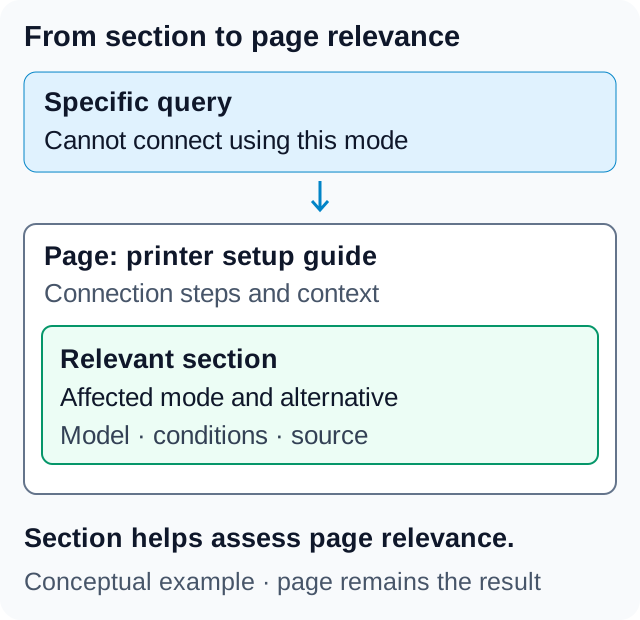
This is a conceptual explanation, not a diagram of Google’s internal processing order. The broader Search systems overview explains other documented systems; natural language processing compares language-understanding roles.
Separate relevance from search appearance
| What you observe | What it establishes |
|---|---|
| A section answers a specific question | You can assess its usefulness and accuracy. This does not identify the system that ranked the page. |
| A result displays a featured snippet | Google selected that presentation. It does not prove passage ranking caused the result. |
| A click jumps to highlighted text | You can inspect the landing experience. The jump does not establish that the section was indexed separately. |
| A query appears beside a URL in Search Console | The report associates search performance with that page. It does not identify which paragraph or ranking system caused it. |
Google’s featured-snippet documentation says publishers cannot mark a page as a featured snippet. A snippet click can also scroll automatically to the relevant section without extra site annotations. Neither behavior supplies a passage-ranking test.
Check the section before changing the page boundary
The following is a practical reader review, not a system-specific optimization formula:
- Name the question. Record the reader’s actual constraint, such as a device, software version or error condition.
- Read the answer with its context. Check that the subject, steps, exceptions and supporting source are clear. Keep qualifications near the claim they limit.
- Check navigation. Use descriptive headings and sensible paragraphs. Add a contents link when it helps a reader reach the answer.
- Choose a useful scope. Keep a short exception with the procedure it qualifies. Consider a separate guide when the reader needs a substantial, distinct procedure and can use it independently.
Google’s SEO Starter Guide recommends readable organization and useful headings. That supports navigation; it does not prescribe question-shaped H2s, a fixed answer length or one URL per paragraph.
Example: an exception inside a setup guide
Hypothetical example: a printer setup guide covers connecting over Wi-Fi. A section explains what to do when the router uses an unsupported security mode.
Keep that exception beside the connection steps if it is a short explanation that depends on them. Give it a descriptive heading, identify the affected model and mode, and explain the supported alternative with a source. If configuring the router requires a separate, substantial procedure, link to a dedicated guide that supplies the missing steps.
This choice serves the reader. It is not evidence that Google rewards longer pages, shorter pages or a particular heading pattern.
Avoid promises about AI citations and schema
Passage ranking does not establish that a section will be cited in AI Overviews. Google’s generative AI optimization guide says there is no requirement to break content into tiny chunks and no special schema markup to add for generative AI search. Do not treat FAQ, HowTo or Article markup as a switch that makes individual passages rank or receive citations.
After a substantive change, save the affected question, URL, answer and source. Use Search Console performance data to compare the same query and page over suitable periods, accounting for other changes. A performance difference can prompt investigation; it cannot identify passage ranking as the cause.