Gemini 4 Hydrogen in Search: how should stores prepare comparison content?

Imagine a customer choosing a device for a cramped desk. Price matters, but so do width, local voltage and whether a subscription is compulsory. They might once have opened several store pages and built their own comparison. Google now wants to handle more of that work inside Search.
On November 12, Search VP Robby Stein introduced Gemini 4 Hydrogen as Search’s largest model upgrade yet. For stores, the practical question is familiar: once Search has organized the answer, what will make the customer want to visit our page?
What did Google confirm?
The Search announcement calls this its largest Search model upgrade yet and announces global availability for all users across supported AI Mode languages. It describes better intent understanding, enhanced query fan-out and links, more visual answers including tables and custom tools, and richer language understanding.
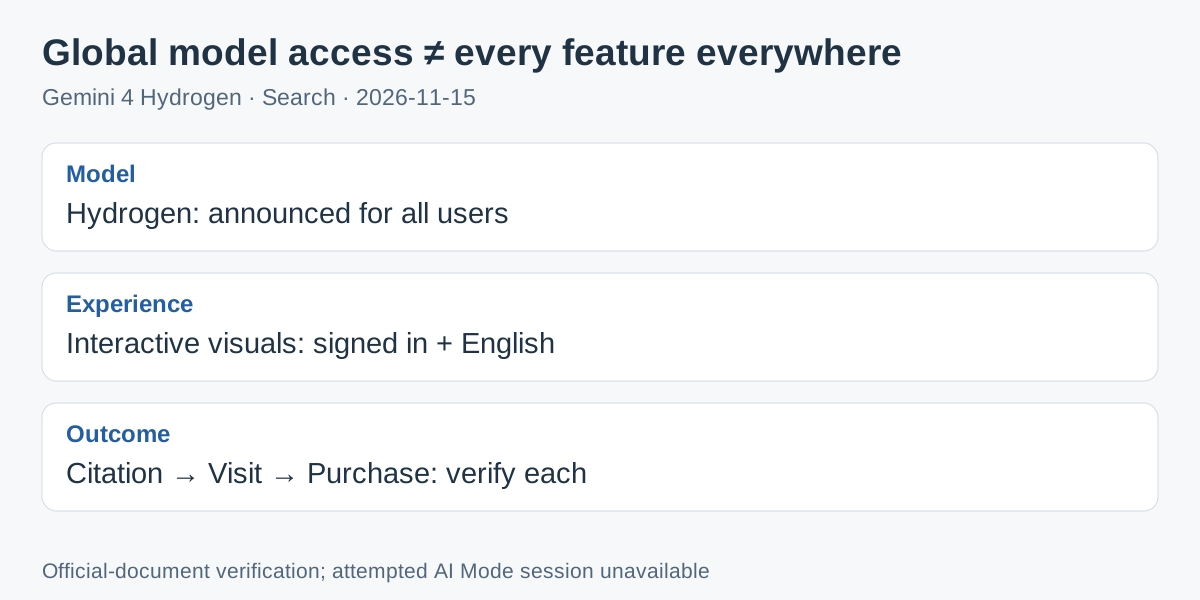
There is no need to rewrite the whole site on the strength of this announcement. Google describes a model and experience upgrade, without announcing a new website ranking rule or quantifying the visits it will send publishers. “Available globally” also does not establish simultaneous access to every feature on every account. The help pages are worth reading before planning around a particular interface.
Can Chinese users generate tools? Does Hydrogen require payment?
For a store serving Chinese-speaking customers, the distinction matters. The AI Mode help page lists separate conditions for the basic experience and some advanced features:
| Question | Verified documentation position |
|---|---|
| Markets and languages | Lists include the US, UK, Japan and Hong Kong; English and Simplified/Traditional Chinese are supported, among others |
| Interactive tools in every language? | Interactive visuals are separately limited to signed-in users in English |
| Ultra required for Hydrogen? | The announcement says all users; the help page’s Ultra, age and daily-limit conditions are for Carbon |
| Must a merchant buy API access? | The checked Search sources establish no such inclusion requirement; API prices are not Search access prices |
| A table on every response? | No guarantee of a particular output format |
We tried google.com/aimode on November 15. After redirecting to Search, it said AI Mode was unavailable for the current device or account. A sign-in option remained visible, and the footer identified an IP-derived location in Japan. We stayed signed out and could not generate a table. That is an entry-point observation, not an answer-quality test or evidence that Japan is unsupported.
9to5Google additionally reports use for harder AI Overview questions. We did not locate a corresponding explicit statement in the checked Search announcement or model launch text, so do not report a confirmed wholesale AI Overviews migration. General model benchmarks are not Search-specific results.
Does stronger fan-out require question headings?
Search Central explains searches across related subtopics, but specifies neither question-form H2s nor three to five subquestions per article. Use headings that accurately describe decisions; avoid manufacturing thin pages or adding question marks mechanically.
Consider a buyer asking for a device below USD100 that fits a 28cm space, accepts 230V and requires no subscription. Budget, width, voltage and subscription are useful planning dimensions. They are not captured Google internal queries. Our query fan-out content brief starts with evidence and scope before choosing headings.
What makes a comparison table useful?
When reviewing a comparison page, first check whether its essential specifications exist only in an image. An HTML table makes them easier to find, copy, compare and maintain. There is no need to claim AI cannot read images: Google’s image guidance describes computer vision alongside alternative text and context. Keep useful photographs and diagrams, with key facts available as text too.
These are fictional teaching inputs, not products or recommendations. The comparison date is November 15, 2026; US item prices exclude tax and shipping. Width means required placement width before any additional ventilation clearance.
| Comparable field | Example A | Example B |
|---|---|---|
| Item price/currency | USD89 | USD79 |
| Required width | 26cm | 30cm |
| Input voltage | 100–240V | 120V |
| Basic-function subscription | Not required | Not required |
| Extra cloud features | Optional USD24/year | Information not provided |
| Four stated constraints | Meets supplied conditions; still check plug, delivery and clearance | Fails width and voltage conditions |
The easy mistake here is not arithmetic. B’s missing cloud information is not a zero price, and A’s optional service does not make every feature free forever. Real comparisons need traceable specifications, measurements or quotations, with matching variants, currencies, tax conditions and dates. A tidy table still misleads if its link opens a different model. The price and stock consistency audit provides a way to check that handoff.
The table narrows the choice; the details underneath often settle it. How was that width measured? Does the plug fit? How much ventilation space remains? An original measurement photo or a test record can answer more than another generic FAQ. Those are good reasons to visit the store. Generated Search tools still need their formulas and facts checked, especially for safety and compatibility.
Do broader links predict more clicks?
Broader linking offers an opportunity, not a traffic cheque for every publisher. A complete answer might remove the need for a visit; a well-chosen source might bring someone with a clearer purchase in mind. Watch for both rather than deciding the shape of the graph in advance.
Search Central currently includes AI Mode and AI Overview performance in Search Console’s Web reporting. Ordinary Web trends cannot isolate Hydrogen, and visible GSC queries are not internal fan-out logs.
Mark November 12 in reporting, then revisit after a week and at fourteen and twenty-eight days. Compare complete windows with matching weekdays, markets and devices, separating branded from non-branded queries. Look at orders alongside clicks, impressions and position. Small samples may need longer: a reporting deadline does not turn noise into a trend. Calculate aggregate CTR from total clicks divided by total impressions, not an average of daily rates.
| Observation | Next check |
|---|---|
| More impressions, flat clicks | New low-ranking queries, markets or devices before assuming zero-click loss |
| CTR and position both fall | Ranking, query mix and site changes before isolating AI effects |
| A citation in a comparison response | Clickability, destination and factual accuracy; not a conversion |
| Fewer clicks, stable orders | Conversion rate, attribution window, volume and margin |
Use the content refresh diagnostic for follow-up. We did not access this site’s GSC performance or observe a Hydrogen traffic effect.
What should store and advertising teams do now?
Start with one comparison page that matters to a purchase. Fix units, variants, subscriptions and usage conditions so a reader can actually choose. Put the facts in text and a proper HTML table, with photographs, measurements and sources nearby. That is a more useful first step than changing headings across the entire site.
When eligible, repeat the same constrained question in English and the target language. Record market, device, sign-in state, date, exact prompt, answer, source URLs and errors. Test public facts without customer orders or private inboxes. Request a table and an interactive tool separately; record non-triggering too. One success cannot establish global reliability.
Keep advertising decisions tied to actual business evidence. This announcement introduces no new ad bidding or attribution rules, and organic citations are not paid impressions. For comparative claims, distinguish measured data from manufacturer specifications, optional from mandatory fees, and unknown from zero. Traceability assists review but does not automatically establish advertising compliance in every market.
As Search gets better at arranging answers, stores need to show what sits behind them: where a fact came from, when it applies and what happens if the customer chooses badly. Keep those details attached when a passage is extracted, and give visitors something more when they arrive. Citations, visits and purchases still need separate accounting.