AI Mode Changed My Content Brief: How I Write for Query Fan-Out in 2026
I used to write content briefs around a primary keyword, three secondary keywords, and a list of related questions. That still helps, but in 2026 it feels incomplete.
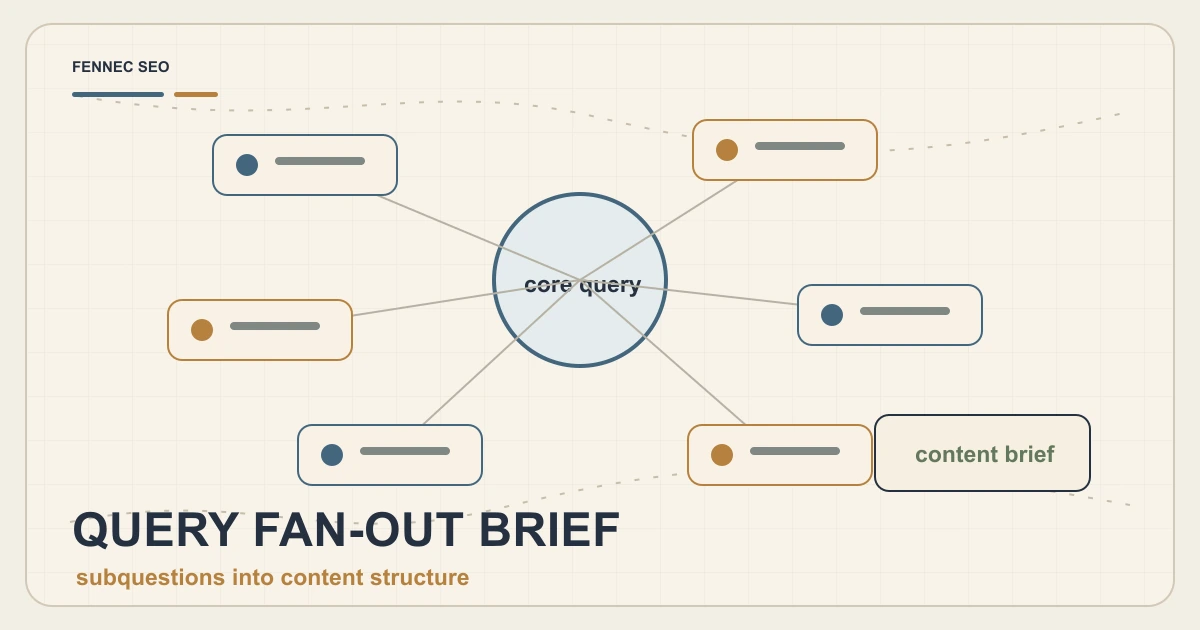
Google’s AI search experience is no longer just matching one query to one page. In its official AI optimization guide, Google explains that generative AI features use retrieval-augmented generation and a technique called query fan-out. In plain English, the system can break one search into a set of related searches, gather supporting pages, and build a more complete answer.
That changes how I brief content.
I do not think the answer is “write longer posts.” The answer is to write pages that survive follow-up questions.
The Old Brief Is Too Flat
The old SEO brief usually asked:
- What is the target keyword?
- What are the top-ranking pages?
- What headings do competitors use?
- How many words should we write?
- Which internal links should we add?
That brief can still produce a decent article, but AI Mode and AI Overviews raise the bar. A page now needs to be useful not only for the first search, but also for the follow-up questions hiding inside that search.
If someone asks “how do I improve SEO for an AI search result,” they may also need:
- What does Google actually say about AI search optimization?
- Is this different from normal SEO?
- What technical basics still matter?
- How do I make my author and brand trustworthy?
- How do I measure whether this work is helping?
That is where query fan-out matters. If my article only answers the headline query, it may be too shallow to become a useful source.
My 2026 AI Mode Brief
Here is the brief format I use now.
1. Start With The One-Sentence Answer
Before I write the outline, I write the answer I want the page to be known for.
For example:
To improve AI search visibility, create crawlable, well-structured pages that answer the main question clearly, add original experience, and connect the topic to trusted author and brand entities.
This sentence becomes the north star. If the article cannot support that answer, the article is not ready.
2. Map The Follow-Up Journey
I list the follow-up questions a reader would naturally ask after the first answer.
For an AI search article, my follow-up map might include:
- What changed in Google AI Mode?
- How does query fan-out affect content planning?
- What should stay the same from traditional SEO?
- What proof should a creator include?
- How should the page be refreshed after publication?
This keeps the article focused on a real user journey instead of a keyword checklist.
3. Add Original Proof
Google’s AI guidance keeps pointing back to helpful, reliable, people-first content. For me, that means every serious article needs at least one of these:
- A personal workflow
- A real checklist
- A before-and-after example
- A screenshot or audit result
- A practical template
- A clear opinion based on doing the work
This is where smaller creators can win. A large site may have authority, but a creator can publish lived experience that is harder to copy.
4. Make The Page Easy To Extract
I now write with “source-worthiness” in mind.
That does not mean writing for robots. It means making key ideas easy to understand, quote, and verify:
- Use descriptive H2s and H3s
- Answer important questions directly before expanding
- Avoid vague claims
- Add links to primary sources
- Use lists when a process has steps
- Keep definitions clean and consistent
When a page has clear sections, both humans and search systems can understand what each section contributes.
5. Connect The Author Entity
This is the part many content teams skip.
If a page is written by a person, I want that person to look like a real entity, not a random byline. That means:
- A stable author page on the site
- A short, specific author bio
- Links to the author’s own site or public profile
- Consistent names across posts and schema
- Article schema that identifies the author as a Person
For my own posts on Fennec SEO, adding my personal site, Anna SEO Journey, helps connect my byline with an external author identity. It is not magic, but it is a cleaner entity signal.
What I Stopped Doing
The biggest change is what I no longer put in a brief.
I no longer ask writers to create ten near-identical articles just because keyword tools show ten variants. Query fan-out makes that strategy feel weaker, not stronger.
I also stopped treating AI Overviews as a separate content universe. Google’s guidance says the basics still matter because generative AI features are rooted in core Search ranking and quality systems. The smart move is not to abandon SEO. The smart move is to make SEO content more complete, more original, and easier to trust.
A Simple Template You Can Copy
Here is the content brief template I would use for a new AI SEO article:
- Main reader question:
- One-sentence answer:
- Follow-up questions:
- Original proof or experience:
- Primary sources to cite:
- Internal links:
- Author entity signals:
- Schema needed:
- Refresh date:
- Success metric:
That last line matters. If the goal is AI search visibility, I want to know what I will check later. It might be Google Search Console queries, branded searches, AI referral traffic, or whether the article starts earning citations and mentions.
My Takeaway
AI Mode does not make content strategy mysterious. It makes weak content briefs more obvious.
A strong 2026 article should answer the first question, support the next five questions, and show why this author is a trustworthy source. That is the kind of page I want attached to my name.
The workflow is simple: write for the journey, prove the advice, connect the author, and make the page easy to understand.
That is where I am putting my effort now.
Sources I Checked
- Google Search Central: AI optimization guide
- Google Blog: AI Mode in Search
- Fennec SEO: Google’s Official AI SEO Guide
Q&A
Does query fan-out mean I need a separate article for every long-tail keyword?
No. Query fan-out makes thin keyword cloning less useful. A stronger page answers the core question clearly, then covers the natural follow-up questions a real reader would ask.
Can content creators appear in AI Mode without being huge publishers?
Yes, but the page needs to be crawlable, specific, useful, and backed by real experience or evidence. Small sites can compete when they publish original examples and clear explanations.
What should I audit first for AI search visibility?
Start with indexability, titles, headings, author information, schema markup, internal links, and whether the page answers the main question in a concise, source-worthy way.