
AI search does not remove the old trust problem. It makes the trust problem easier to notice.
When a page makes a recommendation, explains a technical workflow, or summarizes a fast-changing topic, readers and search systems both need the same answer:
Who is responsible for this content, and why should anyone trust it?
That is the job of author entity SEO.
This is not a magic ranking trick. It is a clarity layer that supports the AI Search Visibility Scorecard, source-worthiness, Article schema, and brand consistency.
What Author Entity SEO Means
Author entity SEO is the practice of making authors, reviewers, and publishers easy to identify across visible content and structured data.
It connects:
- The byline on the article
- The author page
- The publisher organization
- The author’s topical focus
- External profiles where appropriate
- Article structured data
- Update and review signals
The goal is not to create a fake celebrity author. The goal is to reduce ambiguity.
For Fennec SEO, this connects directly to the existing entity work in docs/entity-audit.md: the brand, product, author, and publisher facts should stay consistent across templates, content, app pages, and social profiles.
Why Clarity Still Matters Without Special AI Markup
Google’s current generative AI guidance says there is no special schema required for AI Overviews or AI Mode, and structured data is not required for those features. Author markup should therefore be treated as ordinary identity and Article clarity work, not as an AI ranking technique.
AI search systems may summarize, compare, and cite pages before a user visits the full site. Clear visible authorship still helps readers evaluate responsibility and helps publishers keep editorial facts consistent, but it does not guarantee that an AI system will select or cite the page.
That increases the value of clear source signals:
| Signal | Why it matters |
|---|---|
| Visible author | Readers can identify accountability |
| Author page | Search systems can connect related work |
| Publisher consistency | The brand entity stays stable |
| Dates | Freshness is easier to evaluate |
| Sources | Claims are easier to verify |
| Topic focus | The author is not just a random name |
Google’s guidance still emphasizes helpful, reliable, people-first content. Author clarity supports that goal, but it does not replace content quality.
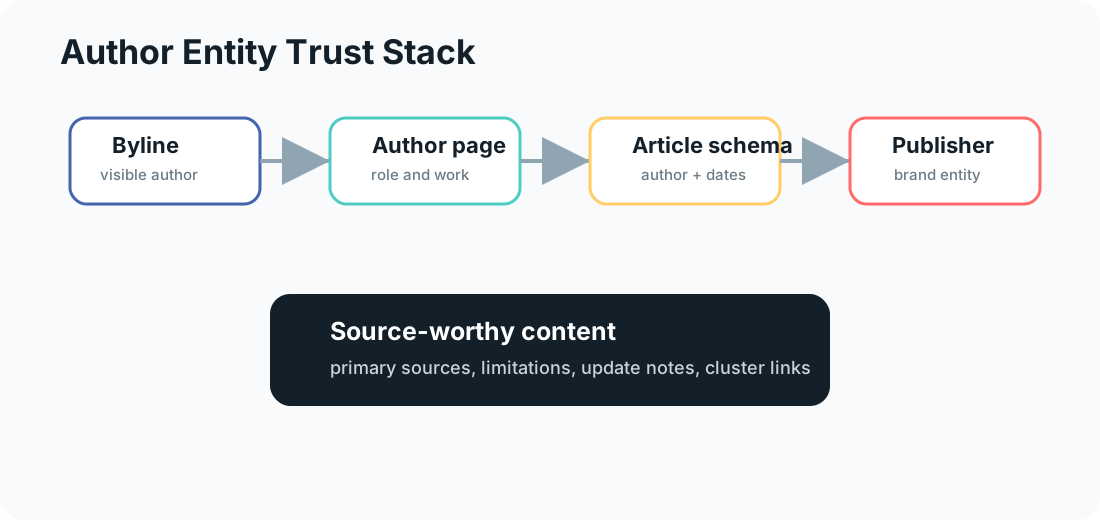
The Minimum Author Trust Stack
Start with this before adding fancy schema:
| Layer | Requirement |
|---|---|
| Byline | Every editorial article has a visible author or publisher |
| Author page | The author name links to a durable author page |
| Bio | The page explains role, topical focus, and editorial responsibility |
| Related articles | Author pages show recent or representative work |
| Publisher | Article schema points to the canonical organization |
| Dates | datePublished and dateModified are accurate |
| Sources | Technical and policy claims cite primary references |
If any of these are missing, fix them before chasing external profiles.
Person, Organization, Or Team Author?
Use the most honest author type.
| Content type | Better author pattern |
|---|---|
| Opinion, analysis, expert workflow | Named person author |
| Product release notes | Organization or product team |
| Legal/privacy pages | Organization |
| Highly technical audits | Named author plus reviewer when available |
| Wiki definitions | Organization or editorial team |
A named author helps when the content has judgment. A team author is fine when the page reflects an official product or company position.
Do not invent expertise. A thin fake author profile is worse than a plain organization byline.
Author Page Checklist
An author page should answer these questions quickly:
| Question | Page element |
|---|---|
| Who is this? | Name and role |
| What topics do they cover? | Topical focus |
| Why should I trust them? | Experience, editorial responsibility, examples |
| What did they publish? | Recent articles |
| How do they connect to the brand? | Organization relationship |
| Is this current? | Updated profile and recent work |
For Fennec, the existing author pages such as 2winter and the authors index are the right surfaces to strengthen.
Structured Data Checklist
For article pages, verify:
ArticleorBlogPostingschema existsheadlinematches the visible titleauthormatches the visible bylinepublisherpoints to the canonical organizationdatePublishedanddateModifiedare correctimageis available and crawlable- Breadcrumb schema matches the visible path
For author pages, avoid overpromising. If you use Person schema, keep fields factual and visible or easily verifiable.
Schema should support the page. It should not say more than the page proves.
Content-Level Trust Signals
Author entity work is weak if the article itself is vague.
For AI search content, add:
- A direct answer near the top
- Clear definitions for technical terms
- Decision tables and checklists
- Primary source links
- Limitations and assumptions
- Update notes when guidance changes
- Internal links to related cluster pages
For example, an article about GPTBot policy should link to official bot docs and to your server log analysis workflow. An article about breadcrumb schema should link to Google’s breadcrumb documentation and your Schema Markup page.
Avoid These Mistakes
Do not:
- Create fake expert personas
- Add unsupported credentials
- Use the same author bio for unrelated topics
- Hide the byline but claim an author in schema
- Add
sameAslinks to profiles you do not control - Treat Person schema as a substitute for a useful article
- Let English and Chinese author facts drift apart
Entity consistency is boring work. That is why it is valuable.
A Practical 30-Minute Audit
Pick five high-value articles and check:
- Does the visible byline match structured data?
- Does the author page exist and load?
- Does the author page list relevant articles?
- Does the article have current dates?
- Are claims supported by primary sources?
- Does the page link to the relevant topic cluster?
- Does the publisher entity match the canonical brand facts?
Then score each page:
| Score | Meaning |
|---|---|
| 0-2 | Weak author clarity |
| 3-5 | Acceptable but incomplete |
| 6-7 | Strong enough for ongoing monitoring |
Use Audit, Schema Markup, and the AI Search Visibility Scorecard to connect this with broader page quality.
Fennec-Specific Next Steps
For this site, the useful next steps are:
- Keep the canonical organization facts in
docs/entity-audit.mdaligned with schema - Strengthen visible author pages with topical focus and representative work
- Keep
2winter,fennec-team, andAnnaroles consistent across English and Chinese pages - Add reviewer notes only when a real review process exists
- Re-run schema validation after author template changes
The win is simple: when AI search systems, crawlers, and readers inspect the site, they should see the same entity story everywhere.
Sources
- Google Search Central: Creating helpful, reliable, people-first content
- Google Search Central: Article structured data
- Google Search Central: Structured data general guidelines
- Google Search Central: Optimizing for generative AI search
- Schema.org: Person
Q&A
Is author entity SEO a ranking shortcut?
No. It is a trust and clarity practice. It helps search systems and readers understand who created the content, but it does not replace useful content.
Do all articles need a named person author?
Not always. Some pages can use an organization author, but expert advice and analysis usually benefit from a clear person, role, and author page.
Should I create fake expert profiles?
No. Author entity work should reflect real people, real expertise, and visible editorial accountability.
Which schema matters most?
Start with accurate Article schema, a consistent author field, Organization publisher data, and visible author pages before adding more complex Person details.