Markdown for Agents: The Content Layer Missing From AI SEO Workflows

Markdown for Agents is easy to misunderstand.
It is not a magic ranking format. It is not a replacement for HTML. It is not the same thing as llms.txt.
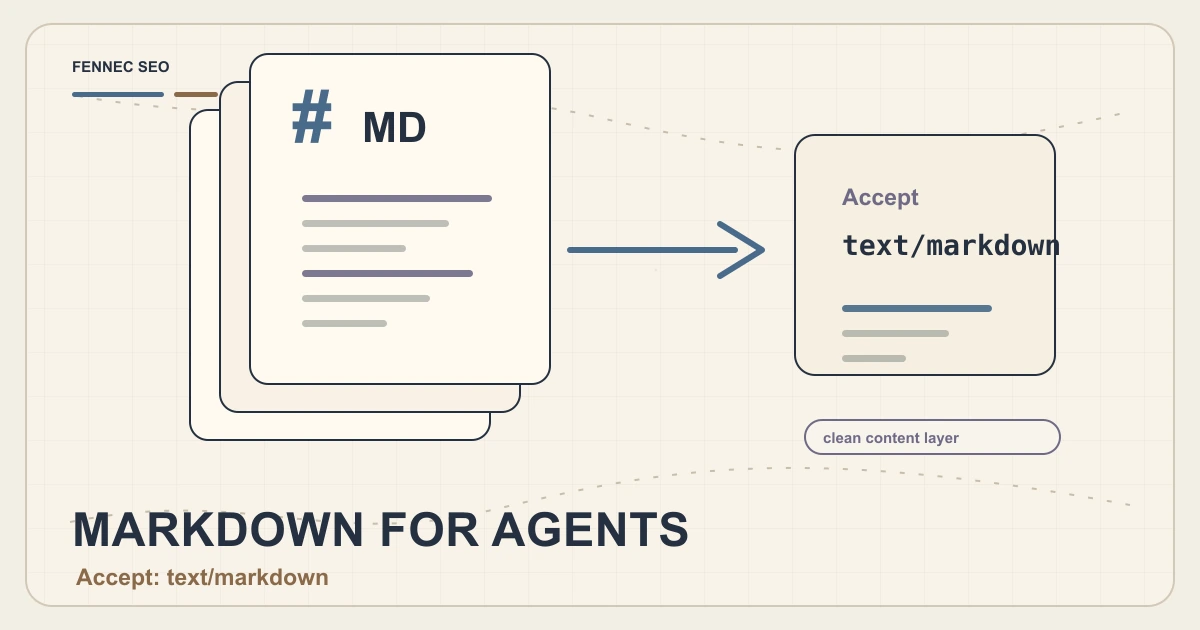
It is a practical content access layer: when an AI agent asks for a page in Markdown, the site can serve a cleaner, lower-friction representation of the same content.
For Agent SEO, that matters.
This article is the content-access spoke in the broader Agent SEO audit cluster.
To see where Markdown fits in the full product checklist, use the Agent SEO audit page.
The Problem: HTML Is Useful But Noisy
Modern pages carry a lot of material that is useful for browsers and humans:
- Navigation
- Styling hooks
- Scripts
- Analytics tags
- Cookie banners
- Repeated layout
- Comments
- Interactive widgets
- Related content
That is normal. But when an AI agent needs to read a page, extract the main answer, compare sources, or summarize a workflow, the extra HTML can add cost and ambiguity.
Agents can parse HTML. The question is whether they should have to parse the entire rendered page every time.
Markdown content negotiation gives them a cleaner option.
What Markdown Content Negotiation Means
The agent sends a request with an Accept header:
Accept: text/markdown
If the site supports Markdown for Agents, it responds with Content-Type: text/markdown and a Markdown representation of the page.
The key word is representation. The Markdown should match the canonical HTML content, including the same claims, links, headings, and update context. It should not be a secret SEO-only version of the page.
Good Markdown output preserves:
- Title
- Description
- Main headings
- Primary content
- Important tables
- Source links
- Calls to action
- Update dates where relevant
It can remove:
- Navigation chrome
- Repeated footer links
- Cookie UI
- Decorative layout
- Non-essential scripts
- Hidden tracking markup
Markdown for Agents vs llms.txt
These two ideas are related, but they do different jobs.
| Asset | Best use | Scope |
|---|---|---|
llms.txt | Curated guide to the site’s most important resources | Site-level |
llms-full.txt | Larger export or index of readable content | Site-level or collection-level |
| Markdown negotiation | Clean Markdown response for the requested page | Page-level |
For example, llms.txt can tell an agent that your best resources are:
- Product page
- Pricing page
- API docs
- Blog index
- Changelog
- Support docs
Markdown negotiation helps after the agent chooses one of those resources.
Use both only if you can maintain both. A stale llms.txt plus inaccurate Markdown is worse than clean HTML and a good sitemap.
Where Google Fits In
Google’s AI optimization guide is clear: special files such as llms.txt, AI text files, extra markup, or Markdown are not required to appear in Google Search or Google’s generative AI features. Treat them as agent-access assets, not special Google ranking or generative AI visibility requirements.
That should shape the SEO strategy.
Do not sell Markdown for Agents as a Google ranking shortcut. Use it for:
- Agent readability
- Lower extraction friction
- Faster technical documentation access
- Cleaner developer and AI assistant workflows
- Better consistency between human pages and machine-readable resources
For Google Search, keep doing the fundamentals: crawlable HTML, useful content, structured internal links, fast pages, stable canonical tags, and accurate structured data where appropriate.
When Markdown for Agents Is Worth It
It is most useful when the site has content agents may need to inspect repeatedly:
- Developer documentation
- API references
- Technical SEO guides
- Pricing and plan details
- Product changelogs
- Help centers
- Policy pages
- Comparison pages
- Research pages with tables
It is less urgent for a small brochure site with only a few pages.
For a product like Fennec SEO, Markdown access makes sense for pages such as:
These are the pages a coding agent, SEO analyst, or AI assistant may want to inspect when recommending fixes.
Implementation Checklist
Before implementation, define the rules:
- Markdown must represent the canonical page, not a different page.
- Internal links should resolve to canonical URLs.
- Headings should keep the same hierarchy as the HTML page.
- Tables should remain tables.
- Source links should remain visible.
- Product claims should match the public page.
- The response should use
Content-Type: text/markdown; charset=utf-8. - The response should send
Vary: Acceptso caches do not mix HTML and Markdown. - Any
Content-Signalheader or robots directive should match the site’s AI bot policy. - The HTML page can include a
<link rel="alternate" type="text/markdown">when a static Markdown URL exists.
Then test with:
curl -H "Accept: text/markdown" https://example.com/page/
If the response is still HTML, the site does not support Markdown negotiation for that URL.
For site-level resource maps, keep using llms.txt. For bot access policy, pair Markdown work with Content Signals and AI bot access control.
Common Mistakes
The biggest mistakes are strategic, not technical.
Avoid:
- Creating Markdown only for agents while humans see weaker content
- Hiding claims from the HTML page
- Publishing Markdown without source links
- Using Markdown to bypass page design instead of fixing poor information architecture
- Letting Markdown fall out of sync with the CMS
- Forgetting multilingual paths
- Treating
llms.txtas crawler control
Crawler access belongs in robots.txt. Resource curation belongs in llms.txt. Page representation belongs in Markdown negotiation.
How This Supports GEO
GEO depends on source-worthy content. Markdown does not create authority by itself, but it can make your source easier to inspect.
For citation and answer systems, good pages still need:
- Specific claims
- Clear definitions
- Updated facts
- Tables and comparisons
- Author and organization context
- Internal links to supporting resources
- External sources where claims depend on outside standards
Markdown can make those signals easier to retrieve. It cannot invent them.
Measurement
Measure the work as an agent-readiness improvement, not as a direct Google ranking lever.
Useful checks:
- Does
Accept: text/markdownreturn Markdown? - Are important pages available?
- Does the Markdown include source links?
- Does
llms.txtpoint to the right resources? - Does IsItAgentReady pass the Markdown check?
- Do AI assistants summarize the page more accurately?
- Do logs show requests for Markdown or LLM-readable files?
Pair this with the Agent SEO audit, AI search measurement, and AI crawler testing for a fuller workflow.
Takeaway
Markdown for Agents is not an AI SEO trick. It is a content delivery option for agentic browsing.
Use it when agents genuinely need to read your content efficiently. Keep the HTML strong, maintain llms.txt as a curated map, and let Markdown be a cleaner representation of the same truth.
Sources
- Cloudflare Docs: Markdown for Agents
- Cloudflare: Introducing the Agent Readiness score
- Google Search Central: AI optimization guide
- Fennec SEO llms.txt
- Fennec SEO llms-full.txt
Q&A
Does Markdown for Agents improve Google rankings?
Google says Markdown, llms.txt, and other special AI files are not required for Google Search visibility. Markdown for Agents is more useful for agent readability and workflow efficiency.
How is Markdown content negotiation different from llms.txt?
llms.txt is a curated site map for AI readers. Markdown content negotiation lets a page return a Markdown representation when an agent requests text/markdown.
How do I test Accept: text/markdown?
Run curl with an Accept: text/markdown header and confirm the response uses Content-Type: text/markdown, includes Vary: Accept, and represents the same canonical content as the HTML page.
Should every site implement Markdown for Agents?
No. It is most useful for documentation, product, pricing, support, and technical resources that agents may inspect repeatedly.