Agent Skills Index: How Websites Expose Reusable Capabilities

Agent Skills are not another metadata tag to add to every website. They are portable packages that teach a compatible AI agent how to complete a defined task.
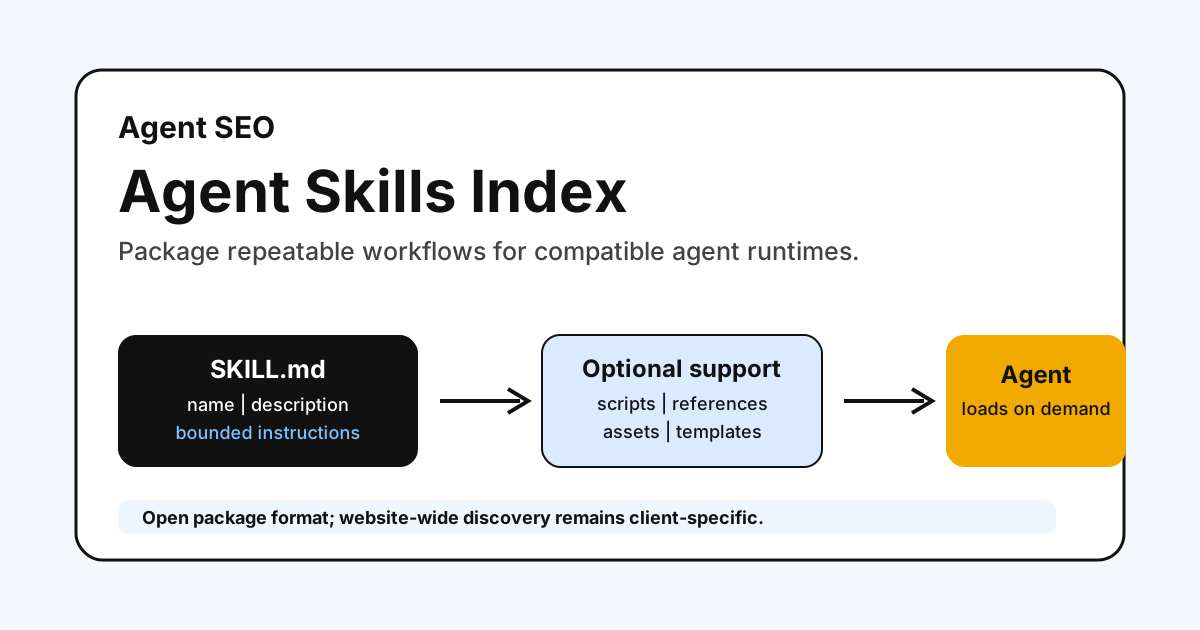
The open Agent Skills specification centers on a SKILL.md file. A skill can add instructions, scripts, references, and assets around that file so an agent can load the right context only when it needs it.
For product websites, that creates a useful distinction: an API exposes an operation, while a skill explains a repeatable workflow around an operation.
This article expands the Agent Skills Index concept inside the broader Agent SEO audit. It is about capability clarity, not a promise of AI-search visibility.
What A Skill Contains
A basic portable skill looks like this:
site-audit/
├── SKILL.md
├── scripts/        # optional executable helpers
├── references/     # optional detailed documentation
└── assets/         # optional templates or files
SKILL.md carries the durable, high-level instructions. The specification requires at least name and description in its frontmatter; supporting materials can be loaded only when relevant.
---
name: site-audit
description: Audit a public website for broken links, indexability, and canonical errors. Use when a user asks for a technical SEO review.
---

# Site audit

1. Confirm the target domain and scope.
2. Run the permitted checks.
3. Separate evidence from recommendations.
The skill is not the API itself. It is a reusable operating guide that may call an API, use a script, or direct an agent to reliable source material.
Skill, API, MCP, And Website Documentation
| Asset | Primary job | Best fit |
|---|---|---|
| Website documentation | Explain a product to people | Product education and support |
| OpenAPI or API catalog | Describe and discover an HTTP service | Public programmatic capability |
| MCP server | Expose tools and resources to an MCP client | Live agent-tool interaction |
| Agent Skill | Package instructions, workflow, and optional assets | Repeatable work in a compatible agent runtime |
llms.txt | Provide a readable content map | Curated reading and navigation |
An e-commerce API might let an agent retrieve availability. A product-research skill can explain which filters to apply, which policy documents to read, and when to ask a user before taking an action.
That is why skills sit near API Catalog SEO, MCP Server Card, and Auth.md and OAuth metadata, but do not replace them.
Do Not Invent A Website-Wide Discovery Standard
Agent Skills has an open package format. It does not define one universal /.well-known/agent-skills path or a generic HTML Link relation that every agent must crawl.
That means a publisher should:
- follow the installation or discovery rules of the target agent runtime;
- keep a human-readable documentation page for customers and developers;
- link to a public repository or published package only when the skill is real and maintained;
- avoid claiming compatibility with clients that have not documented support.
This conservative approach is stronger than publishing an arbitrary JSON index. A fake discovery file can make a site look ready while giving agents nothing usable.
A Capability Index That Helps Humans And Agents
If your product has several skills, publish a simple capability index in product documentation. It should answer:
| Field | Example |
|---|---|
| Skill name | audit-site |
| User outcome | Identify indexability and canonical issues |
| Inputs | Public URL, optional sitemap URL |
| Reads or writes? | Read-only |
| Required access | None for public pages |
| Dependencies | Bot simulator, link checker, public docs |
| Owner and review date | SEO platform team, reviewed quarterly |
This is a documentation and governance asset. Keep private administration, destructive actions, and hidden credentials out of public packages.
A Safe Publishing Workflow
- Choose a real user outcome. A skill should solve a bounded task, not advertise a department.
- Write a precise description. It is a discovery and activation signal, so name the task, inputs, and boundaries.
- Keep core instructions short. Put deep references and large assets in their own folders.
- Declare side effects. State whether the workflow reads data, changes state, needs authentication, or requires confirmation.
- Test in the intended client. Validate the package with the tooling and runtime that will actually load it.
- Review it like product documentation. Update it when workflows, APIs, policies, or permissions change.
The Agent Skills best-practices guide recommends focused skills and progressive disclosure for the same reason: a very large instruction file can be less useful than a small, well-routed one.
Apply An Information-Gain Test Before Publishing
A public skill should contain operational knowledge that is difficult to recover from a generic prompt. Before publishing, ask what the package contributes beyond “read the website and follow the docs.”
| Contribution | Strong example | Weak example |
|---|---|---|
| Decision logic | When to consolidate versus redirect duplicate URLs | “Improve SEO” |
| Verified procedure | Exact checks, expected outputs, and failure branches | A generic five-step list |
| Reusable asset | A tested audit template or schema | A decorative image |
| Product boundary | Which action needs authentication or approval | “Use safely” |
| Maintained reference | Versioned field definitions with an owner | A copied overview with no review date |
If the package only restates public documentation, improve the documentation instead. If it contains a real workflow, publish the smallest package that preserves the decision logic and test evidence.
A Practical Catalog Record
The open specification defines each skill package; your catalog is an owned documentation layer. A useful record can look like this:
name: audit-indexability
outcome: Identify crawl, canonical, and noindex conflicts
package: https://example.com/skills/audit-indexability.zip
version: 1.3.0
runtime_tested: Example Agent 4.2
access: public-web-read-only
side_effects: none
owner: Technical SEO
reviewed: 2026-07-22
Do not list planned packages beside tested packages without an explicit status. Do not publish a compatibility badge unless the named runtime and version were actually tested.
Maintenance And Removal Rules
Review a skill when an API, permission model, user interface, policy, or runtime changes. Remove or archive it when the task no longer exists, required dependencies are unavailable, or the package cannot be tested. A smaller reliable catalog is more useful than a large stale one.
Apply An Information-Gain Test Before Publishing
A public skill should contain operational knowledge that is difficult to recover from a generic prompt. Before publishing, ask what the package contributes beyond “read the website and follow the docs.”
| Contribution | Strong example | Weak example |
|---|---|---|
| Decision logic | When to consolidate versus redirect duplicate URLs | “Improve SEO” |
| Verified procedure | Exact checks, expected outputs, and failure branches | A generic five-step list |
| Reusable asset | A tested audit template or schema | A decorative image |
| Product boundary | Which action needs authentication or approval | “Use safely” |
| Maintained reference | Versioned field definitions with an owner | A copied overview with no review date |
If the package only restates public documentation, improve the documentation instead. If it contains a real workflow, publish the smallest package that preserves the decision logic and test evidence.
A Practical Catalog Record
The open specification defines each skill package; your catalog is an owned documentation layer. A useful record can look like this:
name: audit-indexability
outcome: Identify crawl, canonical, and noindex conflicts
package: https://example.com/skills/audit-indexability.zip
version: 1.3.0
runtime_tested: Example Agent 4.2
access: public-web-read-only
side_effects: none
owner: Technical SEO
reviewed: 2026-07-22
Do not list planned packages beside tested packages without an explicit status. Do not publish a compatibility badge unless the named runtime and version were actually tested.
Maintenance And Removal Rules
Review a skill when an API, permission model, user interface, policy, or runtime changes. Remove or archive it when the task no longer exists, required dependencies are unavailable, or the package cannot be tested. A smaller reliable catalog is more useful than a large stale one.
What This Means For SEO
Agent Skills can make a supported agent more consistent when it needs to use a real product capability. They do not make a page crawlable, source-worthy, or eligible for any Google feature.
Keep the ordinary foundations in place:
- Make product pages discoverable through Technical SEO, navigation, and sitemaps.
- Document public APIs through an API Catalog when one genuinely exists.
- Test visible content and machine access with Bot Simulator.
- Use Agent SEO Audit as a discovery review, not as proof of security or adoption.
The useful test is simple: if an agent receives this package, can it complete a real task more reliably without gaining access it should not have? If not, publish better documentation first.
Sources
- Agent Skills specification
- Agent Skills: adding client support
- Agent Skills: best practices
- Agent Skills official repository
Q&A
Is there a standard well-known URL for Agent Skills?
No. The open Agent Skills specification standardizes skill packages and SKILL.md, not one website-wide discovery URL. Follow the consuming agent's documented installation or discovery method.
Does publishing a skill improve search rankings?
No. A skill is an operational package for compatible agents. It does not guarantee crawling, rankings, citations, or adoption.
Should a content-only site publish skills?
Only when it can provide a real repeatable workflow, authoritative references, or usable assets. Otherwise, ordinary documentation, sitemap, and technical SEO are more appropriate.