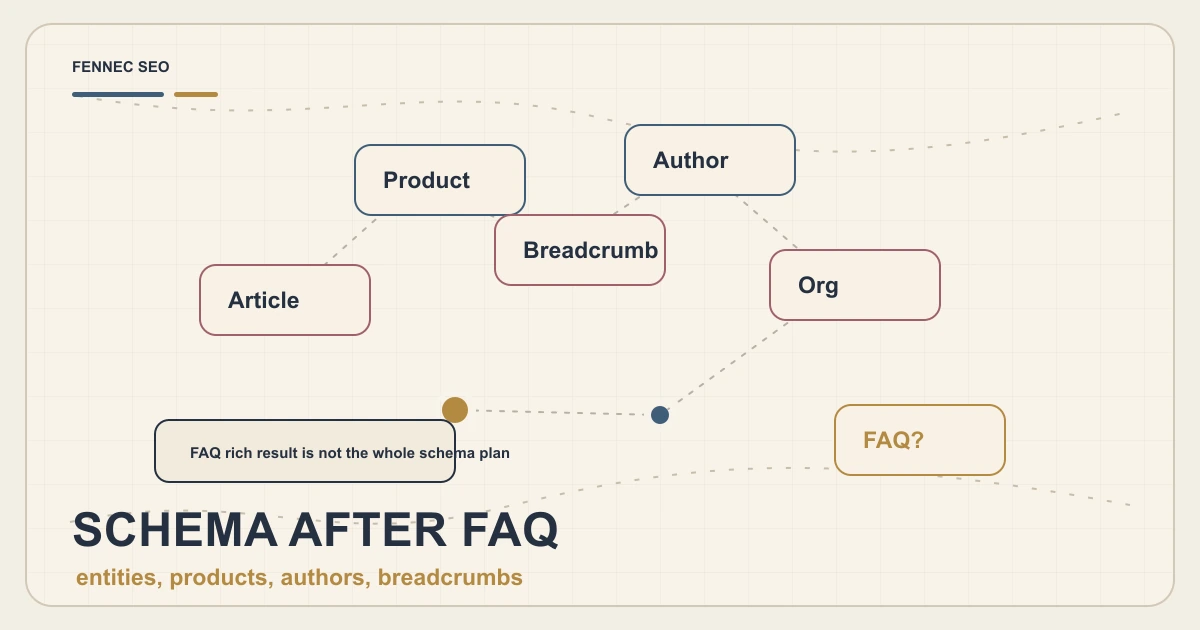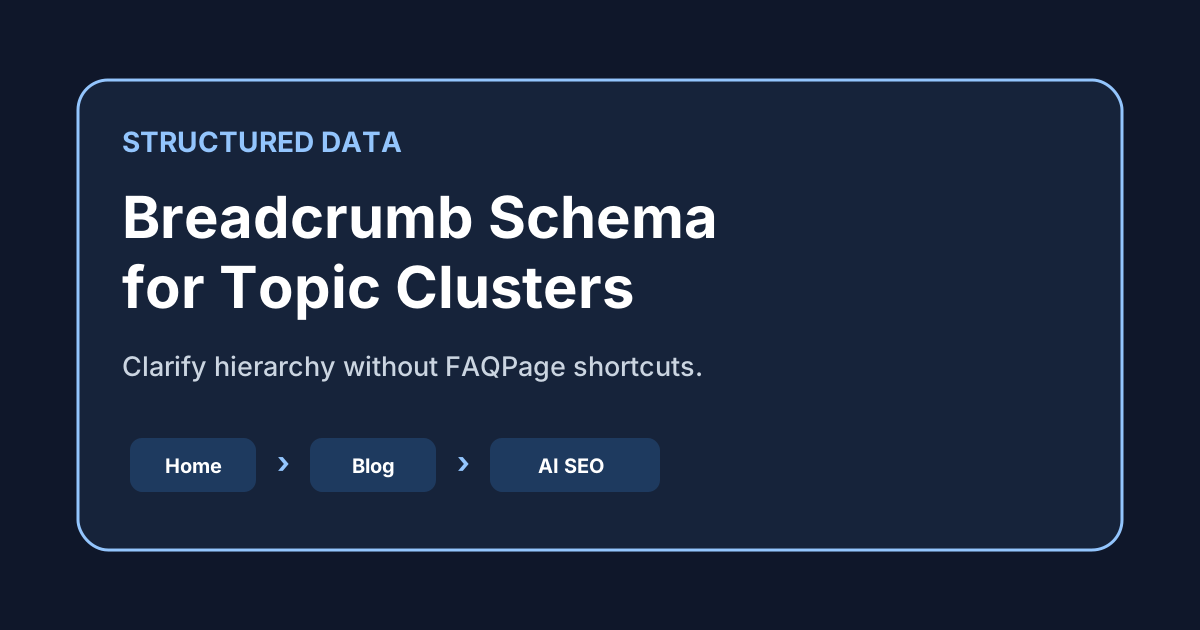
Breadcrumb Schema for Topic Clusters

Topic clusters need structure that both readers and crawlers can follow.
Internal links do most of the work. But Breadcrumb schema adds a second machine-readable layer that explains where a page sits inside the site.
This is ordinary site-structure work, not special markup for AI search. Google’s current guidance says generative search requires no special schema. A page about GPTBot, a page about AI search measurement, and a page about author entities should still connect through visible navigation and internal links before structured data describes that hierarchy.
This guide shows how to use BreadcrumbList for topic clusters without falling back into the old habit of adding FAQPage schema to every article.
What Breadcrumb Schema Does
Breadcrumb schema describes a page’s hierarchical path.
For a blog post, that might be:
Home > Blog > AI SEO > AI Search Visibility Scorecard
For a wiki entry:
Home > Wiki > Technical SEO > Canonical URL
For a product feature page:
Home > Tools > Bot Simulator
The schema does not create authority by itself. It clarifies relationships that should already exist in visible navigation and internal links.
Why Topic Clusters Need Breadcrumbs
Topic clusters can become messy fast.
An AI search cluster may include:
- Measurement pages
- Citation audits
- Query fan-out briefs
- Crawler policy articles
- Schema guides
- Bot simulation workflows
- Product pages
- Wiki definitions
Breadcrumbs help crawlers and users understand whether a page is a hub, a spoke, a tool, or a supporting reference.
That clarity supports the same work as Schema Markup, AI Search Visibility Scorecard, and technical SEO: reduce ambiguity.
The Best Breadcrumb Pattern For Blogs
For most blog posts, keep the path simple:
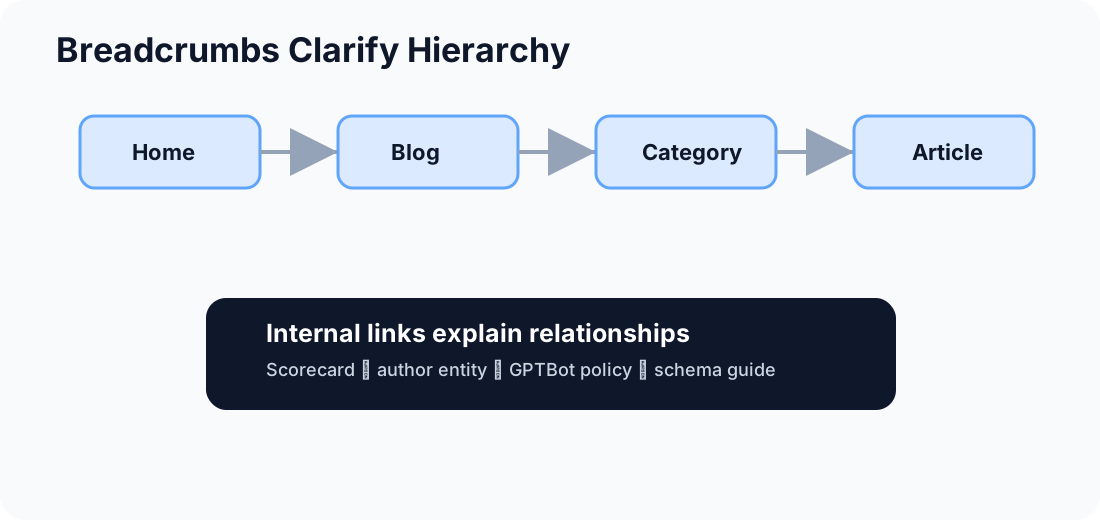
Home > Blog > Category > Article
Example:
{
  "@context": "https://schema.org",
  "@type": "BreadcrumbList",
  "itemListElement": [
    {
      "@type": "ListItem",
      "position": 1,
      "name": "Home",
      "item": "https://example.com/"
    },
    {
      "@type": "ListItem",
      "position": 2,
      "name": "Blog",
      "item": "https://example.com/blog/"
    },
    {
      "@type": "ListItem",
      "position": 3,
      "name": "AI SEO",
      "item": "https://example.com/blog/category/ai-seo/"
    },
    {
      "@type": "ListItem",
      "position": 4,
      "name": "AI Search Visibility Scorecard",
      "item": "https://example.com/blog/ai-search-visibility-scorecard/"
    }
  ]
}
Keep labels short and stable. Do not stuff keywords into breadcrumb names.
Breadcrumbs And Internal Links Are Different
Breadcrumbs explain hierarchy. Internal links explain editorial relationships.
You need both:
| Element | Job |
|---|---|
| Breadcrumb | Shows where the page sits |
| Contextual internal link | Connects related ideas |
| Hub page | Organizes the cluster |
| Category page | Groups similar posts |
| Sitemap | Exposes canonical URL coverage |
For example, an article about GPTBot should have a breadcrumb path through Blog and AI Crawlers, but it should also link contextually to server log analysis, Robots.txt Checker, and Bot Simulator.
Do Not Use FAQPage As A Cluster Shortcut
FAQPage schema used to be overused because it felt like an easy rich-result tactic.
That is not the right pattern for topic clusters.
For normal editorial pages, prioritize:
ArticleorBlogPostingBreadcrumbListOrganizationPersonwhen author entity clarity is useful- Product or SoftwareApplication schema only when the page is truly product/tool-focused
Visible Q&A sections can still help readers. They do not need to become FAQPage structured data.
This aligns with the broader Schema Markup in 2026 strategy: accurate, visible-content-aligned schema beats shortcut markup.
Multilingual Breadcrumbs
For multilingual sites, each language version should use the correct localized path and label.
English:
Home > Blog > Structured Data > Breadcrumb Schema for Topic Clusters
Chinese:
首页 > 博客 > Structured Data > 话题集群里的 Breadcrumb Schema 怎么做
The canonical URL, hreflang links, visible breadcrumb, and JSON-LD should agree.
Use Hreflang Checker and Canonical Checker when you change language templates.
Implementation Checklist
Use this checklist:
| Check | Why |
|---|---|
| Breadcrumb is visible or matches visible structure | Prevents hidden hierarchy |
| JSON-LD uses absolute URLs | Avoids parser ambiguity |
position starts at 1 and increments cleanly | Required for ordered interpretation |
| Final item matches canonical URL | Keeps the page identity clear |
| Labels are stable and human-readable | Prevents keyword-stuffed paths |
| Category URLs return 200 | Avoids broken structured data references |
| Hreflang versions use localized URLs | Reduces multilingual confusion |
Run validation after template changes, category changes, and major cluster reorganizations.
A Topic Cluster Example
For an AI Search Visibility cluster:
| Page | Breadcrumb category | Contextual links |
|---|---|---|
| AI Search Visibility Scorecard | AI SEO | GSC, AI Overview, Bot Simulator, Schema |
| Author Entity SEO | AI SEO | Scorecard, Article schema, author pages |
| GPTBot Decision Framework | AI Crawlers | Server logs, robots, bot simulator |
| Breadcrumb Schema | Structured Data | Schema markup, topic clusters, internal links |
The breadcrumb categories are simple. The contextual links carry the deeper relationships.
Fennec Workflow
For a quick audit:
- Crawl a sample of blog, wiki, and feature pages
- Compare visible breadcrumbs with JSON-LD
- Check category pages return 200
- Validate canonical and hreflang consistency
- Review internal links inside each topic cluster
- Re-run Schema Markup after template edits
Breadcrumb schema is small, but it is easy to get wrong during redesigns, category migrations, and multilingual expansion.
Takeaway
Breadcrumb schema helps topic clusters look like a deliberate structure instead of a pile of articles.
Use it to clarify hierarchy, not to manipulate snippets. Keep it aligned with visible navigation, support it with real internal links, and avoid using FAQPage as a shortcut for ordinary editorial content.
Sources
- Google Search Central: Breadcrumb structured data
- Google Search Central: Structured data general guidelines
- Schema.org: BreadcrumbList
- Google Search Central: Article structured data
- Google Search Central: Optimizing for generative AI search
Q&A
Does breadcrumb schema replace internal links?
No. Breadcrumb schema describes a page's place in the site structure, but real HTML links and navigation still matter.
Should I use FAQPage schema for topic clusters?
No. For normal editorial topic clusters, prioritize Article, BreadcrumbList, Organization, and relevant page schema. Avoid FAQPage unless the page genuinely qualifies.
Can breadcrumbs help AI search?
Not as a special AI signal. Google says generative search needs no special schema. Breadcrumbs can describe hierarchy and support ordinary search appearance, but they do not guarantee AI citations or rankings.
Should breadcrumb labels match visible navigation?
Yes. Breadcrumb structured data should match visible page structure and avoid inventing hidden hierarchy.