AI Bot Data Monitoring and Citation Analysis: Measuring GEO Success in 2026

AI visibility is not one metric. A crawler request, a search impression, a citation in an answer, a referral visit, and a conversion are different events. Combining them into a single “GEO score” without preserving those distinctions produces a confident dashboard that cannot explain what actually happened.
This guide presents a measurement model you can audit. It uses first-party platform reporting where available, verified server logs, web analytics, and a controlled citation-sampling process. It deliberately avoids unsupported market-share estimates and scraping examples that depend on unstable page selectors or violate platform terms.
Start with five separate events
Use a simple evidence chain:
| Event | What it proves | What it does not prove |
|---|---|---|
| Verified bot request | A known crawler fetched a URL | The content was indexed, cited, or shown |
| Generative-search impression | A URL appeared in a reported AI search feature | The user read or clicked the citation |
| Citation observation | A sampled answer cited a URL at a specific time | Stable visibility across users or future runs |
| Referral session | A user arrived from an identifiable source | The visit came from a visible citation in every case |
| Conversion | A business outcome occurred | The AI touchpoint caused the outcome by itself |
The correct question is not “How many AI bot visits did we get?” It is “Where in this chain is evidence increasing or breaking down?”
Measurement source 1: Google Search Console
In June 2026, Google announced dedicated Generative AI performance reports for Search and Discover. The reports are being rolled out to a subset of sites and can show impressions, pages, countries, devices, and dates for appearances in generative AI features. The data remains part of the overall performance reporting as well.
If the report is available for your property:
- Export page-level data on a weekly or monthly schedule.
- Keep Search and Discover views separate.
- Compare the same country, device, and date dimensions before drawing conclusions.
- Join the page URL to your content inventory, not just to an article title.
- Record report availability and export time because rollout and reporting behavior can change.
If the dedicated report is not available, do not invent a proxy and label it “AI Overview impressions.” Use the standard Search performance data as its own dataset and document the limitation.
Source: Google Search Generative AI performance reports.
Measurement source 2: verified server logs
Server logs can reveal whether known crawlers requested your URLs, which sections they visited, and what response they received. They are especially useful for diagnosing access and crawl efficiency.
Capture at least these fields:
- request timestamp in UTC;
- normalized path and query string;
- HTTP method and response status;
- response bytes and request duration;
- User-Agent;
- source IP or a privacy-safe verification result;
- cache status, if available;
- canonical content identifier, added during downstream processing.
Distinguish crawler purposes
Provider documentation matters because similarly named agents can serve different purposes. OpenAI, for example, documents separate controls for OAI-SearchBot and GPTBot. A user-triggered fetch is also not interchangeable with an automated crawler request.
Maintain a versioned bot registry with:
provider
user_agent_token
purpose
verification_method
official_documentation_url
first_seen
last_verified
Use official documentation as the source of truth:
Do not trust User-Agent alone. It can be spoofed. Store verified, unverified, and failed_verification as separate states instead of silently treating every matching string as genuine.
Normalize URLs before aggregation
The same content may appear in logs under several request URLs:
/guide
/guide/
/guide/?utm_source=example
/guide?lang=en
Keep the raw request, but also derive a canonical analysis key. Strip known tracking parameters, apply your trailing-slash policy, and map redirects to their final canonical page. Do not remove functional parameters unless you have an explicit rule for them.
A practical daily table might look like this:
| Date | Provider | Verification | Canonical page | Requests | 2xx | 3xx | 4xx/5xx |
|---|---|---|---|---|---|---|---|
| 2026-07-18 | Example provider | verified | /blog/example/ | 12 | 10 | 1 | 1 |
This table measures fetching behavior only. Name it crawler_requests, not citations.
Measurement source 3: referral analytics
Web analytics can record sessions from recognizable AI or search referrers, but referral data is incomplete. Apps, privacy controls, redirects, and browser behavior can remove or alter referrer information.
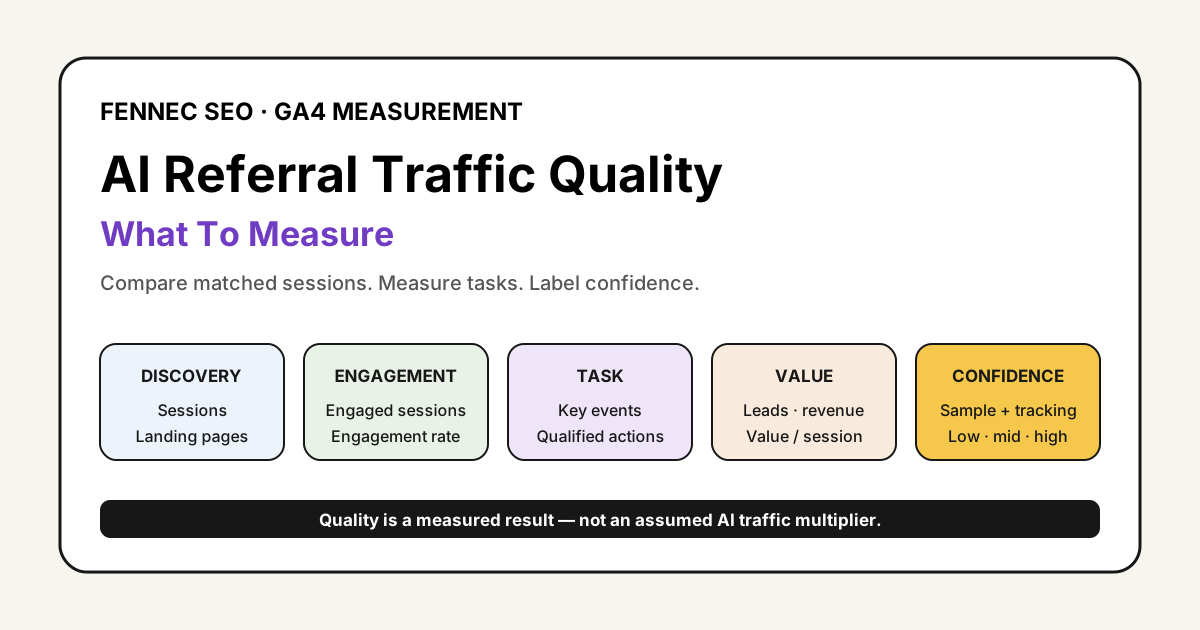
Track:
- sessions by source and landing page;
- engaged sessions or another consistently defined quality metric;
- conversions and conversion value;
- assisted journeys when your analytics setup supports them;
- the share of traffic with missing or unattributed referrers.
Keep the source classification rules visible and versioned. When a new hostname is added, note the effective date so historical trends do not change without explanation.
Never infer a citation count by multiplying bot requests by referral sessions. They are different populations.
Measurement source 4: repeatable citation samples
Some platforms provide limited or no site-owner reporting. A controlled sample can still be useful if it is treated as an observation, not a census of all answers.
Create a prompt set tied to real audience tasks:
- brand and product queries;
- category comparison queries;
- problem and troubleshooting queries;
- definitions where your site has specialist coverage;
- high-value questions already producing Search impressions.
For every run, record:
run_id
timestamp_utc
platform
model_or_surface_if_visible
locale
signed_in_or_signed_out
prompt_id
prompt_text
cited_domain
cited_url
citation_position
answer_snapshot_reference
reviewer
Keep the prompt wording stable for trend comparisons. Run enough repetitions to expose volatility, and report both the numerator and denominator—for example, “cited in 7 of 30 recorded answers,” not “23% AI visibility” without context.
Follow each platform’s terms. Prefer official APIs or permitted manual review. DOM selectors for consumer search pages are unstable and should not be the foundation of a production measurement system.
Core metrics that remain interpretable
Verified crawl coverage
pages requested by verified crawlers
÷ eligible canonical pages
Use this to find important sections that known crawlers never reach. It is not a ranking or citation metric.
Successful fetch rate
verified requests returning 2xx
÷ all verified requests
Break out redirects and errors. A high volume of 3xx requests often indicates stale internal links or old URLs still circulating.
Generative-search page coverage
pages with reported generative-search impressions
÷ eligible canonical pages
Use only when the platform provides the underlying report. Segment by page type so a large documentation library does not hide weak coverage of commercial pages.
Sampled citation rate
answers citing your domain
÷ valid recorded answers in the prompt set
Always publish the sample size, run window, platform, locale, and prompt-set version next to the rate.
Citation-to-visit rate
Do not calculate this unless citations and sessions share a defensible observation window and source definition. Even then, label it directional because a cited answer can be viewed without a click and a referral can lose its citation context.
AI-assisted conversion
Define the attribution rule before reporting it. Examples include last non-direct click, first touch, or a documented multi-touch model. Do not switch models between periods without restating historical results.
Build a dashboard in layers
A useful dashboard should let an analyst move from outcome to evidence.
Layer 1: business outcomes
- attributable sessions;
- conversions and value;
- assisted conversions under the selected model.
Layer 2: visibility
- reported generative-search impressions;
- sampled citation observations;
- cited pages and topics.
Layer 3: access
- verified crawler requests;
- 2xx, 3xx, 4xx, and 5xx rates;
- most requested canonical pages;
- important pages with no verified requests.
Layer 4: data quality
- last successful import time;
- percentage of unverified bot-like requests;
- missing referrer share;
- citation sample size;
- prompt-set and classification-rule versions.
If a KPI cannot link back to its raw evidence and definition, it is not ready for decision-making.
A 30-day operating workflow
Week 1: establish the baseline
- Inventory canonical, indexable pages.
- Confirm which platform reports are actually available.
- Enable or validate server-log retention.
- Create the verified bot registry.
- Define analytics source rules and conversions.
Week 2: clean the data
- Normalize URL variants and redirect targets.
- Separate verified from unverified bot requests.
- Exclude monitoring tools and internal traffic.
- Reconcile page totals with sitemap and canonical rules.
Week 3: start citation sampling
- Freeze prompt-set version 1.
- Record platform, locale, time, and answer evidence.
- Review citation URLs for canonical and content-type patterns.
- Log missing or ambiguous answers instead of discarding them.
Week 4: choose one test
Select a small group of pages with a clear problem. Examples:
- crawled but never appearing in available visibility reports;
- cited but producing no attributable visits;
- strong impressions but outdated or weak answer sections;
- bot requests wasted on redirect and parameter URLs.
Make one documented change, such as consolidating duplicate URLs, adding a source-backed answer block, or improving internal links. Record the change date and wait for a realistic recrawl and reporting window before evaluating it.
Common measurement mistakes
- Calling every bot request a citation;
- identifying bots only by User-Agent;
- mixing automated crawlers with user-triggered fetchers;
- reporting a citation percentage without sample size;
- scraping unstable consumer-result markup as if it were an API;
- combining Search impressions, referrals, and conversions into one undocumented score;
- using unsourced industry benchmarks as performance targets;
- changing source-classification or prompt rules without versioning them;
- treating correlation after a content update as proof of causation.
What success looks like
A mature AI visibility program does not promise a universal ranking score. It produces a traceable chain of evidence:
- Important canonical pages are accessible.
- Verified crawlers receive correct responses.
- Platform reporting or controlled samples show where pages appear.
- Analytics records the visits that can be attributed.
- The business measures outcomes under a declared attribution model.
- Every reported change can be traced to definitions, raw records, and a time-stamped content or technical change.
That discipline makes the program useful even as platforms, crawlers, and reporting surfaces change. It also prevents a common GEO failure: optimizing for an impressive number that never represented visibility in the first place.
Sources
- Google: Generative AI performance reports in Search Console
- Google: Guide to succeeding in AI features
- Google: Verify crawler and fetcher requests
- OpenAI: Overview of OpenAI crawlers
- Perplexity: Crawler documentation
Q&A
Can server logs prove that an AI answer cited my page?
No. Logs can show a verified crawler or user-triggered fetch requested a URL, but a crawl is not proof that the page appeared as a citation. Citation visibility must be measured separately.
Which AI visibility metrics should I track?
Track verified bot requests, generative-search impressions where platform reporting is available, attributable referral sessions, repeatable citation observations, cited-page coverage, and downstream conversions. Keep these metrics separate.
Should I identify AI bots only by User-Agent?
No. User-Agent strings can be spoofed. Use each provider’s official verification method or published IP ranges where available, and label unverified requests separately.